Posts tagged as:

The nice folks at the New York Times “Room for Debate” feature asked me and a group of bright lights to discuss the Verizon-Google agreement on network neutrality regulation, as it stood at various points in the day.

Read the comments of Tim Wu, Lawrence Lessig, David Gelernter, Ed Felten, Jonathan Zittrain, and myself. Much of my comment owes credit to Tim Lee’s excellent paper “The Durable Internet.”

We’re all over the place, folks . . .

Update: Late addition: Gigi Sohn.

Lessig Visits Cato

by on February 1, 2010 · 10 comments

Last week, Harvard professor Lawrence Lessig visited the Cato Institute for a lunchtime talk he had sought through Julian Sanchez. Fellow TLFer Julian discussed the substance of the visit on the Cato@Liberty blog.

I discussed the real purpose of the visit as I interpreted it, and Professor Richard Epstein had a comment, too. He finds that Lessig is now, in fairness, a libertarian—if by “fairness” we mean “tit-for-tat.”

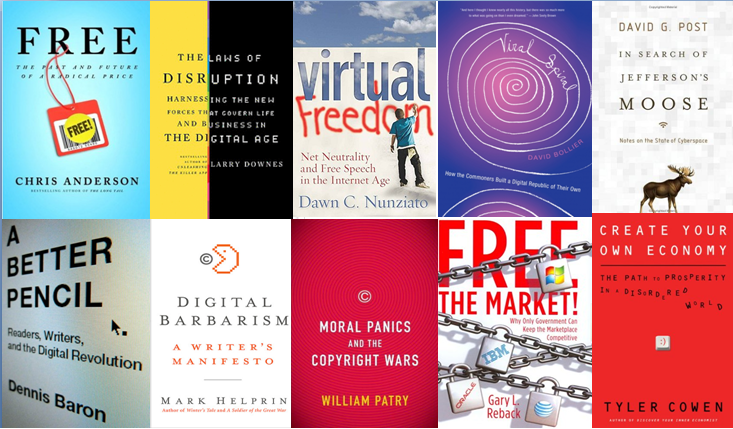
2009 was not as big of a year for Internet and information technology (“info-tech”) policy books as 2008 was, but there were still some notable titles released that offered interesting perspectives about the future of the Net and the impact the Digital Revolution is having on our lives, culture, and economy.  So, like last year, I figured I would throw together my list of the 10 most important info-tech policy books of the year.

book covers collage 2009First, let me repeat a few of the same caveats and disclaimers that I set forth last year.  What qualifies as an “important” info-tech policy book? Simply put, it’s a title that many people are currently discussing and that we will likely be referencing for many years to come.  However, I want to be clear that merely because a book appears on my list it does not necessarily mean I agree with everything said in it. In fact, as was the case in previous years, I found much with which to disagree in my picks for the most important books of 2009 and I find that the cyber-libertarianism I subscribe to has very few fans out there.

Another caveat: Narrowly-focused titles lose a few points on my list. For example, if a book deals mostly with privacy issues, copyright law, or antitrust policy, it does not exactly qualify as the same sort of “tech policy book” as other titles found on this list since it is a narrow exploration of just one set of issues with a bearing on technology policy.

With those caveats in mind, here are my choices for the Most Important Info-Tech Policy Books of 2009. Continue reading →

DroidSeems like everywhere I turn someone is gushing about their new Droid phone, including my TLF colleagues Berin Szoka, Braden Cox, and Ryan Radia, who all had great fun rubbing their new toys in my nose over the past couple of days. And why not, it’s a very cool little device.  It makes my HTC Touch seems positively archaic in some ways, and it’s only a year old.  Apparently, 100,000 people already picked up a Droid in just its first weekend on the market.

But here’s the first thing that pops in my mind every time I see someone showing off their new Droid: How can a device like this even exist when America’s leading cyberlaw experts have been telling us that the whole digital world is increasingly going to hell because of “closed” devices, proprietary code, and managed networks?  I’m speaking, of course, about the lamentations of Harvard professors Lawrence Lessig, Jonathan Zittrain, and their many disciples.  As faithful readers will recall, I have relentlessly hammered this crew for their unwarranted cyber-Chicken Little-ism and hyper techno-pessimism. (See my many battles with Zittrain [1, 2, 3, 4, 5, 6 + video] and my 2-part debate with Lessig earlier this year).

“Left to itself,” Lessig warned in Code, “cyberspace will become a perfect tool of control.”  He went on to forecast a dystopian future in which nefarious corporate schemers would quash our digital liberties unless benevolent public philosopher kings stepped in to save our poor souls. Code was the Old Testament of cyber-collectivism. The New Testament arrived last year with Zittrain’s The Future of the Internet and How to Stop It. In it, we hear the grim prediction that “sterile and tethered” digital technologies and networks will triumph over the more “open and generative” devices and systems of the past.  The iPhone and TiVo are cast as villains in Zittrain’s drama since they apparently represent the latest manifestations of Lessig’s “perfect control” paranoia.

Apple’s “Angel of Death”

How completely out-of-control has this thinking gotten?  Well, here’s David Weinberger — another Harvard Berkman Center worrywart — talking about that supposed satanic font of all evil, the Apple AppStore: Continue reading →

Update: The article is now online. Citizen Tools has collected some responses to it at the end of this post.

Lawrence Lessig has a provocatively titled article in the October 21 issue of The New Republic: “Against Transparency: The Perils of Openness in Government.” (Couldn’t find a link.) As a reader, I found it alternately mysterious, boring, and LOL funny.

I’m a person who notices premises, and Lessig sets up an interesting premise indeed: What he calls the “naked transparency movement”—unvarnished access to government data—“is not going to inspire change. It will simply push any faith in our political system off the cliff.”

Yes, Lessig has “change” and “pushing faith in our political system off the cliff” in opposition. So, the only thing that qualifies as “change” is improving faith in our political system? This pegged my bs detector.

Given the pains Lessig had taken to define the “naked transparency movement” and preemptively critique its effects, I was prepared for a straightforward criticism of public access to raw data. Continue reading →

Last month, Digital Barbarism book cover National Review magazine published a review that I penned of Mark Helprin’s new book, Digital Barbarism: A Writer’s Manifesto.  Helprin’s book is both a passionate defense of copyright law as well as a mini-autobiography.  Helprin is one of the great novelists and essayists of the past half-century, and his book A Soldier of a Great War is one of my all-time favorite novels.  I cannot in strong enough words encourage you to read that book; it is profoundly moving. (I almost named my son after the lead character in the book!)

Thus, I was quite excited when I learned that Helprin had penned a defense of copyright and I jumped at the chance to review it when the folks at National Review asked me to do so.  Alas, as you will see in my review, I was terribly disappointed.  I wish Helprin would have stuck with the very reasonable tone he adopted in this excellent podcast interview he did recently with John J. Miller of National Review Online. Unfortunately, he went a different direction in the book, as I make clear in my review:


National Review July 20, 2009

“Man, Machine, and Copyright” a review of Digital Barbarism: A Writer’s Manifesto, by Mark Helprin by Adam Thierer

It would be difficult to think of anyone more ideally suited to pen a passionate defense of copyright law than novelist Mark Helprin.  Helprin has written several of the finest works of modern literature, including his masterpiece, A Soldier of the Great War, a narrative of transcendent beauty. In Digital Barbarism, Helprin sets out to use his formidable gift for the written word to repel the “cyber mob” that has attacked copyright law and called for its curtailment, or even abolition.

Unfortunately, while Helprin occasionally rises to great heights in his defense of copyright, he too often sinks to lamentable lows — by resorting to the same unbecoming rhetorical tactics used by the mob he seeks to condemn. Indeed, his book is filled with gratuitous vitriol and neo-Luddite ramblings about the Internet and Information Age that severely detract from his defense of copyright. This is a shame, because, in places, Digital Barbarism makes a fine case against those critics who wrongly view copyright as an impediment to the creation and diffusion of content. “The availability of information is not and will not be restrained by the copyright system any more than it is or will be restrained by the delivery systems that make it possible,” Helprin argues. Why, he asks, “must ‘content’ be free” when everything else — access to the Internet, digital devices, etc. — costs good money? He notes that the movement that advocates “free,” universal access to all copyrighted material in the name of “openness” and “the public good” would, ironically, “destroy the dream it advocates”: Continue reading →

Well, here we go again. Harvard’s Jonathan Zittrain has penned another gloomy essay about how “freedom is at risk in the cloud” and the future of the Internet is in peril because nefarious digital schemers like Apple, Facebook, and Google are supposedly out to lock you into their services and take away your digital rights.  And so, as I have done here many times before (see 1, 2, 3, 4, 5 + video!), I will offer a response arguing that Jonathan’s cyber-Chicken Little-ism is largely unwarranted.

Zittrain’s latest piece is entitled “Lost in the Cloud” and it appears in today’s New York Times.  It closely tracks the arguments he has set forth in his book The Future of the Internet–And How to Stop It, which I named the most important technology policy book of 2008, but not because I agreed with its central thesis.  Zittrain’s book and his new NYT essay are the ultimate exposition of Lessigite technological pessimism.  I don’t know what they put in the water up at the Berkman Center to make these guys so remarkably cranky and despondent about the future of of the Internet, but starting with Lawrence Lessig’s Code in 1999 and running through to Zittrain’s Future of the Internet we have been forced to endure endless Tales of the Coming Techno-Apocalypse from these guys.  Back in the late 90s, Prof. Lessig warned us that AOL and some other companies would soon take over the new digital frontier since “Left to itself, cyberspace will become a perfect tool of control.”  Ah yes, how was it that we threw off the chains of our techno-oppressors and freed ourselves from that wicked walled garden hell?  Oh yeah, we clicked our mouses and left! And that was pretty much the end of AOL’s “perfect control” fantasies. [See my recent debate with Prof. Lessig over at Cato Unbound for more about this “illusion of perfect control,” as I have labeled it.]

But Zittrain is the equivalent of the St. Peter upon which the Church of Lessigism has been built and, like any good disciple, he’s still vociferously preaching to the unconverted and using fire and brimstone sermons to warn of our impending digital damnation. In fact, he’s taken it to all new extremes. In Future of the Internet, Jonathan argues that we run the risk of seeing the glorious days of the generative, open Net and digital devices give way to more “sterile, tethered devices” and closed networks. The future that he hopes to “stop” is one in which Apple, TiVo, Facebook, and Google — the central villains in his drama — are supposedly ceded too much authority over our daily lives because of a combination of (a) their wicked ways and (b) our ignorant ones.

Continue reading →

I’ve posted another response in the Cato Unbound online debate over the impact of Lawrence Lessig’s Code and Other Laws of Cyberspace upon the book’s 10th anniversary.  You will recall that I went fairly hard on Prof. Lessig in my essay, “Code, Pessimism, and the Illusion of ‘Perfect Control,’” and Lessig responded with a counter-punch that went after me for it.  I respond in a new essay about “Our Conflict of Cyber-Visions.” In the piece, I address Lessig’s assertion that I just didn’t understand the central teachings of Code, as well as his reluctance to accept the “cyber-collectivism” label that I affixed to his book and life’s work.  Again, please hop over to Cato Unbound for my complete response.

But one thing from the essay that I thought worth reproducing here is my effort to better define the key principles that separate the cyber-libertarian and cyber-collectivist schools of thinking.  I argue that it comes down to this:

The cyber-libertarian believes that “code failures” are ultimately better addressed by voluntary, spontaneous, bottom-up, marketplace responses than by coerced, top-down, governmental solutions. Moreover, the decisive advantage of the market-driven approach to correcting code failure comes down to the rapidity and nimbleness of those response(s).

Of course, another key difference relates to how quickly one jumps to the conclusion that “code failures” are actually occurring at all. I argue:

Continue reading →

The week-long Cato Unbound online debate about the 10th anniversary of Lawrence Lessig’s Code and Other Laws of Cyberspace continues today with Prof. Lessig’s response to Declan McCullagh’s opening essay, “What Larry Didn’t Get,” Jonathan Zittrain’s follow-up essay, and my essay on, “Code, Pessimism, and the Illusion of ‘Perfect Control.’”  Needless to say, Prof. Lessig isn’t too happy with my response. You should jump over to the Cato site to read the entire thing, but here are a couple of excerpts and my response.

To my suggestion that there is a qualitative difference between law and code, Prof. Lessig says:

I’ve argued that things aren’t quite a simple as some libertarians would suggest. That there’s not just bad law. There’s bad code. That we don’t need to worry just about Mussolini. We also need to worry about DRM or the code AT&T deploys to help the government spy upon users. That public threats to liberty can be complemented by private threats to liberty. And that the libertarian must be focused on both.  […] Of course, law is law. Who could be oblivious to that? And who would need a book to explain it?  But the fact that “law is law” does not imply that it has a “much greater impact in shaping markets and human behavior.” Sometimes it does — especially when that “law” is delivered by a B1 bomber. But ask the RIAA whether it is law or code that is having a “greater impact in shaping markets” for music. Or ask the makers of Second Life whether the citizens of that space find themselves more constrained by the commercial code of their geo-jurisdiction or by the fact that the software code of Second Life doesn’t permit you simply to walk away (so to speak) with another person’s scepter. Whether and when law is more effective than code is an empirical matter — something to be studied, and considered, not dismissed by banalities spruced up with italics.

Well, I beg the professor’s pardon for excessive use of italics.  [I won’t ask for an apology for misspelling my last name in his piece!] Regardless, it’s obvious that we’ll just never see eye-to-eye on the crucial distinction between law and code. Again, as I stated in my essay: “With code, escape is possible. Law, by contrast, tends to lock in and limit; spontaneous evolution is supplanted by the stagnation of top-down, one-size-fits-all regulatory schemes.”

Lessig largely dismisses much of this with that last line above, suggesting that we just need to keep studying the matter to determine the right mix of what works best.  To be clear, while I’m all for studying the impact of law vs. code as “an empirical matter,” that in turn begs the question of how we define effectiveness or success. I suspect that the professor and I would have a “values clash” over some rather important first principles in that regard.  This is, of course, a conflict of visions that we see throughout the history of philosophy; a conflict between those who put the individual and the individual’s rights at the core of any ethical political system versus those who would place the rights of “the community,” “the public” or some other amorphous grouping(s) at the center of everything.  It’s a classic libertarian vs. communitarian / collectivist debate.

Continue reading →

The Cato Unbound online debate about the 10th anniversary of Lawrence Lessig’s Code and Other Laws of Cyberspace continues today with my response to Declan McCullagh’s opening essay, “What Larry Didn’t Get,” as well as Jonathan Zittrain’s follow-up.

In my response, “Code, Pessimism, and the Illusion of ‘Perfect Control,'” I begin by arguing that:

The problem with peddling tales of a pending techno-apocalypse is that, at some point, you may have to account for your prophecies — or false prophecies as the case may be. Hence, the problem for Lawrence Lessig ten years after the publication of his seminal book, Code and Other Laws of Cyberspace.

I go on to argue that:

Lessig’s lugubrious predictions proved largely unwarranted. Code has not become the great regulator of markets or enslaver of man; it has been a liberator of both. Indeed, the story of the past digital decade has been the exact opposite of the one Lessig envisioned in Code.

After providing several examples of just how wrong Lessig’s predictions were, I then ask:

[W]hy have Lessig’s predictions proven so off the mark? Lessig failed to appreciate that markets are evolutionary and dynamic, and when those markets are built upon code, the pace and nature of change becomes unrelenting and utterly unpredictable. With the exception of some of the problems identified above, a largely unfettered cyberspace has left digital denizens better off in terms of the information they can access as well as the goods and services from which they can choose. Oh, and did I mention it’s all pretty much free-of-charge? Say what you want about our cyber-existence, but you can’t argue with the price!

Continue reading →