We are entering a new era for technology policy in which many pundits and policymakers will use “algorithmic fairness” as a universal Get Out of Jail Free card when they push for new regulations on digital speech and innovation. Proposals to regulate things like “online safety,” “hate speech,” “disinformation,” and “bias” among other things often raise thorny definitional questions because of their highly subjective nature. In the United States, efforts by government to control these things will often trigger judicial scrutiny, too, because restraints on speech violate the First Amendment. Proponents of prior restraint or even ex post punishments understand this reality and want to get around it. Thus, in an effort to avoid constitutional scrutiny and lengthy court battles, they are engaged in a rebranding effort and seeking to push their regulatory agendas through a techno-panicky prism of “algorithmic fairness” or “algorithmic justice.”
Hey, who could possibly be against FAIRNESS and JUSTICE? Of course, the devil is always in the details as Neil Chilson and I discuss in our new paper for the The Federalist Society and Regulatory Transparency Project on, “The Coming Onslaught of ‘Algorithmic Fairness’ Regulations.” We document how federal and state policymakers from both parties are currently considering a variety of new mandates for artificial intelligence (AI), machine learning, and automated systems that, if imposed, “would thunder through our economy with one of the most significant expansions of economic and social regulation – and the power of the administrative state – in recent history.” Continue reading →
[This is a draft of a section of a forthcoming study on “A Flexible Governance Framework for Artificial Intelligence,” which I hope to complete shortly. I welcome feedback. I have also cross-posted this essay at Medium.]
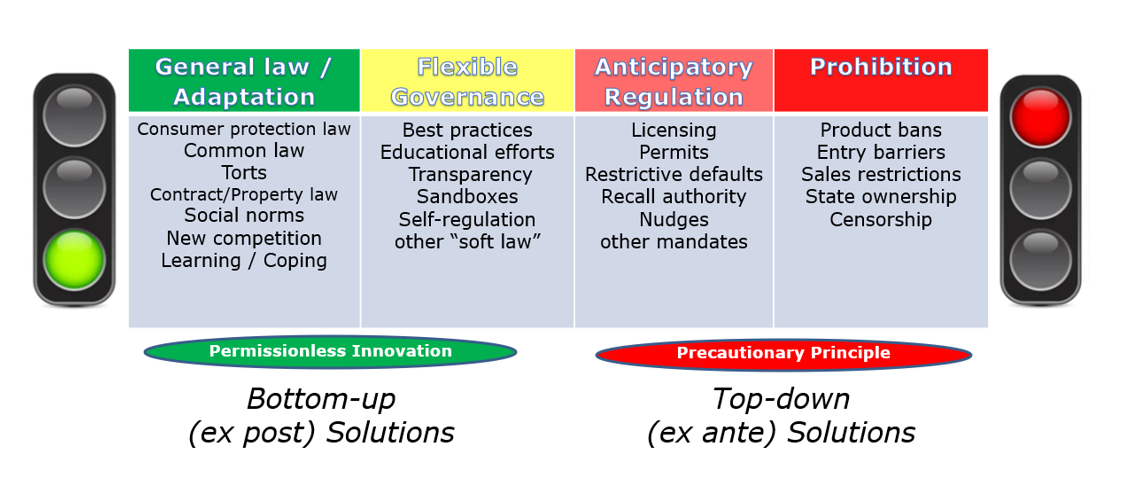
Debates about how to embed ethics and best practices into AI product design is where the question of public policy defaults becomes important. To the extent AI design becomes the subject of legal or regulatory decision-making, a choice must be made between two general approaches: the precautionary principle or the proactionary principle.[1] While there are many hybrid governance approaches in between these two poles, the crucial issue is whether the initial legal default for AI technologies will be set closer to the red light of the precautionary principle (i.e., permissioned innovation) or to the green light of the proactionary principle (i.e., (permissionless innovation). Each governance default will be discussed.
The American Enterprise Institute (AEI) has kicked off a new project called “Digital Platforms and American Life,” which will bring together a variety of scholars to answer the question: How should policymakers think about the digital platforms that have become embedded in our social and civic life? The series, which is being edited by AEI Senior Fellow Adam J. White, highlights how the democratization of knowledge and influence in the Internet age comes with incredible opportunities but also immense challenges. The contributors to this series will approach these issues from various perspectives and also address different aspects of policy as it pertains to the future of technological governance.
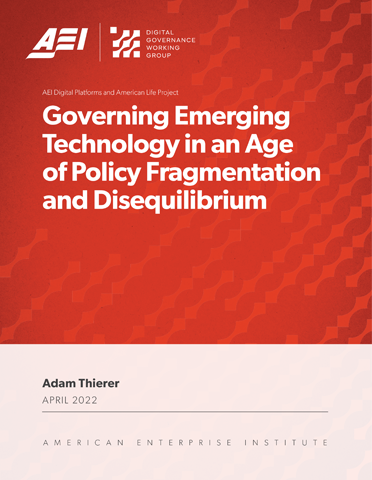
It is my honor to have the lead paper in this new series. My 19-page essay is entitled, Governing Emerging Technology in an Age of Policy Fragmentation and Disequilibrium, and it represents my effort to concisely tie together all my writing over the past 30 years on governance trends for the Internet and related technologies. The key takeaways from my essay are:
Traditional governance mechanisms are being strained by modern technological and political realities. Newer technologies, especially digital ones, are developing at an ever-faster rate and building on top of each other, blurring lines between sectors.
Congress has failed to keep up with the quickening pace of technological change. It also continues to delegate most of its constitutional authority to agencies to deal with most policy concerns. But agencies are overwhelmed too. This situation is unlikely to change, creating a governance gap.
Decentralized governance techniques are filling the gap. Soft law—informal, iterative, experimental, and collaborative solutions—represents the new normal for technological governance. This is particularly true for information sectors, including social media platforms, for which the First Amendment acts as a major constraint on formal regulation anyway.
No one-size-fits-all tool can address the many governance issues related to fast-paced science and technology developments; therefore, decentralized governance mechanisms may be better suited to address newer policy concerns.
My arguments will frustrate many people of varying political dispositions because I adopt a highly pragmatic approach to technological governance. Continue reading →
On Tuesday, Nancy Pelosi, Speaker of the U.S. House of Representatives, posted the text of the “America Creating Opportunities for Manufacturing, Pre-Eminence in Technology and Economic Strength Act of 2022,” or “The America COMPETES Act.” As far as industrial policy measures go, the COMPETES Act is one of the most ambitious and expensive central planning efforts in American history. It represents the triumph of top-down, corporatist, techno-mercantilist thinking over a more sensible innovation policy rooted in bottom-up competition, entrepreneurialism, private investment, and free trade.
Unprecedented Planning & Spending
First, the ugly facts: The full text of the COMPETES Act weighs in at a staggering 2,912 pages. A section-by-section “summary” of the measure takes up 109 pages alone. Even the shorter “fact sheet” for the bill is 20 pages long. It is impossible to believe that anyone in Congress has read every provision of this bill. It will be another case of having “to pass the bill so you can find out what’s in it,” as Speaker Pelosi once famously said about another mega-measure.
Of course, a mega bill presents major opportunities for lawmakers to sneak in endless gobs of pork and unrelated policy measures they can’t find any other way to get through Congress. The Senate already passed a similar 2,600-page companion measure last summer, “The U.S. Innovation and Competition Act.” Lawmakers loaded up that measure with so much pork and favors for special interests that Sen. John N. Kennedy (R-La.) labelled the effort an “orgy of spending porn.” Like that effort, the new COMPETES Act includes $52 billion to boost domestic semiconductor production as well as $45 billion in grants and loans to address supply chain issues.
But there are billions allocated for other initiatives, as well as countless provisions addressing other technologies and sectors. The list is seemingly endless and includes: Continue reading →
This report was a major undertaking that involved dozens of interviews, extensive historic research, several events and presentations, and then numerous revisions before the final product was released. The final PDF version of the journal article is attached.
“The world should think better about catastrophic and existential risks.” So says a new feature essay in The Economist. Indeed it should, and that includes existential risks associated with emerging technologies.
The primary focus of my research these days revolves around broad-based governance trends for emerging technologies. In particular, I have spent the last few years attempting to better understand how and why “soft law” techniques have been tapped to fill governance gaps. As I noted in this recent post compiling my recent writing on the topic;
soft law refers to informal, collaborative, and constantly evolving governance mechanisms that differ from hard law in that they lack the same degree of enforceability. Soft law builds upon and operates in the shadow of hard law. But soft law lacks the same degree of formality that hard law possess. Despite many shortcomings and criticisms, compared with hard law, soft law can be more rapidly and flexibly adapted to suit new circumstances and address complex technological governance challenges. This is why many regulatory agencies are tapping soft law methods to address shortcomings in the traditional hard law governance systems.
I argued in recent law review articles as well as my latest book, despite its imperfections, I believe that soft law has an important role to play in filling governance gaps that hard law struggles to address. But there are some instances where soft law simply will not cut it. Continue reading →
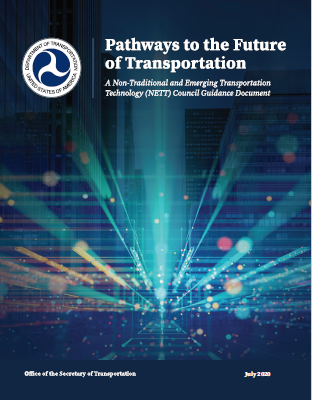
On July 23rd, the U.S. Department of Transportation (DoT) released Pathways to the Future of Transportation, which was billed as “a policy document that is intended to serve as a roadmap for innovators of new cross modal technologies to engage with the Department.” This guidance document was created by a new body called the Non-Traditional and Emerging Transportation Technology (NETT) Council, which was formed by U.S. Transportation Secretary Elaine L. Chao last year. The NETT Council is described as “an internal deliberative body to identify and resolve jurisdictional and regulatory gaps that may impede the deployment of new technologies.”
The creation of NETT Council and the issuance of its first major report highlight the continued growth of “soft law” as a major governance trend for emerging technology in the US. Soft law refers to informal, collaborative, and constantly evolving governance mechanisms that differ from hard law in that they lack the same degree of enforceability. A partial inventory of soft law methods includes: multistakeholder processes, industry best practices or codes of conduct, technical standards, private certifications, agency workshops and guidance documents, informal negotiations, and education and awareness efforts. But this list of soft law mechanisms is amorphous and ever-changing.
Soft law systems and processes are multiplying at every level of government today: federal, state, local, and even globally. Such mechanisms are being tapped by government bodies today to deal with fast-moving technologies that are evolving faster than the law’s ability to keep up.
The US Department of Transportation has become a leading candidate for Soft Law Central at the federal level. The agency has been tapping a variety of soft law mechanisms and approaches to deal with driverless cars and drone policy issues in particular. (See the essays listed down below for more details).
The NETT Council represents the next wave of this governance trend. We might consider it an effort to bring a greater degree of formality and coordination to the agency’s soft law efforts. Continue reading →
I was speaking at a conference recently and discussing my life’s work, which for 30 years has been focused on the importance of innovation and intellectual battles over what we mean progress. I put together up a short list of some things I have written over the last few years on this topic and thought I would just re-post them here. I will try to keep this regularly updated, at least for a few years.
Margaret Talbot has written an excellent New Yorker essay entitled, “The Rogue Experimenters,” which documents the growth of the D.I.Y.-bio movement. This refers to the organic, bottom-up, citizen science movement, or “leaderless do-ocracy” of tinkerers, as she notes. I highly recommend you check it out.
As I noted in my new book on
Evasive Entrepreneurs and the Future of Governance, “DIY health services and medical devices are on the rise thanks to the combined power of open-source software, 3D printers, cloud computing, and digital platforms that allow information sharing between individuals with specific health needs. Average citizens are using these new technologies to modify their bodies and abilities, often beyond the confines of the law.”
Talbot discusses many of the same examples I discuss in my book, including:
the Four Thieves Vinegar collective, which devised instructions for building its own version of the EpiPen;
e-nable, an international collective of thirty thousand volunteers, designs and 3-D-prints prosthetic hands and arms (and which has, more recently, distributed more than fifty thousand face shields in more than twenty-five countries.);
GenSpace and other community biohacking labs; and
Open Insulin and Open Artificial Pancreas System.
I like the way Talbot compares these movements to the hacker and start-up culture of the Digital Revolution: Continue reading →
The Technology Liberation Front is the tech policy blog dedicated to keeping politicians' hands off the 'net and everything else related to technology. Learn more about TLF →

 On July 23rd, the U.S. Department of Transportation (DoT) released
  Margaret Talbot has written an excellent New Yorker essay entitled, “
 The Technology Liberation Front is the tech policy blog dedicated to keeping politicians' hands off the 'net and everything else related to technology.