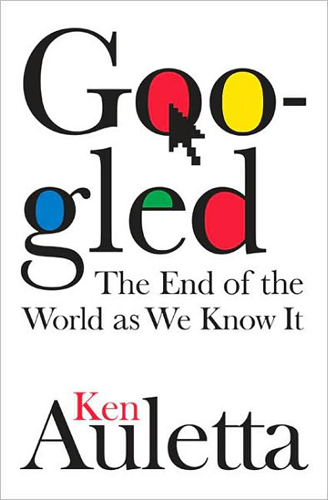
 I just finished Ken Auletta’s latest book,
Googled: The End of the World As We Know It, and I highly recommend it. Auletta is an amazingly gifted journalist and knows how put together a hell of good story. It helps in this case that he was granted unprecedented access to the Google team and their day-to-day workings at the Googleplex. I’m really shocked by the level of access he was granted to important meetings and officials–over 150 interviews with Googlers, including 11 with CEO Eric Schmidt and several with founders Sergey Brin and Larry Page. That’s impressive.
I just finished Ken Auletta’s latest book,
Googled: The End of the World As We Know It, and I highly recommend it. Auletta is an amazingly gifted journalist and knows how put together a hell of good story. It helps in this case that he was granted unprecedented access to the Google team and their day-to-day workings at the Googleplex. I’m really shocked by the level of access he was granted to important meetings and officials–over 150 interviews with Googlers, including 11 with CEO Eric Schmidt and several with founders Sergey Brin and Larry Page. That’s impressive.
The book shares much in common with Randall Stross’s excellent Planet Google: One Company’s Audacious Plan to Organize Everything We Know, which I reviewed here earlier this year. Both books recount the history of Google from its early origins to present. And both survey a great deal of ground in terms of the challenges that Google faces as it matures and the policy issues that are relevant to the company (privacy, free speech, copyright law, etc).
What makes Auletta’s book unique is the way we taps his extensive “old media” world contacts and integrates such a diverse cast of characters into the narrative — Mel Karmazin (former Viacom, now Sirius XM), Bob Iger (Disney), Howard Stringer (Sony), Martin Sorrrell (WPP), Irwin Gotlieb (Group M), and even the Internet’s “inventor”–Al Gore! Auletta interviews them or recounts stories about their interactions with Google to show the growing tensions being created by this disruptive company and its highly disruptive technologies. There are some terrifically entertaining anecdotes in the book, but the bottom line is clear: Google has made a lot of enemies in a very short time.
Indeed, the book is as much about the decline of old media as it is about Google’s ascendancy. What Auletta has done so brilliantly here is to tell their stories together and ask how much old media’s recent woes can be blamed on Google and digital disintermediation in general. “If Google is destroying or weakening old business models,” Auletta argues, “it is because the Internet inevitably destroys old ways of doing things, spurs ‘creative destruction.’ This does not mean that Google is not ambitious to grow, and will not grow at the expense of others. But the rewards, and the pain, are unavoidable,” he concludes. Continue reading →
 Google recently experienced failures of its core services — a phenomenon that quickly spawned the hashtag “googlefail” on the popular social networking platform Twitter. These failures show that a company once thought of as the odds-on favorite for dominating the global market in all things web — the monolith of Mountain View — is looking more and more like a search-only player.
Big firms consistently fail to use their “market dominance” to take over adjacent markets, something that should give antitrust warriors in the Obama administration reason for pause. The renewed call for tough antitrust enforcement comes at a time when Google, a poster-child for market dominance, simply can’t leverage its position at all.
Continue reading →
Over at DrewClark.com, earlier today I reported today that television networks – which in recent years have had a strained relationship with local broadcasters on a variety of fronts – joined with the National Association of Broadcasters in calling for a time out on the politically simmering issue of “white spaces.” Here’s the start of the story, and you can read the full post at DrewClark.com
WASHINGTON, October 23 – The top executives of the four major broadcast networks on Thursday urged the head of the Federal Communications Commission to delay a vote on a politically simmering issue that pits broadcasters against Google and high-tech executives.
In the letter, the CEOs of CBS Corp., NBC Universal and Walt Disney, and the chief operating officer of News Corp., urge that the FCC exercise caution before taking irreparable action with regard to the vacant television channels known as “white spaces.”
Google and the other technology executives, including Microsoft, Motorola, Philips and others, want the FCC to authorize electronic devices that capable of transmitting internet signals over vacant television bands.
The network executives – CBS’s Leslie Moonves, Disney’s Robert Iger, NBC’s Jeffrey Zucker and Peter Chernin of News Corp. – want a time out.
They join their local broadcasting colleagues, as well as manufacturers and users of wireless microphones, like the National Football League and Boadway theater owners, who have been actively lobbying the issue.
[…]
Read the rest of the story at my blog, DrewClark.com – The Politics of Telecom, Media and Technology
By Berin Szoka & Adam Thierer
As we noted in our intro to this ongoing series, Google’s tenth anniversary has passed with Googlephobia reaching new heights of hysteria.
But is Google really too big and dangerous, or are people just too lazy to find other alternatives to each of the wonderful services that Google offers? If one is truly paranoid about the firm’s supposed dominance, it doesn’t take much effort to live a Google-free life. To prove it, we set out to find alternatives to each of the services that Google provides. After awhile, we got a little tired of compiling alternatives in each category and just provided links for the additional choices at your disposal. It’s tough to see what the fuss is about with the cornucopia of choices at our disposal. If you don’t like Google, then just don’t use it or any of its services. The choice is yours.
In each case, we’ve listed Google first, even though Google may not be the market leader (
e.g., Google’s relatively unknown social network Orkut).
Search Engines
Continue reading →
By Berin Szoka & Adam Thierer
as part of an
ongoing series

With Google celebrating its 10th anniversary this week, many panicky pundits are using the occasion to claim that Google has become the Great “Satan” of the Internet. Nick Carr wonders what the future holds for “The OmniGoogle.” The normally level-headed Mike Malone worries that Google is “turning into Big Brother.” And Washington Post’s Rob Dubbin says that he can’t escape Google’s “tentacles,” even for just 24 hours. Meanwhile, speculation abounds that the Justice Department is preparing a major antitrust lawsuit against Google concerning its advertising partnership with Yahoo! or perhaps even a broader suit concerning Google’s “dominance” of online advertising generally.
Carr quotes Google co-founder Sergey Brin’s now-famous 2003 interview:
I think people tend to exaggerate Google’s significance in both directions. Some say Google is God. Others say Google is Satan. But if they think Google is too powerful, remember that with search engines, unlike other companies, all it takes is a single click to go to another search engine. People come to Google because they choose to. We don’t trick them.
In the last five years, Google has become far more than just a search engine. As Google’s suite of suite of complementary products continues to grow, so too does the specter of Google as an all-knowing and therefore all-powerful economic colossus. Yet Google isn’t even close to being the sort of nefarious monopolist out to destroy user privacy at every turn, as some seem to imply—if not exclaim. Indeed, in our view, the Net is overall a far better place because of the existence of Google and the many free services it provides consumers.
Our point is not that Google should be immune from criticism. Indeed, healthy criticism of corporate actions plays a vital role in the free market by disciplining corporate policies and behavior—often thus providing an effective alternative to government regulation. This is particularly important in the area of consumer privacy protection, as demonstrated by Google’s quick response to public concern about its Chrome EULA. Continue reading →

 The Technology Liberation Front is the tech policy blog dedicated to keeping politicians' hands off the 'net and everything else related to technology.