Evan Selinger, a super-sharp philosopher of technology up at the Rochester Institute of Technology, is always alerting me to interesting new essays and articles and this week he brought another important piece to my attention. It’s a short new article by Arturo Casadevall, Don Howard, and Michael J. Imperiale, entitled, “The Apocalypse as a Rhetorical Device in the Influenza Virus Gain-of-Function Debate.” The essay touches on something near and dear to my own heart: the misuse of rhetoric in debates over the risk trade-offs associated with new technology and inventions. Casadevall, Howard, and Imperiale seek to “focus on the rhetorical devices used in the debate [over infectious disease experiments] with the hope that an analysis of how the arguments are being framed can help the discussion.”
They note that “humans are notoriously poor at assessing future benefits and risks” and that this makes many people susceptible to rhetorical ploys based on the artificial inflation of risks. Their particular focus in this essay is the debate over so-called “gain-of-function” (GOF) experiments involving influenza virus, but what they have to say here about how rhetoric is being misused in that field is equally applicable to many other fields of science and the policy debates surrounding various issues. The last two paragraphs of their essay are masterful and deserve everyone’s attention: Continue reading →
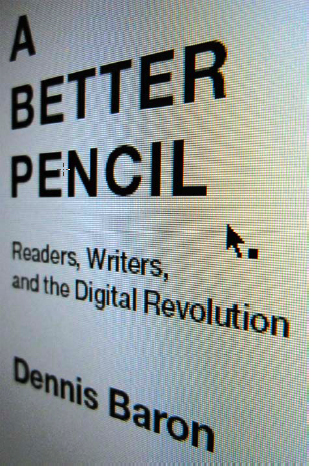 I very much enjoyed Dennis Baron’s new book, A Better Pencil: Readers, Writers, and the Digital Revolution, and highly recommend you pick it up. Baron does a wonderful job exploring the history of techno-pessimism and the endless battles about the impact of new technologies on life and learning, something I have written about here before in my essays on “Internet optimists vs. pessimists” (See: 1, 2, 3).
I have a complete review of Baron’s
A Better Pencil now up on the City Journal‘s website here. I’ve also pasted it down below.
Plato Wrote it Down
by Adam Thierer
a review of A Better Pencil: Readers, Writers, and the Digital Revolution, by Dennis Baron (Oxford University Press, 280 pp., $24.95)
In the beginning, Dennis Baron reminds us in his new book,
A Better Pencil, there was the word—the spoken word, that is. Oral tradition, the passing of knowledge through stories and lectures, was the primary method of instruction and learning throughout early human civilization. But then a few innovative souls decided to start writing everything down on stones and clay. Almost as soon as they did, a great debate began on the impact of new communications technology on culture and education. And it rages on today, with a new generation of optimists and skeptics battling over the impact that computing, the Internet, and digital technologies have on our lives and on how we learn about the world.
Continue reading →

 The Technology Liberation Front is the tech policy blog dedicated to keeping politicians' hands off the 'net and everything else related to technology.