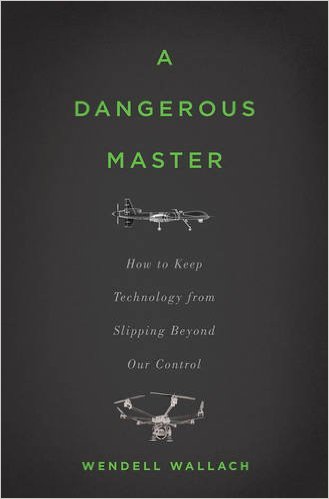
On May 3rd, I’m excited to be participating in a discussion with Yale University bioethicist Wendell Wallach at the Microsoft Innovation & Policy Center in Washington, DC. (RSVP here.) Wallach and I will be discussing issues we write about in our new books, both of which focus on possible governance models for emerging technologies and the question of how much preemptive control society should exercise over new innovations.
Of all the books of technological criticism or skepticism that I’ve read in recent years—and I have read stacks of them!—
A Dangerous Master is by far the most thoughtful and interesting. I have grown accustomed to major works of technological criticism being caustic, angry affairs. Most of them are just dripping with dystopian dread and a sense of utter exasperation and outright disgust at the pace of modern technological change.
Although he is certainly concerned about a wide variety of modern technologies—drones, robotics, nanotech, and more—Wallach isn’t a purveyor of the politics of panic. There are some moments in the book when he resorts to some hyperbolic rhetoric, such as when he frets about an impending “techstorm” and the potential, as the book’s title suggests, for technology to become a “dangerous master” of humanity. For the most part, however, his approach is deeper and more dispassionate than what is found in the leading tracts of other modern techno-critics.
NPR science correspondent Shankar Vedantam had a great spot on NPR’s Morning Edition today about the disputes among social scientists over the impact of violent video games on kids. [“It’s A Duel: How Do Violent Video Games Affect Kids?”] You won’t be surprised to hear I wholeheartedly agree with Texas A&M psychologist Chris Ferguson, who noted in the spot:
Ferguson says it’s easy to think senseless video game violence can lead to senseless violence in the real world. But he says that’s mixing up two separate things. “Many of the games do have morally objectionable material and I think that is where a lot of the debate on this issue went off the rails,” he said. “We kind of mistook our moral concerns about some of these video games, which are very valid — I find many of the games to be morally objectionable — and then assumed that what is morally objectionable is harmful.”
I’ve written about Ferguson’s work and these issues more generally many times over through the years here at the TLF. Here are some of the most relevant essays:
Over at TechDirt, Mike Masnick has an interesting post asking “Why Did Apple Approve Spotify?” which builds on an AdAge column asking a similar question: “Did Apple Sacrifice ITunes With Latest Apps?” As the title of that AdAge piece suggests, some folks are wondering if Apple shot itself in the foot by approving Spotify, a music streaming app that some regard as a potential iTunes killer. I don’t really have any comment on the business angle here, rather, I wanted to just comment on Mike’s suggestion that one possible explanation for Apple’s approval of the app is that:
As we noted when the app was approved, Apple appears to be somewhat gunshy, following the FCC inquiry into why it “blocked” Google Voice on the iPhone (and, yes, Apple still insists it didn’t actually block the app, but Google says otherwise). Given the scrutiny, Apple probably realized that it was in for some serious political trouble if it blocked an app like Spotify, which would have received a lot of press attention. Oddly, the AdAge article doesn’t mention this at all.
Indeed, it is odd that
AdAge didn’t bother mentioning that fact. But what I find doubly odd here is that nobody is even blinking an eye at the prospect of such political meddling with — or even possible FCC regulation of — Apple, iTunes, or music streaming market in general! Seriously, have we gotten to the point now in our Bold New World of Neutrality Regulation that innovative high-tech companies must live in fear of constant regulatory intervention even when they completely lack any statutory authority to play these games? Moreover, does anyone think that the a bunch of Beltway bureaucrats can micro-manage music and high-tech application markets and give us more options than we have today?
I know the prospect of such meddling makes some academics and regulatory activists groups happy, but I can’t see how this ends well for consumers or high-tech markets more generally. Regardless, for those of you who laugh when we suggest that the slippery slope of regulation is real, consider this case to be Exhibit A. Or perhaps it’s Exhibit B since the Google Voice spat with Apple was already moving the FCC in the direction of becoming a device regulator and applying “handset neutrality” principles that have no basis in law. It’s your anything-goes government at work.
The Technology Liberation Front is the tech policy blog dedicated to keeping politicians' hands off the 'net and everything else related to technology. Learn more about TLF →

 The Technology Liberation Front is the tech policy blog dedicated to keeping politicians' hands off the 'net and everything else related to technology.