Posts tagged as:

I recently posted an essay over at The Bridge about “The Pacing Problem and the Future of Technology Regulation.” In it, I explain why the pacing problem—the notion that technological innovation is increasingly outpacing the ability of laws and regulations to keep up—“is becoming the great equalizer in debates over technological governance because it forces governments to rethink their approach to the regulation of many sectors and technologies.”

In this follow-up article, I wanted to expand upon some of the themes developed in that essay and discuss how they relate to two other important concepts: the “Collingridge Dilemma” and technological determinism. In doing so, I will build on material that is included in a forthcoming law review article I have co-authored with Jennifer Skees, Ryan Hagemann (“Soft Law for Hard Problems: The Governance of Emerging Technologies in an Uncertain Future”) as well as a book I am finishing up on the growth of “evasive entrepreneurialism” and “technological civil disobedience.”

Recapping the Nature of the Pacing Problem

First, let us quickly recap that nature of “the pacing problem.” I believe Larry Downes did the best job explaining the “problem” in his 2009 book on The Laws of Disruption. Downes argued that “technology changes exponentially, but social, economic, and legal systems change incrementally” and that this “law” was becoming “a simple but unavoidable principle of modern life.” Continue reading →


Juma book cover

“The quickest way to find out who your enemies are is to try doing something new.” Thus begins Innovation and Its Enemies, an ambitious new book by Calestous Juma that will go down as one of the decade’s most important works on innovation policy.

Juma, who is affiliated with the Harvard Kennedy School’s Belfer Center for Science and International Affairs, has written a book that is rich in history and insights about the social and economic forces and factors that have, again and again, lead various groups and individuals to oppose technological change. Juma’s extensive research documents how “technological controversies often arise from tensions between the need to innovate and the pressure to maintain continuity, social order, and stability” (p. 5) and how this tension is “one of today’s biggest policy challenges.” (p. 8)

What Juma does better than any other technology policy scholar to date is that he identifies how these tensions develop out of deep-seated psychological biases that eventually come to affect attitudes about innovations among individuals, groups, corporations, and governments. “Public perceptions about the benefits and risks of new technologies cannot be fully understood without paying attention to intuitive aspects of human psychology,” he correctly observes. (p. 24) Continue reading →

I’m currently plugging away at a big working paper with the running title, “Argumentum in Cyber-Terrorem: A Framework for Evaluating Fear Appeals in Internet Policy Debates.” It’s an attempt to bring together a number of issues I’ve discussed here in my past work on “techno-panics” and devise a framework to evaluate and address such panics using tools from various disciplines. I begin with some basic principles of critical argumentation and outline various types of “fear appeals” that usually represent logical fallacies, including: argumentum in terrorem, argumentum ad metum, and argumentum ad baculum.  But I’ll post more about that portion of the paper some other day. For now, I wanted to post a section of that paper entitled “The Problem with the Precautionary Principle.” I’m posting what I’ve got done so far in the hopes of getting feedback and suggestions for how to improve it and build it out a bit. Here’s how it begins…

________________

The Problem with the Precautionary Principle

“Isn’t it better to be safe than sorry?” That is the traditional response of those perpetuating techno-panics when their fear appeal arguments are challenged. This response is commonly known as “the precautionary principle.” Although this principle is most often discussed in the field of environment law, it is increasingly on display in Internet policy debates.

The “precautionary principle” basically holds that since every technology and technological advance poses some theoretical danger or risk, public policy should be crafted in such a way that no possible harm will come from a particular innovation before further progress is permitted. In other words, law should mandate “just play it safe” as the default policy toward technological progress. Continue reading →

Here’s the first of two essays I’ve recently penned making “The Case for Internet Optimism.” This essay was included in the book, The Next Digital Decade: Essays on the Future of the Internet (2011), which was edited by Berin Szoka and Adam Marcus of TechFreedom.  In these essays, I identify two schools of Internet pessimism: (1) “Net Skeptics,” who are pessimistic about the Internet improving the lot of mankind; and (2) “Net Lovers,” who appreciate the benefits the Net brings society but who fear those benefits are disappearing, or that the Net or openness are dying.  (Regular readers of this blog will be familiar with these themes since I sketched them out in previous essays here such as, “Are You an Internet Optimist or Pessimist?” and “Two Schools of Internet Pessimism.”) The second essay is here.

This essay focuses on the first variant of Internet pessimism, which is rooted in general skepticism about the supposed benefits of cyberspace, digital technologies, and information abundance. The proponents of this pessimistic view often wax nostalgic about some supposed “good ‘ol days” when life was much better (although they can’t seem to agree when those were). At a minimum, they want us to slow down and think twice about life in the Information Age and how it’s personally affecting each of us.  Occasionally, however, this pessimism borders on neo-Ludditism, with some proponents recommending steps to curtail what they feel is the destructive impact of the Net or digital technologies on culture or the economy.  I identify the leading exponents of this view of Internet pessimism and their major works. I trace their technological pessimism back to Plato but argue that their pessimism is largely unwarranted. Humans are more resilient than pessimists care to admit and we learn how to adapt to technological change and assimilate new tools into our lives over time. Moreover, were we really better off in the scarcity era when we were collectively suffering from information poverty?  Generally speaking, despite the challenges it presents society, information abundance is a better dilemma to be facing than information poverty.  Nonetheless, I argue, we should not underestimate or belittle the disruptive impacts associated with the Information Revolution.  But we need to find ways to better cope with turbulent change in a dynamist fashion instead of attempting to roll back the clock on progress or recapture “the good ‘ol days,” which actually weren’t all that good.

Down below, I have embedded the entire chapter in a Scribd reader, but the essay can also be found on the TechFreedom website for the book as well as on SSRN.  I have also includes two updated tables that appeared in my old “optimists vs. pessimists” essay.  The first lists some of the leading Internet optimists and pessimists and their books. The second table outlines some of the major lines of disagreement between these two camps and I divided those disagreements into (1) Cultural / Social beliefs vs. (2) Economic / Business beliefs.

Continue reading →

I’m going to close out my series of essays about Tim Wu’s new book, The Master Switch: The Rise and Fall of Information Empires, by discussing his proposed solutions.  In the first five essays in the series, [1, 2, 3, 4, 5] I’ve critiqued Wu’s look at information history as well as his use of terms like “market failure,” “laissez-faire” and “open” vs. “closed.”  I argued there’s a great deal of over-simplification, even outright distortion, in his use of those terms throughout the book.

Anyway, let’s run through the basics of the book once more before getting to Wu’s proposed solutions.  By my reading of The Master Switch, Wu’s argument essentially goes something like this:

  • Information industries go through cycles. After a period of “openness” and competition, they tend to drift toward “closed,” corporate-controlled, anti-consumer models and outcomes.
  • The resulting “monopolists” then block much innovation, competition, and free speech.
  • Consequently, “the purely economic laissez-faire approach… is no longer feasible.”
  • Moreover, information industries are more important than all others (“information industries… can never be properly understood as ‘normal’ industries”) and even traditional forms of regulation, including antitrust, “are clearly inadequate for the regulation of information industries.” (p. 303).
  • Thus, special rules should apply to information-related sectors of our economy.

Again, I’ve challenged some of these assertions in my previous essays, specifically, Wu’s incomplete history of cycles and the fact that he greatly underplays the role of governments in “locking-in” sub-optimal market structures or, worse yet, creating those structures through misguided public policies or regulatory capture.  Wu discusses some of those factors in his book, but he tends to regard them as secondary to the inquiry, whereas I believe they are crucial to understanding how most “closed” or anti-competitive scenarios develop or endure. Instead, Wu simplistically suggests that “the purely economic laissez-faire approach… is no longer feasible,” even though no such state of affairs has ever existed within communications or media industries. They have been subjected to varying levels of indirect influence or direct control almost since their inception.

Regardless, what does Tim Wu want done about the problems he has (mis-)diagnosed? Continue reading →

Of the many tech policy-related books I’ve read in recent years, I can’t recall ever being quite so torn over one of them as much as I have been about Jaron Lanier‘s You Are Not a Gadget: A Manifesto.  There were moments while I was reading through it when I was thinking, “Yes, quite right!,” and other times when I was muttering to myself, “Oh God, no!”

The book is bound to evoke such strong emotions since Lanier doesn’t mix words about what he believes is the increasingly negative impact of the Internet and digital technologies on our lives, culture, and economy. In this sense, Lanier fits squarely in the pessimist camp on the Internet optimists vs. pessimists spectrum. (I outlined the intellectual battle lines between these two camps my essay, “Are You An Internet Optimist or Pessimist? The Great Debate over Technology’s Impact on Society.”) But Lanier is no techno-troglodyte. Generally speaking, his pessimism isn’t as hysterical in tone or Luddite-ish in its prescriptions as the tracts of some other pessimists.  And as a respected Internet visionary, a gifted computer scientist, an expert on virtual reality, and a master wordsmith, the concerns Lanier articulates here deserve to be taken seriously— even if one ultimately does not share his lugubrious worldview.

On the very first page of the book, Lanier hits on three interrelated concerns that other Net pessimists have articulated in the past:

  1. Loss of individuality & concerns about “mob” behavior (Lanier: “these words will mostly be read by nonpersons–automatons or numb mobs composed of people who are no longer acting as individuals.”)
  2. Dangers of anonymity (Lanier: “Reactions will repeatedly degenerate into mindless chains of anonymous insults and inarticulate controversies.”)
  3. “Sharecropper” concern that a small handful of capitalists are getting rich off the backs of free labor (Lanier: “Ultimately these words will contribute to the fortunes of those few who have been able to position themselves as lords of the computing clouds.”)

Again, others have tread this ground before, and it’s strange that Lanier doesn’t bother mentioning any of them. Neil Postman, Mark Helprin, Andrew Keen, and Lee Siegel have all railed against the online “mob mentality” and argued it can be at least partially traced to anonymous online communications and interactions. And it was Nick Carr, author of The Big Switch, who has been the most eloquent in articulating the “sharecropper” concern, which Lanier now extends with his “lords of the computing clouds” notion. [More on that towards the end.] Continue reading →

[I’ve been working on an outline for a book I hope to write surveying technological skepticism throughout history. I first started thinking about this topic two years when I noticed that a great number of recent books about Internet policy could generally be grouped into one of two camps: Internet optimists vs. Internet pessimists. I subsequently penned an essay on the subject that generated a fair bit of attention. So, I figured I must be on to something, and the more Net policy books I read, the more I realized that the divisions between these two camps were growing wider and increasingly heated. Thus, I thought I would share this very rough draft (much of it still in outline form) of the opening chapter of that book I want to write about this great intellectual war over the impact of technology on society. I invite reader input. Update Jan. 2011: I finally published a full-length essay on this topic. You can find it here. ]

__________

The impact of technological change on culture, learning, and morality has long been the subject of intense debate, and every technological revolution brings out a fresh crop of both pessimists and pollyannas. Indeed, a familiar cycle has repeat itself throughout history whenever new modes of production (from mechanized agriculture to assembly-line production), means of transportation (water, rail, road, or air), energy production processes (steam, electric, nuclear), medical breakthroughs (vaccination, surgery, cloning), or communications techniques (telegraph, telephone, radio, television) have appeared on the scene.

The cycle goes something like this. A new technology appears. Those who fear the sweeping changes brought about by this technology see a sky that is about to fall. These “techno-pessimists” predict the death of the old order (which, ironically, is often a previous generation’s hotly-debated technology that others wanted slowed or stopped).  Embracing this new technology, they fear, will result in the overthrow of traditions, beliefs, values, institutions, business models, and much else they hold sacred.

The pollyannas, by contrast, look out at the unfolding landscape and see mostly rainbows in the air. Theirs is a rose-colored world in which the technological revolution du jour is seen as improving the general lot of mankind and bringing about a better order.  If something has to give, then the old ways be damned! For such “techno-optimists,” progress means some norms and institutions must adapt—perhaps even disappear—for society to continue its march forward.

Our current Information Revolution is no different. It too has its share of techno-pessimists and techno-optimists. Indeed, before most of us had even heard of the Internet, people were already fighting about it—or at least debating what the rise of the Information Age meant for our culture, society, and economy. Continue reading →

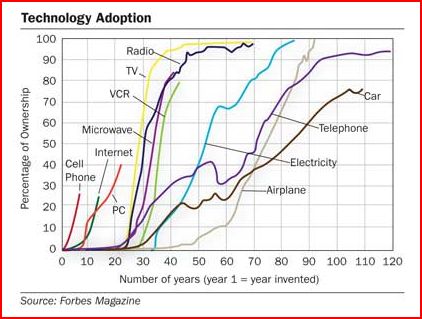
Via Kevin Kelly I see that at some point Forbes magazine produced this chart measuring technology diffusion rates for various media and communications technologies since their year of inception. Forbes tech diffusion chart I found this of great interest because, since the mid-90s, I have been putting together various charts and tables illustrating technological diffusion [most recently I did this in my “Media Metrics” report] and this particular chart is quite challenging since you are forced to pick a “Year 1” date to begin each of the “S curves.” For example, what is “Year 1” for electricity or telephony on one hand, or the PC or the Internet on the other? That’s not always easy to determine since it is unclear when certain technologies were “born.”

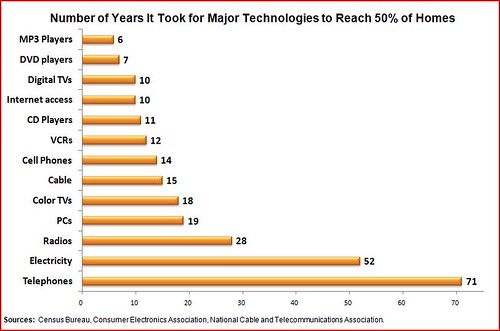
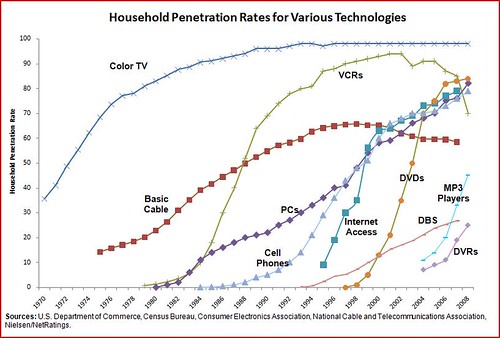
Regardless, no matter how you cut it, the more modern and the less regulated the technologies, the quicker they get to market. Here’s a couple of my recent charts illustrating that fact. The first shows how long it took before various technologies reached 50% household penetration. The second illustrates the extent of household diffusion over time.
However, as Kevin Kelly notes, we usually never see any technology hit 100% household penetration (although the boob tube got close!): Continue reading →

A few months ago, I penned a mega book review about the growing divide between “Internet optimists and pessimists.” I noted that the Internet optimists — people like Chris Anderson, Clay Shirky, Yochai Benkler, Kevin Kelly, and others — believe that the Internet is generally improving our culture, economy, and society for the better. They believe the Net has empowered and liberated the masses, sparked unparalleled human creativity and communication, provided greater personalization and customization of media content, and created greater diversity of thought and a more deliberative democracy. By contrast, the Internet pessimists — including Nick Carr, Andrew Keen, Lee Siegel, and others — argue that the Internet is destroying popular culture and professional media, calling “truth” and “authority” into question by over-glamorizing amateurism and user-generated content, and that increased personalization is damaging deliberative democracy by leading to homogenization, close-mindedness, and an online echo-chamber. Needless to say, it’s a very heated debate!

I am currently working on a greatly expanded version of my “Net optimists vs. pessimists” essay for a magazine in which I will draw out more of these distinctions and weigh the arguments made by those in both camps. I plan on concluding that article by arguing that the optimists generally have the better of the argument, but that the pessimists make some fair points about the downsides of the Net’s radically disintermediating role on culture and economy.

So, this got me thinking that I needed to come up with some sort of a label for my middle-of-the-road position as well as a statement of my personal beliefs. As far as labels go, I guess I would call myself a “pragmatic optimist” since I generally side with the optimists in most of these debates, but not without some occasional reservations. Specifically, I don’t always subscribe to the Pollyanna-ish, rose-colored view of the world that some optimists seem to adopt. But the outright Chicken Little-like Ludditism of some Internet pessimists is even more over-the-top at times. Anyway, what follows is my “Pragmatic (Internet) Optimist’s Creed” which better explains my views. (Again, read my old essay first for some context about the relevant battle lines in this intellectual war).

Continue reading →

[Note: I updated this discussion and chart in a subsequent essay. See: “Are You An Internet Optimist or Pessimist? The Great Debate over Technology’s Impact on Society.”]

A number of very interesting books have been released over the past year or two which debate how the Internet is reshaping our culture and the economy. I’ve reviewed a couple of them here but I have been waiting to compile a sort of mega-book review once I found a sensible way to conceptually group them together. I’m not going to have time to cover each of them here in the detail they deserve, but I think I have at least found a sensible way to categorize them. For lack of better descriptors, I’ve divided these books and thinkers into two camps: “Internet optimists” versus “Internet Pessimists.” Here’s a list of some of the individuals and books (or other articles and blogs) that I believe epitomize these two camps of thinking:

Adherents & Their Books / Writings

Internet Optimists

Internet Pessimists

Yochai Benkler, The Wealth of Networks

Andrew Keen, The Cult of the Amateur

Chris Anderson, The Long Tail and “Free!”

Lee Siegel, Against the Machine

Clay Shirky, Here Comes Everybody

Nick Carr, The Big Switch

Cass Sunstein, Infotopia

Cass Sunstein, Republic.com

Don Tapscott, Wikinomics

Todd Gitlin, Media Unlimited

Kevin Kelly & Wired mag in general

Alex Iskold, “The Danger of Free

Mike Masnick & TechDirt blog

Mark Cuban

And here’s a rough sketch of the major beliefs or key themes that separate these two schools of thinking about the impact of the Internet on our culture and economy:

Beliefs / Themes

Internet Optimists

Internet Pessimists

Culture / Social

Net is Participatory

Net is Polarizing

Net yields Personalization

Net yields Fragmentation

a “Global village

Balkanization

Heterogeneity / Diversity of Thought

Homogeneity / Close-mindedness

Net breeds pro-democratic tendencies

Net breeds anti-democratic tendencies

Tool of liberation & empowerment

Tool of frequent misuse & abuse

Economics / Business

Benefits of “free” (“Free” = future of media / business)

Costs of “free” (“Free” = end of media / business)

Increasing importance of “Gift economy

Continuing importance of property rights, profits, firms

“Wiki” model = wisdom of crowds; power of collective intelligence

“Wiki” model = stupidity of crowds; errors of collective intelligence

Mass collaboration

Individual effort

So, what to make of this intellectual war? Who’s got the story right?

Continue reading →