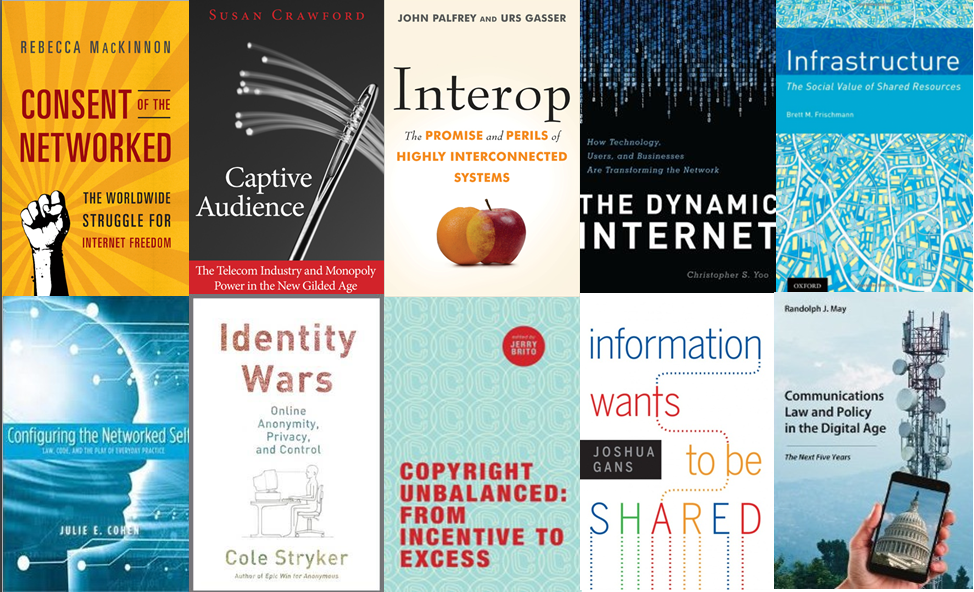
The number of major cyberlaw and information tech policy books being published annually continues to grow at an astonishing pace, so much so that I have lost the ability to read and review all of them. In past years, I put together end-of-year lists of important info-tech policy books (here are the lists for 2008, 2009, 2010, and 2011) and I was fairly confident I had read just about everything of importance that was out there (at least that was available in the U.S.). But last year that became a real struggle for me and this year it became an impossibility. A decade ago, there was merely a trickle of Internet policy books coming out each year. Then the trickle turned into a steady stream. Now it has turned into a flood. Thus, I’ve had to become far more selective about what is on my reading list. (This is also because the volume of journal articles about info-tech policy matters has increased exponentially at the same time.)
So, here’s what I’m going to do. I’m going to discuss what I regard to be the five most important titles of 2012, briefly summarize a half dozen others that I’ve read, and then I’m just going to list the rest of the books out there. I’ve read most of them but I have placed an asterisk next to the ones I haven’t. Please let me know what titles I have missed so that I can add them to the list. (Incidentally, here’s my compendium of all the major tech policy books from the 2000s and here’s the running list of all my book reviews.)
Continue reading →
 I recently finished Tyler Cowen’s latest book, Create Your Own Economy: The Path to Prosperity in a Disordered World. Like everything he writes, this book is worth reading and it will be of interest to those who follow technology policy debates since Cowen makes a passionate case for “Internet optimism” in the face of recent criticisms of the Internet and the Information Age in general.
Cowen is a Professor of Economics at George Mason University and the co-author, along with Alex Tabarrok, of the wonderful MarginalRevolution.com blog. And if you haven’t read Cowen’s
In Praise of Commercial Culture, stop what you’re doing and go get yourself a copy right now. Brilliant book. Compared to that book, Create Your Own Economy is a difficult book to summarize. Seriously, this book is all over the place… but in a good way. Even though it sometimes feels like “Tyler’s Miscellaneous Ramblings,” those ramblings will keep you engaged and entertained. Cord Blomquist did a pretty good job of summarizing the general themes of the book in this post two months ago when he noted that, “despite cultural reflexes that would have us do otherwise, we should embrace… new technologies as means to be more selective about what information we absorb and therefore welcome the increased volume of bytes into our lives. In his new book, [Cowen] explores technology as a vehicle to help you determine what you really value, not a series of a email-powered torture devices.” That’s a pretty good summation, but the book is about much more than that.
Instead of a full-blown review, I want to focus on some of passages from Cowen’s book about coping with information overload, which I think readers here might find of interest. In doing so, I will contrast Cowen’s views with those of John Freeman, who just penned “A Manifesto for Slow Communication” in The Wall Street Journal. As we will see, Cowen and Freeman’s differences exemplify the heated ongoing debate taking place among “Internet optimists & pessimists,” which I have discussed here many times before. Continue reading →
In a previous essay, I critiqued Andrew Keen’s thesis that our culture was better off in the age of scarcity than it is in today’s world of media and cultural abundance. In this essay, I want to make a few comments about his latest anti-Web 2.0 rant regarding how, in addition to destroying art and culture, the age of abundance and “amateur” content creation is going to result in the death of advertising.
In an AdWeek guest editorial this week, Keen argues that:
Web 2.0 is, in truth, the very worst piece of news for the advertising industry since the birth of mass media. In the short term, the Web 2.0 hysteria marks the end of the golden age of advertising; in the long term, it might even mark the end of advertising itself.
[…]
[F]or the advertiser, media content is indeed losing its value, a value historically derived from its scarcity. This devaluation of media isn’t hard to quantify: It can be measured everywhere, in falling CPM and the failure of social networks to develop viable business models. No new technology—neither the false dawn of mobile, nor the holy grail of personalized, targeted advertising—is going to save the advertising business now. No, the truth is that advertising can only be saved if we can re-create media scarcity. That means less user-generated content and more professionally created information and entertainment, less technology and more creativity. The advertising community desperately needs more gatekeepers, more professional creative authorities, more so-called media “elites” who will curate, filter and organize content. That’s the way to re-establish the value of the message. It’s the one commercial antidote to Web 2.0’s radically destructive cultural democracy.
Oh my, where to begin…
Continue reading →
Andrew Keen is the web’s favorite whipping boy these days, and in some ways he has it coming. His latest book, The Cult of the Amateur: How Today’s Internet is Killing Our Culture, is an anti-all-things-Web 2.0 screed. Keen lambastes “Internet democracy” (specifically the Wiki model of collaborative creation) and decries the rising tide of user-generated everything. When you get right down to it, Keen’s view of the world is unapologetically techno-conservative and culturally elitist. He’s angry that there are fewer intermediaries minding the culture. As a result, he argues, “professional” media (by which he means to say “better” media) is giving way to “amateur” media (which he regards as synonymous with, well… crap).
Unsurprisingly, the blogosphere has fought back with a vengeance and called Keen every nasty name in the book. But the best and most level-headed critique of Keen’s work is still this old essay by the ever-insightful Clay Shirky. Clay’s response rightly concedes that Keen in correct in pointing out that some important things have been lost with the rise of the Internet. There certainly are fewer intermediaries filtering our culture for us, and that will sound like a great thing to many of us. But it’s important to realize that some of those mediating forces serve a valuable role. Editors, for example, play an important, but often overlooked, role in terms of improving the quality of great deal of media content of all varieties (journalism, books, movies, music, etc). The blogosphere is becoming an editor-free zone, and at times it really shows. There are times when some particularly insulting things are said or silly mistakes are made that probably would have been corrected had a good editor been responsible for overseeing the final product.
On the other hand, the unfiltered Web 2.0 experience is wonderfully refreshing. Sometimes it’s nice to see what the uninhibited exchange of ideas results in. Regardless, the bottom line is that the editing profession (broadly defined) is changing because of the Internet. That is undeniable. And other mediating forces or institutions are seeing their power or relative importance in the cultural creation process diminished as the Internet-spawned disintermediation continues unabated.
Will that create short term problems? Undeniably. But Keen thinks these developments are contributing to a sort of cultural catastrophe and that we are collectively much worse off because of this disintermediation and empowerment of the “amateur.” This goes much too far in my opinion.
Continue reading →

 The Technology Liberation Front is the tech policy blog dedicated to keeping politicians' hands off the 'net and everything else related to technology.