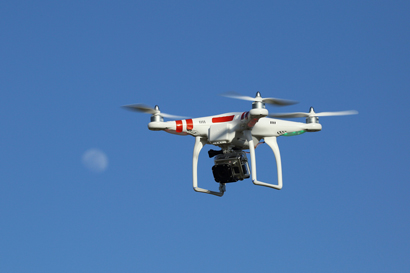
 The use of unmanned aircraft systems, or “drones,” for private and commercial uses remains the subject of much debate. The issue has been heating up lately after Congress ordered the Federal Aviation Administration (FAA) to integrate UASs into the nation’s airspace system by 2015 as part of the FAA Modernization and Reform Act of 2012.
The debate has thus far centered mostly around the safety and privacy-related concerns associated with private use of drones. The FAA continues to move slowly on this front based on a fear that private drones could jeopardize air safety or the safety of others on the ground. Meanwhile, some privacy advocates are worried that private drones might be used in ways that invade private spaces or even public areas where citizens have a reasonable expectation of privacy. For these and other reasons, the FAA’s current ban on private operation of drones in the nation’s airspace remains in place.
But what about the
speech-related implications of this debate? After all, private and commercial UASs can have many peaceful, speech-related uses. Indeed, to borrow Ithiel de Sola Pool’s term, private drones can be thought of as “technologies or freedom” that expand and enhance the ability of humans to gather and share information, thus in turn expanding the range of human knowledge and freedom.
A new Mercatus Center at George Mason University working paper, “News from Above: First Amendment Implications of the Federal Aviation Administration Ban on Commercial Drones,” deals with these questions. This 59-page working paper was authored by Cynthia Love, Sean T. Lawson, and Avery Holton. (Love is currently a Law Clerk for Judge Carolyn B. McHugh in 10th Circuit U.S. Court of Appeals. Lawson and Holton are affliated with the Department of Communication at the University of Utah.)
“To date, little attention has been paid to the First Amendment implications of the [FAA] ban,” note Love, Lawson, and Holton. Their article argues that “aerial photography with UASs, whether commercial or not, is protected First Amendment activity, particularly for news-gathering purposes. The FAA must take First Amendment-protected uses of this technology into account as it proceeds with meeting its congressional mandate to promulgate rules for domestic UASs.” They conclude by noting that “The dangers of [the FAA’s] regulatory approach are no mere matter of esoteric administrative law. Rather, as we have demonstrated, use of threats to enforce illegally promulgated rules, in particular a ban on journalistic use of UASs, infringes upon perhaps our most cherished constitutional right, that of free speech and a free press.” Continue reading →
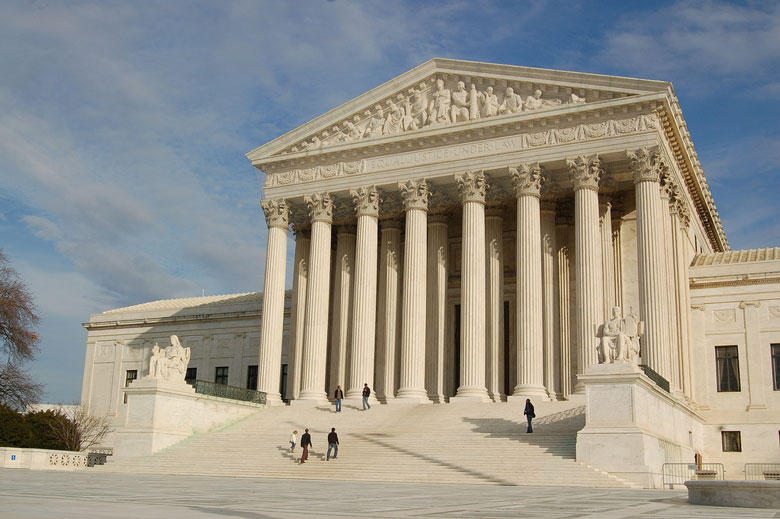 I’m still digesting the transcript from Tuesday’s Supreme Court oral arguments in the important First Amendment video game case, Schwarzenegger v. EMA. [Full transcript is here.] I thought I would post just a couple of quick thoughts here. [Reminder: here is the amicus brief that Berin Szoka and I filed in the case, and here is some analysis of the case by Larry Downes.]
On Defining “Deviant Violence”
Much of the discussion during oral arguments was preoccupied with defining the contours of the term “deviant violence.” I was pleased to see the Justices asking some sharp questions about the interpretation of that term for regulatory purposes. In particular, I enjoyed Justice Scalia’s remarks and questions to California Deputy Attorney General Zackery Morazzini, who argued the case on behalf of the state. Scalia said:
I am not just concerned with the vagueness. I am concerned with the vagueness, but I am concerned with the First Amendment, which says Congress shall make no law abridging the freedom of speech. And it was always understood that the freedom of speech did not include obscenity. It has never been understood that the freedom of speech did not include portrayals of violence. You are asking us to create… a whole new prohibition which the American people never — never ratified when they ratified the First Amendment. They knew they were — you know, obscenity was — was bad, but — what’s next after violence? Drinking? Smoking? Movies that show smoking can’t be shown to children? Does — will that affect them? Of course, I suppose it will. But is — is that — are — are we to sit day by day to decide what else will be made an exception from the First Amendment? Why — why is this particular exception okay, but the other ones that I just suggested are not okay? (p. 15-16)
Indeed, that’s what is at stake in this case: The beginning of a new class of exceptions to the First Amendment based upon concerns about children’s exposure to depictions of “excessive” or “deviant” violence.” Once you open up this can of worms, the sky is likely the limit in terms of how far governments might go to regulate speech in the name of “protecting children.” Continue reading →
 by Adam Thierer & Berin Szoka — (Ver. 1.0 — Summer 2009)
We are attempting to articulate the core principles of cyber-libertarianism to provide the public and policymakers with a better understanding of this alternative vision for ordering the affairs of cyberspace. We invite comments and suggestions regarding how we should refine and build-out this outline. We hope this outline serves as the foundation of a book we eventually want to pen defending what we regard as “Real Internet Freedom.” [Note: Here’s a printer-friendly version, which we also have embedded down below as a Scribd document.]
I. What is Cyber-Libertarianism?
Cyber-libertarianism refers to the belief that individuals—acting in whatever capacity they choose (as citizens, consumers, companies, or collectives)—should be at liberty to pursue their own tastes and interests online.
Generally speaking, the cyber-libertarian’s motto is “Live & Let Live” and “Hands Off the Internet!” The cyber-libertarian aims to minimize the scope of state coercion in solving social and economic problems and looks instead to voluntary solutions and mutual consent-based arrangements.
Cyber-libertarians believe true “Internet freedom” is freedom
from state action; not freedom for the State to reorder our affairs to supposedly make certain people or groups better off or to improve some amorphous “public interest”—an all-to convenient facade behind which unaccountable elites can impose their will on the rest of us.
Continue reading →
With today’s historic Supreme Court decision in FCC v. Fox, I have been commenting on the logic and implications of the decision. Part 3 dealt with the majority’s decision in the case, which was driven solely by procedural / admin law considerations. This installment will discuss the very interesting concurring opinion penned by Justice Thomas, which is the only one that takes a serious look at the constitutional foundations of the FCC’s current regulatory regime. While I was sad to see Justice Thomas join the majority’s decision upholding the FCC’s radical expansion of speech regulation in recent years, he joined that majority only on straightforward procedural grounds. On the underlying constitutional issues at stake here, it is clear from his concurring statement that he is ready for the Court to hear a challenge to the previous court precedents and traditional regulatory doctrines that have long supported FCC speech and media controls.
“I write separately,” Justice Thomas says “to note the questionable viability of the two precedents that support the FCC’s assertion of constitutional authority to regulate the programming at issue in this case.” Specifically, he addresses the two key cases upon which almost all FCC speech regulation rests: Red Lion Broadcasting Co. v. FCC, 395 U. S. 367 (1969) and FCC v. Pacifica Foundation, 438 U. S. 726 (1978). Thomas continues: “Red Lion and Pacifica were unconvincing when they were issued, and the passage of time has only increased doubt regarding their continued validity.”
BOOM! With those words, Justice Thomas has dropped the hammer and taken what will hopefully be the first swing at toppling the house of cards that is modern FCC speech regulation. Justice Thomas goes on to itemize the many problems with what I have referred to as “America’s Jurisprudential Twilight Zone” when it comes to how we apply the First Amendment to media platforms in this country. He states:
Continue reading →

 The Technology Liberation Front is the tech policy blog dedicated to keeping politicians' hands off the 'net and everything else related to technology.