Posts tagged as:

The debate over the imposition of sales tax collection obligations on interstate vendors is heating up again at the federal level with the introduction of S. 1452, “The Main Street Fairness Act.” [pdf]  The measure would give congressional blessing to a multistate compact that would let states impose sales taxes on interstate commerce, something usually blocked by the Commerce Clause of the U.S. Constitution.  Senator Dick Durbin (D-IL) introduced the bill in the Senate along with Tim Johnson (D-SD) and Jack Reed (D-RI).  The measure is being sponsored in the House of Representatives by John Conyers (D-MI) and Peter Welch (D-VT). At this time, there are no Republican co-sponsors even though Sen. Mike Enzi was rumored to be a considered co-sponsoring the measure before introduction.

Without any Republicans on board the effort, the measure may not advance very far in Congress. Nonetheless, to the extent the measure gets any traction, it is worth itemizing a few of the problems with this approach. My Mercatus Center colleague Veronique de Rugy and I have done some work on this issue together in the past and we are planning a short new paper on the topic. It will build on this lengthy Cato Institute paper we authored together in 2003, “The Internet Tax Solution: Tax Competition, Not Tax Collusion.” The key principle we set forth was this: “Congress must.. take an affirmative stand against efforts by state and local governments to create a collusive multistate tax compact to tax interstate sales.” “It would be wrong,” we argued, “for members of Congress to abdicate their responsibility to safeguard the national marketplace by giving the states carte blanche to tax interstate commercial activities through a tax compact. The guiding ethic of this debate must remain tax competition, not tax collusion.” Continue reading →

Northwestern Law Prof. James Speta has a new paper out that touches on many of the themes that Barbara Esbin, my colleague at The Progress & Freedom Foundation, has been covering in her excellent work explaining why the FCC doesn’t actually have have the vast, essentially unlimited authority over the Internet that it has asserted in its recent effort to enforce its non-binding 2005 net neutrality policy statement and its ongoing net neutrality rulemaking. (See her FCC comments on that issue here and Adam’s thoughts on this here.) Speta’s thesis also seems to parallel the approach taken under PFF’s 2005 Digital Age Communications Act (DACA), which emphasized focusing on on unfair practices and relying on a standard of consumer harm as in antitrust rather than trying to enshrine abstract principles like “neutrality” into law.

Anyway, here’s the abstract for Speta’s paper: Continue reading →

Can the Federal Communications Commission (FCC) just do anything it wants? If it wants to bring the entire Internet under its thumb, or regulate any speech uttered over electronic media, can it just do so on a whim? The agency’s recent actions on the Net neutrality and free speech fronts seems to suggest that the agency thinks so.

I don’t need to rehash here what the FCC has been up to on the Net neutrality front.  Most everyone is familiar with how the agency has essentially been trying to invent its authority to regulate out of thin air.  If you want the whole ugly history of how this charade has unfolded over past few years, I encourage you to read these amazing comments filed today in the FCC’s net neutrality NPRM proceeding by my PFF colleague Barbara Esbin.  Barbara simply demolishes the FCC’s argument that it can do anything it wants under the guise of its “ancillary jurisdiction.” As Barbara argues in her comments, the FCC’s position “is akin to saying that the FCC can regulate if its actions are ancillary to its ancillary jurisdiction, and that is one ancillary too many.”  She notes that:

The proposed rules regulating the services and network management practices of broadband Internet providers must rest, if at all, on the Commission‘s implied or ancillary jurisdiction and the NPRM fails to provide a basis upon which the exercise of such jurisdiction can be considered lawful.

She shows how farcical it is for the FCC to concoct its supposed authority to regulate from provisions of the Communications Act that have nothing whatsoever to do with Net neutrality or even expanding regulation in general. Specifically, the agency’s reliance on sections 230(b) and 706(a) of the Telecommunications Act of 1996 is completely outlandish.  Anyone who knows a lick about telecom law and the nature of those two sections understands they were never intended to serve as the basis of an expansive new regulatory regime for the Internet. As Barbara puts it:

This exercise—searching for snippets and threads of regulatory authority over a communications medium as significant as the Internet in multiple, unrelated statutory provisions—should signal to the Commission that no credible source of authority to regulate Internet services exists.

All I have to say is, thank God for checks and balances. I believe the courts will put a stop to this nonsense, but it will take some time.  Until then, I suppose the FCC will continue to act like a rogue agency, hell-bent and tossing the constitution to the wind and concocting asinine theories about why they should be allowed to do anything they want. But there are signs that the courts are ready to start holding the FCC more accountable. Continue reading →

Federal Cloud CommissionHmmm… What am I missing? I cannot lay my finger on a single line in the Communications Act of 1934, the Telecommunications Act of 1996, or any statute in between that gives the Federal Communications Commission (FCC) the authority to regulate cloud computing.  And yet, like any good stickler for jurisdictional authority, my PFF colleague Barbara Esbin keeps bringing to my attention little FCC chirps here and there which suggest that the agency is slowly positioning itself to become the Federal Cloud Commission. For example, back in September, Barbara brought to my attention this passage in the Commission’s recent Wireless Innovation and Investment Notice of Inquiry, (paragraph 60, pg. 21):

As other approaches, such as cloud computing, evolve, will established standards or de facto standards become more important to the applications development process? For example, can a dominant cloud computing position raise the same competitive issues that are now being discussed in the context of network neutrality? Will it be necessary to modify the existing balance between regulatory and market forces to promote further innovation in the development and deployment of new applications and services?

In my earlier essay about this, I noted that these questions should serve as a wake-up call for Google and other cloud-based providers who think that “neutrality” mandates will end at the infrastructure layer of the Net.  As Berin Szoka and I argued in our paper on “high-tech mutually assured destruction,” regulatory regimes grow but almost never contract.  And I’m even less optimistic about the FCC limiting its regulatory aspirations after the latest thing Barbara Esbin brought to my attention.

Today, as part of the Commission’s ongoing effort to develop a National Broadband Plan, the FCC released a request for information “on data portability and its relationship to broadband.”  (NBP Public Notice #21) “The Commission seeks tailored comment on broadband and portability of data and their relation to cloud computing, transparency, identity, and privacy,” the notice says.  Here was the second item on the list of things the Commission said it was investigating: Continue reading →

On Friday, the Federal Communications Commission (FCC) released a new Notice of Inquiry entitled, “Empowering Parents and Protecting Children in an Evolving Media Landscape” (MB Docket No. 09-194).  The purpose of this investigation is to:

seek information on the extent to which children are using electronic media today, the benefits and risks these technologies bring for children, and the ways in which parents, teachers, and children can help reap the benefits while minimizing the risks. (p. 2)… Our goal with this NOI is to gather data and recommend-ations from experts, industry, and parents that will enable us to identify actions that all stakeholders can take to enable parents and children to navigate this promising electronic media landscape safely and successfully. (p. 3)

This Notice builds on the FCC’s August 31st Report to Congress (“Implementation of the Child Safe Viewing Act; Examination of Parental Control Technologies for Video or Audio Programming”) that was required pursuant to the “Child Safe Viewing Act of 2007,” which Congress passed last year and President Bush signed last December. The goal of that bill and the FCC’s proceeding (MB Docket No. 09-26) was to study “advanced blocking technologies” that “may be appropriate across a wide variety of distribution platforms, including wired, wireless, and Internet platforms.” [I filed 150+ pages worth of comments in that proceeding, and here’s my analysis of why the bill and the FCC’s proceedings are worth monitoring. In previous posts here, I also listed all the major filings and reply comments that were submitted to the FCC in the matter.]

While the FCC’s new Notice outlines several positive impacts that media use may have for children, it then goes on to itemize a variety of concerns about media exposure: Continue reading →

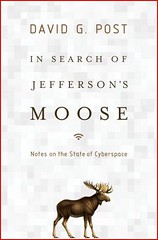
Post Jeffersons MooseI used to have a (semi-crazy) uncle who typically began conversations with lame jokes or bad riddles. This sounds like one he might have used had he lived long enough: What do Thomas Jefferson, a moose, and cyberspace have in common?

The answer to that question can be found in a new book, In Search of Jefferson’s Moose: Notes on the State of Cyberspace, by David G. Post, a Professor of Law at Temple University. Post, who teaches IP and cyberspace law at Temple, is widely regarded as one of the intellectual fathers of the “Internet exceptionalist” school of thinking about cyberlaw.  Basically, Post sees this place we call “cyberspace” as something truly new, unique, and potentially worthy of some special consideration, or even somewhat different ground rules than we apply in meatspace. More on that in a bit.

[ Full disclosure: Post’s work was quite influential on my own thinking during the late 1990s, so much so that when I joined the Cato Institute in 2000, one of the first things I did was invite David to become an adjunct scholar with Cato. He graciously accepted and remains a Cato adjunct scholar today. Incidentally, Cato is hosting a book forum for him on February 4th that I encourage you to attend or watch online. Anyway, it’s always difficult to be perfectly objective when you know and admire someone, but I will try to do so here.]

Post’s book is essentially an extended love letter — to both cyberspace and Jefferson. Problem is, as Post even admits at the end, it’s tough to know which subject this book is suppose to teach us more about. The book loses focus at times — especially in the first 100 pages — as Post meanders between historical tidbits of Jefferson’s life and thinking and what it all means for cyberspace. But the early focus is on TJ.  Thus, those who pick up the book expecting to be immediately immersed in cyber-policy discussions may be a bit disappointed at first.  As a fellow Jefferson fanatic, however, I found all this history terrifically entertaining, whether it was the story of Jefferson’s Plow and his other agricultural inventions and insights, TJ’s unique interest in science (including cryptography), or that big moose of his.

OK, so what’s the deal with the moose? When TJ was serving as a minister to France in in the late 1780s, at considerable expense to himself, he had the complete skeleton, skin and horns of a massive American moose shipped to the lobby of his Paris hotel. Basically, Jefferson wanted to make a bold statement to his French hosts about this New World he came from and wake them up to the fact that some very exciting things were happening over there that they should be paying attention to. That’s one hell of way to make a statement!

Continue reading →