Posts tagged as:
Originally published on 9/9/19 at The Bridge as, “Beware Calls for Government to ‘Save the Press‘”
—– by Adam Thierer & Andrea O’Sullivan Anytime someone proposes a top-down, government-directed “plan for journalism,” we should be a little wary. Journalism should not be treated like it’s a New Deal-era public works program or a struggling business sector requiring bailouts or an industrial policy plan. Such ideas are both dangerous and unnecessary. Journalism is still thriving in America, and people have more access to more news content than ever before. The news business faces serious challenges and upheaval, but that does not mean central planning for journalism makes sense. Unfortunately, some politicians and academics are once again insisting we need government action to “save journalism.” Senator and presidential candidate Bernie Sanders (D-VT) recently penned an op-ed for the  Columbia Journalism Review that adds media consolidation and lack of union representation to the parade of horrors that is apparently destroying journalism. And a recent University of Chicago report warns that “digital platforms” like Facebook and Google “present formidable new threats to the news media that market forces, left to their own devices, will not be sufficient” to continue providing high-quality journalism. Critics of the current media landscape are quick to offer policy interventions. “The Sanders scheme would add layers of regulatory supervision to the news business,” notes media critic Jack Shafer. Sanders promises to prevent or rollback media mergers, increase regulations on who can own what kinds of platforms, flex antitrust muscles against online distributors, and extend privileges to those employed by media outlets. The academics who penned the University of Chicago report recommend public funding for journalism, regulations that “ensure necessary transparency regarding information flows and algorithms,” and rolling back liability protections for platforms afforded through Section 230 of the Communications Decency Act. Both plans feature government subsidies, too. Sen. Sanders proposes “taxing targeted ads and using the revenue to fund nonprofit civic-minded media” as part of a broader effort “to substantially increase funding for programs that support public media’s news-gathering operations at the local level.” The Chicago plan proposed a taxpayer-funded $50 media voucher that each citizen will then be able to spend on an eligible media operation of their choice. Such ideas have been floated before and the problems are still numerous. Apparently, “saving journalism” requires that media be placed on the public dole and become a ward of the state. Socializing media in order to save it seems like a bad plan in a country that cherishes the First Amendment. Continue reading →


Yesterday afternoon, the Federal Aviation Administration (FAA) finally released its much-delayed rules for private drone operations. As The Wall Street Journal  points out, the rules “are about four years behind schedule,” but now the agency is asking for expedited public comments over the next 60 days on the whopping 200-page order. (You have to love the irony in that!) I’m still going through all the details in the FAA’s new order — and here’s a summary of what the major provisions — but here are some high-level thoughts about what the agency has proposed.

Opening the Skies…

  • The good news is that, after a long delay, the FAA is finally taking some baby steps toward freeing up the market for private drone operations.
  • Innovators will no longer have to operate entirely outside the law in a sort of drone black market. There’s now a path to legal operation. Specifically, small unmanned aircraft systems (UAS) operators (for drones under 55 lbs.) will be able to go through a formal certification process and, after passing a test, get to operate their systems.

Continue reading →

This morning, the Federal Communications Commission (FCC) released its eagerly-awaited “Future of Media” report. The 475-page final report is entitled, “The Information Needs of Communities: The Changing Media Landscape in a Broadband Age.”  [Here’s a 2-page summary and the official press release.]  The report is a bit overdue; the effort was supposed to be wrapped up late last year. Comments in the proceeding were filed over a year ago. Here are some of the major ones. Also, here is the 80-page monster filing that I submitted with my former PFF colleagues Berin Szoka and Ken Ferree.

Quick refresher… Federal policymakers have been taking a greater interest in the health of media and journalism in recent years. In 2009, the Senate held hearings about “the future of journalism,” and Senator Benjamin L. Cardin (D-MD) introduced the “Newspaper Revitalization Act,” which would allow newspapers to become tax-exempt non-profits in an effort to help them stay afloat. In 2010, the Federal Trade Commission hosted two workshops asking “How Will Journalism Survive the Internet Age?” and also released a staff report on “Potential Policy Recommendations to Support the Reinvention of Journalism.” (As I noted here and here, the FTC was blasted for that report and quickly backed off the issue. The agency has since gone radio silent on the issue.) The FCC also launched its “Examination of the Future of Media and Information in a Digital Age” in 2010, and today’s report wraps up their work on this front.

My first reaction after scanning the FCC’s final report is one of relief. For those of us who care about the First Amendment, media freedom, and free-market experimentation with new media business models, it feels like we’ve dodged a major bullet. The report does not recommend sweeping regulatory actions that might have seen Washington inserting itself into the affairs of the press or bailing out dying business models.

Continue reading →

In a post here last month on “Two Paradoxes of Privacy Regulation,” I discussed some of the interesting — and to me, troubling — similarities between rising calls for online privacy regulation and ongoing attempts to enact various types of controls on online speech or expression.  In that essay, I argued that while most privacy advocates are First Amendment supporters as it pertains to content regulation, they abandon their free speech values and corresponding constitutional tests when it comes to privacy regulation. When the topic of debate shifts from concerns about potentially objectionable content to the free movement of personal information, personal responsibility and self-regulation become the last option, not the first.  Privacy advocates typically ignore, downplay, or denigrate user-empowerment tools, even though many of those same advocates endorse “self-help” efforts as the superior method of dealing with objectionable speech or media content. In essence, therefore, they are claiming self-help is the right answer in one context, but not the other.  Ironically, therefore, privacy advocates and moral conservatives actually share much in common in that they are using the same playbook to advance their goals:  They are rejecting personal responsibility and user-empowerment tools and techniques in favor or government control for their respective issues.

Keeping that insight in mind, I want to take this comparison a step further and suggest that what really unites these two movements is a general conservatism about how our online lives and online business should be governed.  For the moral conservatives, that instinct is well-understood. They want hold the line against what they believe is a decaying moral order by restricting access to potentially objectionable speech or content — dirty words, violent video games, online porn, or whatever else.   The conservatism of the modern privacy movement is less obvious at first blush.  I suspect that many privacy conservatives would not consider themselves “conservative” at all, and they might even be highly offended at being grouped in with moral conservatives who seek to wield government power to control online speech and expression. Nonetheless, the two groups share a common trait — an innate hostility to the impact of technological / social change within the realm of “rights” or values they care about.  In their respective arenas, they both rejected the evolutionary dynamism of the free marketplace and they long for a return to a simpler and supposedly better time. Continue reading →

To hails of derision in some quarters—I’m looking at you, Adam—I have talked about how social media will occupy some of the space being ceded by traditional news reporting, which is struggling to find a business model. Perhaps with validation from an official, vetted, professional, dead-tree news source, it will seem less ridiculous to talk about news reporting being generated spontaneously by people “on the scene” or with the greatest knowledge of facts and conditions in a particular area.

Think of the mental habit that has us calling police and fire personnel “first responders.” They are almost always, in fact, second responders, with first response undertaken by average citizens, who often do a pretty good job of it. Think of the true first responders to recent attempted bombings on transatlantic flights: ordinary citizens who thwarted the underwear and shoe bombers. (I risk painting too heroic a picture . . . .)

Newspaper reporters and photographers are intellectual second responders, who come in after the fact, as generalists, to summarize events and trends for us. Yet these are who we look to as authorities on what happened, and how to think about it? That doesn’t seem to make sense if there are other options for being informed. And now there are.

I’ll take a cue from Adam’s good work in debunking the Internet pessimists who argue that “closed” access and technology models are strangling the open/’generative’ Internet: There’s plenty of room for both—both traditional journalism, as it finds its new niche, and reporting by ordinary people who are on the scene and who have superior knowledge in a particular domain.

I suspect that we’ll find better media and filters than Twitter’s firehose of info-pellets by which to learn about things like the hostage-taking in the D.C. area. There may even be a business model in it. Go to it, technology and markets!

I’m late to the party, but I wanted to say a few things about the District Court’s decision in the Viacom v. YouTube case this week and.  This will be a four-part post, covering:

1.  The holding

2.  The economic principle behind it

3.  The next steps in the case

4.  A review of the errors in legal analysis and procedure committed by reporters covering the case

Continue reading →

So, I’m sitting here at today’s Federal Trade Commission (FTC) workshop, “Will Journalism Survive the Internet Age?” and several panelists have argued that private “professional” media is toast, not just because of the rise of the Net and digital media, but also because the inherent cross-subsidy that advertising has traditionally provided is drying up.  It very well could be the case that both statements are true and that private media operators are in some trouble because of it. But what nobody seems to be acknowledging is that our government is currently on the regulatory warpath against advertising and that this could have profound impact on the outcome of this debate.

As Berin Szoka and I noted in a recent paper, “The Hidden Benefactor: How Advertising Informs, Educates & Benefits Consumers,” the FTC, the FCC, the FDA, and Congress are all considering, or already imposing, a host of new rules that will seriously affect advertising markets.  This article in AdAge today confirms this:

The advertising industry is heading for a “tsunami” of regulation and is at a “tipping point” of greatly increased scrutiny, warned a panel on social media and privacy at the American Advertising Federation conference here [in Orlando].

The reason this is so important for the ongoing debate about the future of media and journalism is because, as Berin and I argued in our paper: Continue reading →

Just a reminder that tomorrow the Federal Trade Commission (FTC) will be hosting the 3rd workshop in its ongoing event series, “Will Journalism Survive the Internet Age?” This workshop will feature various experts discussing the FTC’s 47-page “staff discussion draft,” which outlines “Potential Policy Recommendations to Support the Reinvention of Journalism.” In these two recent essays, I discussed the controversy surrounding some of the recommendations in that discussion draft:

According to this press release announcing the event,”The workshop is free and open to the public, but space is limited and attendees will be admitted on a first-come basis. The workshop will be held at: The National Press Club, 549 14th Street NW, 13th Floor, Washington, DC. Members of the public and press who wish to participate but who cannot attend can view a live webcast.  A link will be available on the day of the workshop at: http://www.ftc.gov/opp/workshops/news/index.shtml.”

Unless I am missing something, the FTC has still not posted an agenda or list of speakers, which is a bit strange. But apparently Rick Edmonds of the Poynter Institute will be participating. He’s got a nice piece up over at Poynter Online (“FTC Future-of-Journalism Inquiry Wraps Up With Little Momentum for Major Intervention“) summarizing some of what he’ll say tomorrow. I particularly liked his conclusion, which echoes the call Berin Szoka and I have made for allowing continuing marketplace evolution and experimentation: Continue reading →

As I pointed out here last week, the Federal Trade Commission’s (FTC) recently released 47-page document outlining “Potential Policy Recommendations to Support the Reinvention of Journalism” has been raising eyebrows in many different quarters. Even though it is just a “discussion draft” and the agency hasn’t formally endorsed any of the recommendations in it yet, the sweeping scope and radical nature of many of the proposals in the document has already raised the blood pressure for many folks. It doesn’t help that the document reads like the CliffsNotes for the recent media-takeover manifesto, The Death and Life of American Journalism, by the neo-Marxist media scholar Robert W. McChesney and Nation editor John Nichols. Their book is horrifying in its imperial ambitions since it invites the government become the High Lord and Protector of the Fourth Estate. [For an in-depth look at all of McChesney’s disturbing views on these issues, see: “Free Press, Robert McChesney & the “Struggle” for Media.”]

The FTC’s seeming infatuation with McChesney’s proposals has many rightly concerned about where exactly the Obama Administration’s FTC (and FCC) may be taking us in the name of “saving journalism.”  In an editorial this week, Investors Business Daily worries that the feds are “Seizing The News Business and wonders “why, as the administration contemplates a federal takeover of their business, [there is] such thundering silence” from journalists and media executive themselves.  The good news, however, is that a recent survey found plenty of skepticism among news executives regading government subsidies and regulatory meddling in their business. According to this April survey by the Pew Research Center’s Project for Excellence in Journalism in association with the American Society of News Editors (ASNE) and the Radio Television Digital News Association (RTDNA), revealed that, “Fully 75% of all news executives surveyed—and 88% of newspaper executives—said they had ’serious reservations,’ or the highest level of concern, about direct subsidies from the government.” A smaller percentage (only 46%) had serious reservations about tax credits for news organizations, then again, only 13% said they “would welcome such funding” and just 6% said they were “enthusiastic” about it.

And now there’s this new survey by Rasmussen Reports which finds that average Americans find some of the FTC’s proposed recommendations pretty silly: Continue reading →

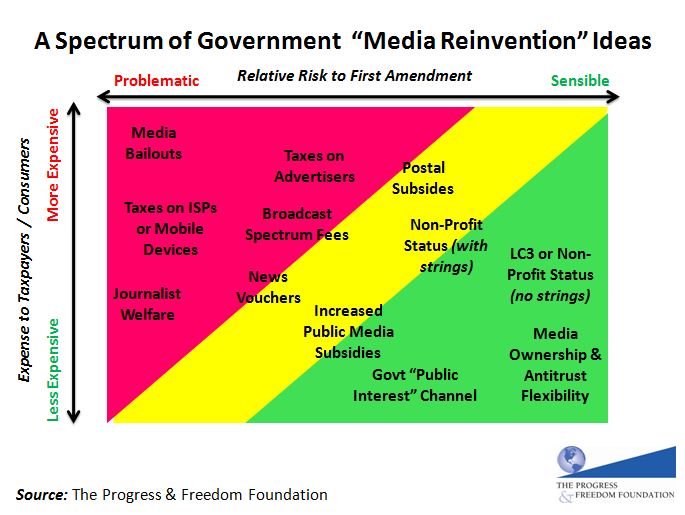
As I’ve noted here before, the Federal Trade Commission (FTC) has an ongoing proceeding asking “How Will Journalism Survive the Internet Age?” The agency has hosted two workshops on the issue and a third is scheduled for June 15th at the National Press Club. Recently, the FTC released a 47-page staff discussion draft entitled “Potential Policy Recommendations to Support the Reinvention of Journalism,” which outlines dozens of proposals that have been set forth in recent years to “save journalism,” “reinvent media,” or support various forms of so-called “public interest programming.”  [I’ve embedded the document down below.] Although the FTC makes it very clear on the first page of the discussion draft that it “does not represent final conclusions or recommendations by the Commission or FTC staff [and] it is solely for purposes of discussion,” the document is drawing scrutiny and raising concern since it might foreshadow where the FTC (and Obama Administration) could be heading on this front.

Some of those raising a stink about the FTC draft include: Jeff Jarvis (“FTC Protects Journalism’s Past“); Rob Port (“Federal Government Considering “iPad Tax” To Subsidize Journalism“); Mark Tapscott: “(Will Journalists Wake up in Time to Save Journalism from Obama’s FTC?”); and Andrew Malcolm of the Los Angeles Times (“Obama’s FTC Plan to Reinvent America’s News Media“), who says, “this FTC study is rated R for anyone who thinks the federal government, the object of copious news coverage itself, has no business deciding which sectors of the private media business survive and thrive through its support, subsidies and encouragement with things like tax incentives. Yet that’s what this Obama administration paper is suggesting as another of the ex-community organizer’s galactic reform plans.”   Ouch!

Continue reading →