2009 was not as big of a year for Internet and information technology (“info-tech”) policy books as 2008 was, but there were still some notable titles released that offered interesting perspectives about the future of the Net and the impact the Digital Revolution is having on our lives, culture, and economy. So, like last year, I figured I would throw together my list of the 10 most important info-tech policy books of the year.
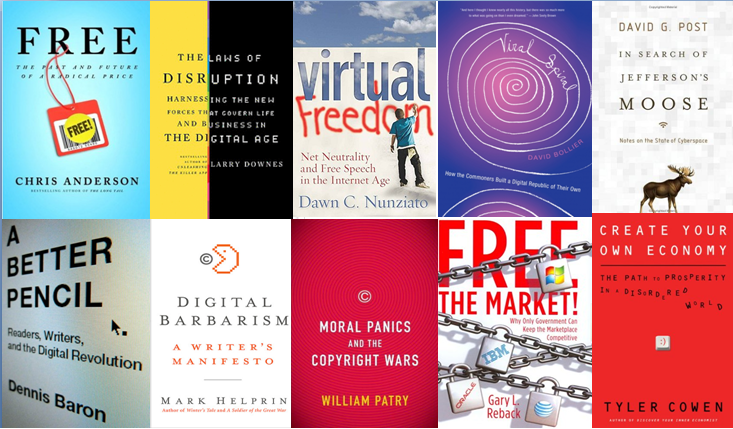 First, let me repeat a few of the same caveats and disclaimers that I set forth last year. What qualifies as an “important” info-tech policy book? Simply put, it’s a title that many people are currently discussing and that we will likely be referencing for many years to come. However, I want to be clear that merely because a book appears on my list it does not necessarily mean I agree with everything said in it. In fact, as was the case in previous years, I found much with which to disagree in my picks for the most important books of 2009 and I find that the cyber-libertarianism I subscribe to has very few fans out there.
Another caveat: Narrowly-focused titles lose a few points on my list. For example, if a book deals mostly with privacy issues, copyright law, or antitrust policy, it does not exactly qualify as the same sort of “tech policy book” as other titles found on this list since it is a narrow exploration of just one set of issues with a bearing on technology policy.
With those caveats in mind, here are my choices for the Most Important Info-Tech Policy Books of 2009. Continue reading →
 Seems like everywhere I turn someone is gushing about their new Droid phone, including my TLF colleagues Berin Szoka, Braden Cox, and Ryan Radia, who all had great fun rubbing their new toys in my nose over the past couple of days. And why not, it’s a very cool little device. It makes my HTC Touch seems positively archaic in some ways, and it’s only a year old. Apparently, 100,000 people already picked up a Droid in just its first weekend on the market.
But here’s the first thing that pops in my mind every time I see someone showing off their new Droid: How can a device like this even exist when America’s leading cyberlaw experts have been telling us that the whole digital world is increasingly going to hell because of “closed” devices, proprietary code, and managed networks? I’m speaking, of course, about the lamentations of Harvard professors Lawrence Lessig, Jonathan Zittrain, and their many disciples. As faithful readers will recall, I have relentlessly hammered this crew for their unwarranted cyber-Chicken Little-ism and hyper techno-pessimism. (See my many battles with Zittrain [1, 2, 3, 4, 5, 6 + video] and my 2-part debate with Lessig earlier this year).
“Left to itself,” Lessig warned in Code, “cyberspace will become a perfect tool of control.” He went on to forecast a dystopian future in which nefarious corporate schemers would quash our digital liberties unless benevolent public philosopher kings stepped in to save our poor souls. Code was the Old Testament of cyber-collectivism. The New Testament arrived last year with Zittrain’s
The Future of the Internet and How to Stop It. In it, we hear the grim prediction that “sterile and tethered” digital technologies and networks will triumph over the more “open and generative” devices and systems of the past. The iPhone and TiVo are cast as villains in Zittrain’s drama since they apparently represent the latest manifestations of Lessig’s “perfect control” paranoia.
Apple’s “Angel of Death”
How completely out-of-control has this thinking gotten? Well, here’s David Weinberger — another Harvard Berkman Center worrywart — talking about that supposed satanic font of all evil, the Apple AppStore: Continue reading →
by Berin Szoka & Adam Thierer, Progress Snapshot 5.11 (PDF)
Ten years ago, Nobel Prize-winning economist Milton Friedman lamented the “Business Community’s Suicidal Impulse:” the persistent propensity to persecute one’s competitors through regulation or the threat thereof. Friedman asked: “Is it really in the self-interest of Silicon Valley to set the government on Microsoft?” After yesterday’s FCC vote’s to open a formal “Net Neutrality” rule-making, we must ask whether the high-tech industry—or consumers—will benefit from inviting government regulation of the Internet under the mantra of “neutrality.”
The hatred directed at Microsoft in the 1990s has more recently been focused on the industry that has brought broadband to Americans’ homes (Internet Service Providers) and the company that has done more than any other to make the web useful (Google). Both have been attacked for exercising supposed “gatekeeper” control over the Internet in one fashion or another. They are now turning their guns on each other—the first strikes in what threatens to become an all-out, thermonuclear war in the tech industry over increasingly broad neutrality mandates. Unless we find a way to achieve “Digital Détente,” the consequences of this increasing regulatory brinkmanship will be “mutually assured destruction” (MAD) for industry and consumers.
New Fronts in the Neutrality Wars
The FCC’s proposed rules would apply to all broadband providers, including wireless, but not to Google or many other players operating in other layers of the Net who favor such broadband-specific rules. With this rulemaking looming, AT&T came after Google with letters to the FCC in late September and then another last week accusing the company of violating neutrality principles in their business practices and arguing that any neutrality rules that apply to ISPs should apply equally to Google’s panoply of popular services. In particular, AT&T accused Google of “search engine bias,” suggesting that only government-enforced neutrality mandates could protect consumers from Google’s supposed “monopolist” control.
The promise made yesterday by the FCC—to only apply neutrality principles to the infrastructure layer of the Net—is hollow and will ultimately prove unenforceable. Continue reading →
Well, here we go again. Harvard’s Jonathan Zittrain has penned another gloomy essay about how “freedom is at risk in the cloud” and the future of the Internet is in peril because nefarious digital schemers like Apple, Facebook, and Google are supposedly out to lock you into their services and take away your digital rights. And so, as I have done here many times before (see 1, 2, 3, 4, 5 + video!), I will offer a response arguing that Jonathan’s cyber-Chicken Little-ism is largely unwarranted.
Zittrain’s latest piece is entitled “Lost in the Cloud” and it appears in today’s New York Times. It closely tracks the arguments he has set forth in his book The Future of the Internet–And How to Stop It, which I named the most important technology policy book of 2008, but not because I agreed with its central thesis. Zittrain’s book and his new NYT essay are the ultimate exposition of Lessigite technological pessimism. I don’t know what they put in the water up at the Berkman Center to make these guys so remarkably cranky and despondent about the future of of the Internet, but starting with Lawrence Lessig’s Code in 1999 and running through to Zittrain’s Future of the Internet we have been forced to endure endless Tales of the Coming Techno-Apocalypse from these guys. Back in the late 90s, Prof. Lessig warned us that AOL and some other companies would soon take over the new digital frontier since “Left to itself, cyberspace will become a perfect tool of control.” Ah yes, how was it that we threw off the chains of our techno-oppressors and freed ourselves from that wicked walled garden hell? Oh yeah, we clicked our mouses and left! And that was pretty much the end of AOL’s “perfect control” fantasies. [See my recent debate with Prof. Lessig over at Cato Unbound for more about this “illusion of perfect control,” as I have labeled it.]
But Zittrain is the equivalent of the St. Peter upon which the Church of Lessigism has been built and, like any good disciple, he’s still vociferously preaching to the unconverted and using fire and brimstone sermons to warn of our impending digital damnation. In fact, he’s taken it to all new extremes. In
Future of the Internet, Jonathan argues that we run the risk of seeing the glorious days of the generative, open Net and digital devices give way to more “sterile, tethered devices” and closed networks. The future that he hopes to “stop” is one in which Apple, TiVo, Facebook, and Google — the central villains in his drama — are supposedly ceded too much authority over our daily lives because of a combination of (a) their wicked ways and (b) our ignorant ones.
Continue reading →

 The Technology Liberation Front is the tech policy blog dedicated to keeping politicians' hands off the 'net and everything else related to technology.