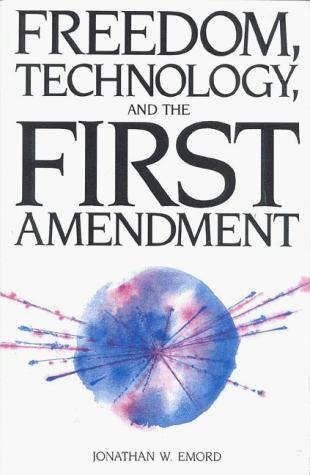
 Twenty years ago, one of the best books ever penned about freedom of speech was released. Sadly, many people still haven’t heard of it. That book was Freedom, Technology and the First Amendment, by Jonathan Emord. With the exception of Ithiel de Sola Pool’s 1983 masterpiece Technologies of Freedom: On Free Speech in an Electronic Age, no book has a more profound impact on my thinking about free speech and technology policy than Emord’s 1991 classic. Emord’s book is, at once, a magisterial history and a polemical paean. This is no wishy-washy apologia for free speech, rather, it is a celebration of the amazing gift of freedom that the Founding Fathers gave us with the very first amendment to our constitution.
Unlike most people, Emord assumes nothing about the nature and purpose of the First Amendment; instead, he starts in pre-colonial times and explains how our rich heritage of freedom of speech and expression came about. Like Pool, Emord also makes the case for equality of all press providers and debunks the twisted logic behind much of this century’s corrupt jurisprudence governing speech transmitted via electronic media. Pool and Emord make it clear that if the First Amendment is retain its true meaning and purpose as a bulwark against government control of speech and expression, electronic media providers (TV, radio, cable, the Internet) must be accorded full First Amendment freedoms on par with traditional print media (newspapers, magazines, books and journals). Continue reading →
[Note: This post is updated regularly as I discover relevant old or new material.]
“Regulatory capture” occurs when special interests co-opt policymakers or political bodies — regulatory agencies, in particular — to further their own ends. Capture theory is closely related to the “rent-seeking” and “political failure” theories developed by the public choice school of economics. Another term for regulatory capture is “client politics,” which according to James Q. Wilson, “occurs when most or all of the benefits of a program go to some single, reasonably small interest (and industry, profession, or locality) but most or all of the costs will be borne by a large number of people (for example, all taxpayers).” (James Q. Wilson,
Bureaucracy, 1989, at 76).
While capture theory cannot explain all regulatory policies or developments, it does provide an explanation for the actions of political actors with dismaying regularity. Because regulatory capture theory conflicts mightily with romanticized notions of “independent” regulatory agencies or “scientific” bureaucracy, it often evokes a visceral reaction and a fair bit of denialism. (See, for example, the reaction of New Republic’s Jonathan Chait to Will Wilkinson’s recent Economist column about the prevalence of corporatism in our modern political system.) Yet, countless studies have shown that regulatory capture has been at work in various arenas: transportation and telecommunications; energy and environmental policy; farming and financial services; and many others.
I thought it might be useful to build a compendium of quotes from various economists and political scientists who have studied the regulatory process throughout history and identified regulatory capture or client politics as a major problem. I would greatly appreciate having others suggest additional quotes and studies to add to this list since I plan to update it frequently and eventually work all of this into a future paper or book. [
Note: I have updated this compendium over a dozen times since the original post, so please check back for updates.]
The following list is chronological and begins, surprisingly, with the thoughts of progressive hero Woodrow Wilson…
Continue reading →
Tim Lee has been taking some heat here from Richard Bennett and Steve Schultze about various aspects of his new Net neutrality paper. I haven’t had much time this week to jump into these debates, but I did want to mention one important portion of Tim’s paper that is being overlooked. Specifically, I like the way Tim took head-on some of the silly free speech arguments being put forth as a rationale for net neutrality regulation. As Tim notes in the introduction of the paper:
Concerns that network owners will undermine free speech online are particularly misguided. Network owners have neither the technology nor the manpower to effectively filter online content based on the viewpoints being expressed, nor do profit-making businesses have any real incentive to do so. Should a network owner be foolish enough to attempt large-scale censorship of its customers, it would not only fail to suppress the disfavored speech, but the network would actually increase the visibility of the content as the effort at censorship attracted additional coverage of the material being censored.
I think that’s exactly right and, later in his paper (between pgs 22-3), Tim nicely elaborates about the “Herculean task” associated with any attempt by a broadband provider to “manipulate human communication.” Not only is it true, as Tim argues, that “no widescale manipulation would go unnoticed for very long,” but he is also correct in noting that the public and press backlash would be enormous.
Again, I agree wholeheartedly with all these sentiments, but I think Tim missed another important angle here when discussing the unfounded fears about corporate censorship and the misguided attempts to use free speech as a justification for imposing net neutrality regulations.
Continue reading →

 The Technology Liberation Front is the tech policy blog dedicated to keeping politicians' hands off the 'net and everything else related to technology.