 Information overload is a hot topic these days. I’ve really enjoyed recent essays by Aaron Saenz (“Are We Too Plugged In? Distracted vs. Enhanced Minds”), Michael Sacasas (“Technology Sabbaths and Other Strategies for the Digitized World“), and Peggy Noonan (“Information Overload is Nothing New“) discussing this concern in a thoughtful way. Thoughtful discussion about this issue is sometimes hard to find because, as I’ve noted here before, information overload is a subject that bitterly divides Internet optimists and pessimists. The pessimists tend to overplay the issue and discuss it in apocalyptic terms. The optimists, by contrast, often dismiss the concern out of hand. Certainly there must be some reasonable middle ground on this issue, no?
There is, and some of it can be found in a fine new book,
Hamlet’s BlackBerry: A Practical Philosophy for Building a Good Life in the Digital Age, by William Powers. Powers, a former staff writer for the Washington Post
, is a gifted storyteller and his walk though the history of philosophy and technology makes this slender volume an enjoyable, quick read. He begins by reminding us that:
whenever new devices have emerged, they’ve presented the kinds of challenges we face today — busyness, information overload, that sense of life being out of control. These challenges were as real two millennia ago as they are today, and throughout history, people have been grappling with them and looking for creative ways to manage life in the crowd. (p. 5)
His key insight is that humans
can adapt to new technology, but it takes time, patience, humility, and a little effort. “The key is to strike a balance,” he says, between “the call of the crowd” and the “need for time and space apart” from it. (p. 4) The problem we face today is that all the pressure is on us to be what he calls “Digital Maximalists.” That is, many of us are increasingly out to maximize the time spent in front of various digital “screens” whether we have made the determination that is really in our best interest or not. It has just gradually happened, Powers argues, because “The goal is no longer to be ‘in touch’ but to erase the possibility of ever being out of touch.” (p. 15)
Continue reading →
2009 was not as big of a year for Internet and information technology (“info-tech”) policy books as 2008 was, but there were still some notable titles released that offered interesting perspectives about the future of the Net and the impact the Digital Revolution is having on our lives, culture, and economy. So, like last year, I figured I would throw together my list of the 10 most important info-tech policy books of the year.
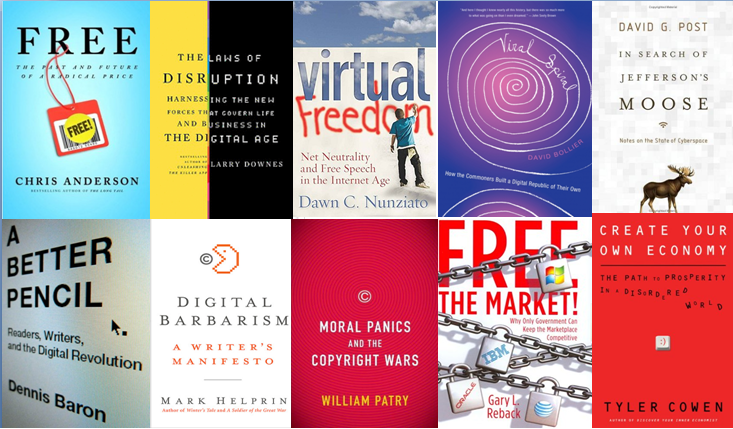 First, let me repeat a few of the same caveats and disclaimers that I set forth last year. What qualifies as an “important” info-tech policy book? Simply put, it’s a title that many people are currently discussing and that we will likely be referencing for many years to come. However, I want to be clear that merely because a book appears on my list it does not necessarily mean I agree with everything said in it. In fact, as was the case in previous years, I found much with which to disagree in my picks for the most important books of 2009 and I find that the cyber-libertarianism I subscribe to has very few fans out there.
Another caveat: Narrowly-focused titles lose a few points on my list. For example, if a book deals mostly with privacy issues, copyright law, or antitrust policy, it does not exactly qualify as the same sort of “tech policy book” as other titles found on this list since it is a narrow exploration of just one set of issues with a bearing on technology policy.
With those caveats in mind, here are my choices for the Most Important Info-Tech Policy Books of 2009. Continue reading →
 I recently finished Tyler Cowen’s latest book, Create Your Own Economy: The Path to Prosperity in a Disordered World. Like everything he writes, this book is worth reading and it will be of interest to those who follow technology policy debates since Cowen makes a passionate case for “Internet optimism” in the face of recent criticisms of the Internet and the Information Age in general.
Cowen is a Professor of Economics at George Mason University and the co-author, along with Alex Tabarrok, of the wonderful MarginalRevolution.com blog. And if you haven’t read Cowen’s
In Praise of Commercial Culture, stop what you’re doing and go get yourself a copy right now. Brilliant book. Compared to that book, Create Your Own Economy is a difficult book to summarize. Seriously, this book is all over the place… but in a good way. Even though it sometimes feels like “Tyler’s Miscellaneous Ramblings,” those ramblings will keep you engaged and entertained. Cord Blomquist did a pretty good job of summarizing the general themes of the book in this post two months ago when he noted that, “despite cultural reflexes that would have us do otherwise, we should embrace… new technologies as means to be more selective about what information we absorb and therefore welcome the increased volume of bytes into our lives. In his new book, [Cowen] explores technology as a vehicle to help you determine what you really value, not a series of a email-powered torture devices.” That’s a pretty good summation, but the book is about much more than that.
Instead of a full-blown review, I want to focus on some of passages from Cowen’s book about coping with information overload, which I think readers here might find of interest. In doing so, I will contrast Cowen’s views with those of John Freeman, who just penned “A Manifesto for Slow Communication” in The Wall Street Journal. As we will see, Cowen and Freeman’s differences exemplify the heated ongoing debate taking place among “Internet optimists & pessimists,” which I have discussed here many times before. Continue reading →
 Information overload is a hot topic these days. I’ve really enjoyed recent essays by Aaron Saenz (“Are We Too Plugged In? Distracted vs. Enhanced Minds”), Michael Sacasas (“Technology Sabbaths and Other Strategies for the Digitized World“), and Peggy Noonan (“Information Overload is Nothing New“) discussing this concern in a thoughtful way. Thoughtful discussion about this issue is sometimes hard to find because, as I’ve noted here before, information overload is a subject that bitterly divides Internet optimists and pessimists. The pessimists tend to overplay the issue and discuss it in apocalyptic terms. The optimists, by contrast, often dismiss the concern out of hand. Certainly there must be some reasonable middle ground on this issue, no?
 The Technology Liberation Front is the tech policy blog dedicated to keeping politicians' hands off the 'net and everything else related to technology.