Posts tagged as:

Here’s the first of two essays I’ve recently penned making “The Case for Internet Optimism.” This essay was included in the book, The Next Digital Decade: Essays on the Future of the Internet (2011), which was edited by Berin Szoka and Adam Marcus of TechFreedom.  In these essays, I identify two schools of Internet pessimism: (1) “Net Skeptics,” who are pessimistic about the Internet improving the lot of mankind; and (2) “Net Lovers,” who appreciate the benefits the Net brings society but who fear those benefits are disappearing, or that the Net or openness are dying.  (Regular readers of this blog will be familiar with these themes since I sketched them out in previous essays here such as, “Are You an Internet Optimist or Pessimist?” and “Two Schools of Internet Pessimism.”) The second essay is here.

This essay focuses on the first variant of Internet pessimism, which is rooted in general skepticism about the supposed benefits of cyberspace, digital technologies, and information abundance. The proponents of this pessimistic view often wax nostalgic about some supposed “good ‘ol days” when life was much better (although they can’t seem to agree when those were). At a minimum, they want us to slow down and think twice about life in the Information Age and how it’s personally affecting each of us.  Occasionally, however, this pessimism borders on neo-Ludditism, with some proponents recommending steps to curtail what they feel is the destructive impact of the Net or digital technologies on culture or the economy.  I identify the leading exponents of this view of Internet pessimism and their major works. I trace their technological pessimism back to Plato but argue that their pessimism is largely unwarranted. Humans are more resilient than pessimists care to admit and we learn how to adapt to technological change and assimilate new tools into our lives over time. Moreover, were we really better off in the scarcity era when we were collectively suffering from information poverty?  Generally speaking, despite the challenges it presents society, information abundance is a better dilemma to be facing than information poverty.  Nonetheless, I argue, we should not underestimate or belittle the disruptive impacts associated with the Information Revolution.  But we need to find ways to better cope with turbulent change in a dynamist fashion instead of attempting to roll back the clock on progress or recapture “the good ‘ol days,” which actually weren’t all that good.

Down below, I have embedded the entire chapter in a Scribd reader, but the essay can also be found on the TechFreedom website for the book as well as on SSRN.  I have also includes two updated tables that appeared in my old “optimists vs. pessimists” essay.  The first lists some of the leading Internet optimists and pessimists and their books. The second table outlines some of the major lines of disagreement between these two camps and I divided those disagreements into (1) Cultural / Social beliefs vs. (2) Economic / Business beliefs.

Continue reading →

Well, even though I just recently put to bed my annual list of the “Most Important Info-Tech Policy Books of 2010,” I’ve already started investigating what new titles we’ll need to pay attention to in 2011.  Accordingly, I’ve started this list and hope that others can suggest other books I may have missed.  Here’s what I’ve got so far:

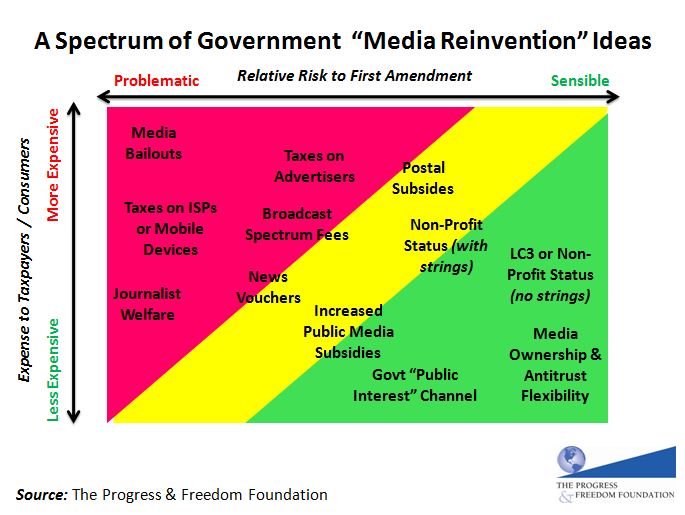
As I’ve noted here before, the Federal Trade Commission (FTC) has an ongoing proceeding asking “How Will Journalism Survive the Internet Age?” The agency has hosted two workshops on the issue and a third is scheduled for June 15th at the National Press Club. Recently, the FTC released a 47-page staff discussion draft entitled “Potential Policy Recommendations to Support the Reinvention of Journalism,” which outlines dozens of proposals that have been set forth in recent years to “save journalism,” “reinvent media,” or support various forms of so-called “public interest programming.”  [I’ve embedded the document down below.] Although the FTC makes it very clear on the first page of the discussion draft that it “does not represent final conclusions or recommendations by the Commission or FTC staff [and] it is solely for purposes of discussion,” the document is drawing scrutiny and raising concern since it might foreshadow where the FTC (and Obama Administration) could be heading on this front.

Some of those raising a stink about the FTC draft include: Jeff Jarvis (“FTC Protects Journalism’s Past“); Rob Port (“Federal Government Considering “iPad Tax” To Subsidize Journalism“); Mark Tapscott: “(Will Journalists Wake up in Time to Save Journalism from Obama’s FTC?”); and Andrew Malcolm of the Los Angeles Times (“Obama’s FTC Plan to Reinvent America’s News Media“), who says, “this FTC study is rated R for anyone who thinks the federal government, the object of copious news coverage itself, has no business deciding which sectors of the private media business survive and thrive through its support, subsidies and encouragement with things like tax incentives. Yet that’s what this Obama administration paper is suggesting as another of the ex-community organizer’s galactic reform plans.”   Ouch!

Continue reading →

Can we steer people toward hard news — and get them to financially support it — through the use  of “news vouchers” or “public interest vouchers”? That’s the subject of this latest installment in my ongoing series on proposals to have the government play a greater role in the media sector in the name of sustaining struggling enterprises or “saving journalism.”

As I mentioned here previously, last week I testified at the FCC’s first “Future of Media” workshop on “Serving the Public Interest in the Digital Era.” (@3:29 mark of video).  It was a great pleasure to testify alongside the all-star cast there that day, which included the always-provocative Jeff Jarvis of the CUNY Graduate School of Journalism.  He delivered some very entertaining remarks and vociferously pushed back against many of the ideas that others were suggesting about “saving journalism.” Jeff is a very optimistic guy–far more optimistic than me, in fact–about the prospect that new media and citizen journalism will help fill whatever void is left by the death of many traditional media operators and institutions. He had a lively exchange with Srinandan Kasi, Vice President, General Counsel and Secretary of the Associated Press, that is worth watching (somewhere after the 5-hour mark on the video).

Nonetheless, Jarvis is a enough of a realist to know that it has always been difficult to find resources to fund hard news, which he creatively refers to as “broccoli journalism.”  This is what is keeping the FCC, the FTC (workshop today), and many media worrywarts up at night; the fear that as traditional financing mechanisms falter (advertising, classifieds, subscription revenues, etc) many traditional news-gathering efforts and institutions will disappear. Of course, while it is certainly true we are in the midst of a gut-wrenching media revolution with a great deal of creative destruction taking place, it is equally true that exciting new media business models and opportunities are developing. We shouldn’t over look that, as I argued here and here.

Anyway, a lot of different proposals are being put forth by scholars and policymakers to find new ways to finance news-gathering or “save journalism.” One of the ideas that has been gaining some steam as of late is the idea of crafting a “public interest voucher” or what Robert W. McChesney & John Nichols, authors of the new book The Death and Life of American Journalism, call a “Citizenship News Voucher.”  And McChesney discussed this idea in more detail when he spoke at today’s FTC event on saving journalism. Continue reading →

[I’ve been working on an outline for a book I hope to write surveying technological skepticism throughout history. I first started thinking about this topic two years when I noticed that a great number of recent books about Internet policy could generally be grouped into one of two camps: Internet optimists vs. Internet pessimists. I subsequently penned an essay on the subject that generated a fair bit of attention. So, I figured I must be on to something, and the more Net policy books I read, the more I realized that the divisions between these two camps were growing wider and increasingly heated. Thus, I thought I would share this very rough draft (much of it still in outline form) of the opening chapter of that book I want to write about this great intellectual war over the impact of technology on society. I invite reader input. Update Jan. 2011: I finally published a full-length essay on this topic. You can find it here. ]

__________

The impact of technological change on culture, learning, and morality has long been the subject of intense debate, and every technological revolution brings out a fresh crop of both pessimists and pollyannas. Indeed, a familiar cycle has repeat itself throughout history whenever new modes of production (from mechanized agriculture to assembly-line production), means of transportation (water, rail, road, or air), energy production processes (steam, electric, nuclear), medical breakthroughs (vaccination, surgery, cloning), or communications techniques (telegraph, telephone, radio, television) have appeared on the scene.

The cycle goes something like this. A new technology appears. Those who fear the sweeping changes brought about by this technology see a sky that is about to fall. These “techno-pessimists” predict the death of the old order (which, ironically, is often a previous generation’s hotly-debated technology that others wanted slowed or stopped).  Embracing this new technology, they fear, will result in the overthrow of traditions, beliefs, values, institutions, business models, and much else they hold sacred.

The pollyannas, by contrast, look out at the unfolding landscape and see mostly rainbows in the air. Theirs is a rose-colored world in which the technological revolution du jour is seen as improving the general lot of mankind and bringing about a better order.  If something has to give, then the old ways be damned! For such “techno-optimists,” progress means some norms and institutions must adapt—perhaps even disappear—for society to continue its march forward.

Our current Information Revolution is no different. It too has its share of techno-pessimists and techno-optimists. Indeed, before most of us had even heard of the Internet, people were already fighting about it—or at least debating what the rise of the Information Age meant for our culture, society, and economy. Continue reading →

Interesting piece from Jeff Jarvis about “Google Bigotry,” or his belief that “media people are going after Google’s success for no good reason other than their own jealousy.”  Jarvis argues that reporters penning hard-nosed stories about Google are, in reality, just a bunch of envious cry-babies:

newspaper people will use their last drops of ink to complain about Google’s success and try to blame it for their own failures rather than changing their own businesses. ..  It’s not just that they dislike the competition – and they do, for it is a new experience for too many of them. If they were smart, they’d use Google to get more audience and make more money but they don’t know how to (or rather, they’d prefer not to change). No, the problem is that Google represents change and a new world they’ve refused to understand.

Well, yes and no.  I don’t believe that every story penned about Google by a mainstream media reporter is rooted in envy, and certainly not the one that Jarvis alludes to as prompting him to pen this piece.  Jarvis apparently received an inquiry from a French journalist at Le Monde asking for comment about “an article about Google facing a rising tide of discontent concerning privacy and monopoly.”  That doesn’t necessarily sound like an unreasonable journalistic inquiry to me. So, I’m not sure it’s fair to accuse every journalist who calls with a hard-nosed question about privacy and antitrust as being guilty of “Google bigotry.”

That being said, some journalists are likely feeling a bit miffed about Google’s recent success, thinking it comes at their expense, and, therefore, their envy might be prompting some of them to pen attack stories on the company.  I think Jarvis in on stronger ground, however, in asserting that most privacy and antitrust complaints about Google are unfounded, and also based on envy. Indeed, Berin Szoka and I have have been cataloging the complaints that we believe are driven by an irrational form of corporate envy we call “Googlephobia.”  And in prior years we saw a similar form of Microsoft-bashing at work that we still have with us today. That’s why I think Jarvis is on to something when he notes that Google-bashing represents a broader sociological phenomenon: Continue reading →

This catfight between Ron Rosenbaum of Slate and Jeff Jarvis of Buzz Machine about the future of journalism in the Internet Age is quite a heated affair. But what I found most interesting about it is that it reflects one element of the Net “optimist — pessimist” divide that I have been writing about here recently. Specifically, it touches on the divide over whether the Internet and digital technologies are reshaping the media marketplace and the field of journalism for better or for worse.

Rosenbaum is playing the pessimist role here and asking some sharp questions about the advice being dished out by “Web futurists” and “new-media gurus” as it relates the reversing the decline of the journalism profession. Rosenbaum says that the problem with Jarvis is that:

he’s become increasingly heartless about the reporters, writers, and other “content providers” who have been put out on the street by the changes in the industry. Not only does he blame the victims, he denies them the right to consider themselves victims. They deserve their miserable fate — and if they don’t know it, he’ll tell them why at great length. Sometimes it sounds as if he’s virtually dancing on their graves.

Continue reading →