Posts tagged as:

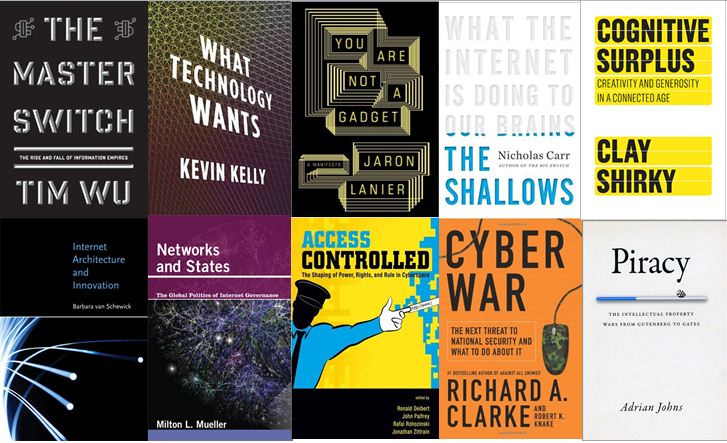
2013 is shaping up to be another big year for Internet and information technology policy books. Here’s a list of what’s coming out or already on the market.  As faithful readers know, I put together end-of-year lists of important info-tech policy books, and here are the lists for 2008, 2009, 2010, 2011 and the most recent one for 2012. And here’s my compendium of all the major tech policy books from the 2000s. So I’ll do my best to get through all these books and whatever else follows throughout the year. Consider this my public service to the Internet policy community: I read nerdy Internet policy books so that you don’t have to!

Let me know what else I may have missed and I will add it to the list.

My thanks to both Maria H. Andersen and Michael Sacasas for their thoughtful responses to my recent Forbes essay on “10 Things Our Kids Will Never Worry About Thanks to the Information Revolution.” They both go point by point through my Top 10 list and offer an alternative way of looking at each of the trends I identify. What their responses share in common is a general unease with the hyper-optimism of my Forbes piece. That’s understandable. Typically in my work on technological “optimism” and “pessimism” — and yes, I admit those labels are overly simplistic — I always try to strike a sensible balance between pollyannism and hyper-pessimism as it pertains to the impact of technological change on our culture and economy. I have called this middle ground position “pragmatic optimism.” In my Forbes essay, however, I was in full-blown pollyanna mode. That doesn’t mean I don’t generally feel very positive about the changes I itemized in that essay, rather, I just didn’t have the space in a 1,000-word column to identify the tradeoffs inherent in each trend. Thus, Andersen and Sacasas are rightfully pushing back against my lack of balance.

But there is a problem with their slightly pessimistic pushback, too. To better explain my own position and respond to Andersen and Sacasas, let me return to the story we hear again and again in discussion about technological change: the well-known allegorical tale from Plato’s Phaedrus about the dangers of the written word. In the tale, the god Theuth comes to King Thamus and boasts of how Theuth’s invention of writing would improve the wisdom and memory of the masses relative to the oral tradition of learning.  King Thamus shot back, “the discoverer of an art is not the best judge of the good or harm which will accrue to those who practice it.”  King Thamus then passed judgment himself about the impact of writing on society, saying he feared that the people “will receive a quantity of information without proper instruction, and in consequence be thought very knowledgeable when they are for the most part quite ignorant.”

After recounting Plato’s allegory in my essay, “Are You An Internet Optimist or Pessimist? The Great Debate over Technology’s Impact on Society,” I noted how this same tension has played out in every subsequent debate about the impact of a new technology on culture, values, morals, language, learning, and so on. It is a never-ending cycle. Continue reading →

Here’s the first of two essays I’ve recently penned making “The Case for Internet Optimism.” This essay was included in the book, The Next Digital Decade: Essays on the Future of the Internet (2011), which was edited by Berin Szoka and Adam Marcus of TechFreedom.  In these essays, I identify two schools of Internet pessimism: (1) “Net Skeptics,” who are pessimistic about the Internet improving the lot of mankind; and (2) “Net Lovers,” who appreciate the benefits the Net brings society but who fear those benefits are disappearing, or that the Net or openness are dying.  (Regular readers of this blog will be familiar with these themes since I sketched them out in previous essays here such as, “Are You an Internet Optimist or Pessimist?” and “Two Schools of Internet Pessimism.”) The second essay is here.

This essay focuses on the first variant of Internet pessimism, which is rooted in general skepticism about the supposed benefits of cyberspace, digital technologies, and information abundance. The proponents of this pessimistic view often wax nostalgic about some supposed “good ‘ol days” when life was much better (although they can’t seem to agree when those were). At a minimum, they want us to slow down and think twice about life in the Information Age and how it’s personally affecting each of us.  Occasionally, however, this pessimism borders on neo-Ludditism, with some proponents recommending steps to curtail what they feel is the destructive impact of the Net or digital technologies on culture or the economy.  I identify the leading exponents of this view of Internet pessimism and their major works. I trace their technological pessimism back to Plato but argue that their pessimism is largely unwarranted. Humans are more resilient than pessimists care to admit and we learn how to adapt to technological change and assimilate new tools into our lives over time. Moreover, were we really better off in the scarcity era when we were collectively suffering from information poverty?  Generally speaking, despite the challenges it presents society, information abundance is a better dilemma to be facing than information poverty.  Nonetheless, I argue, we should not underestimate or belittle the disruptive impacts associated with the Information Revolution.  But we need to find ways to better cope with turbulent change in a dynamist fashion instead of attempting to roll back the clock on progress or recapture “the good ‘ol days,” which actually weren’t all that good.

Down below, I have embedded the entire chapter in a Scribd reader, but the essay can also be found on the TechFreedom website for the book as well as on SSRN.  I have also includes two updated tables that appeared in my old “optimists vs. pessimists” essay.  The first lists some of the leading Internet optimists and pessimists and their books. The second table outlines some of the major lines of disagreement between these two camps and I divided those disagreements into (1) Cultural / Social beliefs vs. (2) Economic / Business beliefs.

Continue reading →

Wow, what a year for cyberlaw and information technology policy books!  Both in terms of number of titles and the gravity of the books released, 2010 was one of the biggest years of the past decade (perhaps matched only by 2006 or 2008 in terms of significance).  So, here’s my annual list of the Most Important Info-Tech Policy Books of 2010.

First, however, as is the case each year [see my 2008 & 2009 lists], I need to repeat a few disclaimers.  First, what qualifies as an “important” info-tech policy book is highly subjective, but I would define it as a title that many people — especially scholars in the field — are currently discussing and that we will likely be referencing for many years to come.  But I “weight” books in the sense that narrowly-focused titles lose a few points. For example, books that deal mostly with privacy issues, copyright law, or antitrust policy do not exactly qualify as the same sort of “info-tech policy book” as other titles that offer a broader exploration of policy issues / concerns. For that reason, “big picture” info-tech policy books tend to rank higher on my lists.

The second caveat: Merely because a book appears on my list it does not necessarily mean I agree with everything in it. In fact, as was the case in previous years, I found much with which to disagree in my picks for the most important books of 2010 and I find that the cyber-libertarianism I subscribe to has very few fans out there.

With those caveats in mind, here are my choices for the Most Important Info-Tech Policy Books of 2010. Continue reading →

[I am currently helping Berin Szoka edit a collection of essays from various Internet policy scholars for a new PFF book called “The Next Digital Decade: Essays about the Internet’s Future.”  I plan on including two chapters of my own in the book responding to the two distinct flavors of Internet pessimism that I increasingly find are dominating discussions about Internet policy. Below you will see how the first of these two chapters begins. I welcome input as I refine this draft. ]

Surveying the prevailing mood surrounding cyberlaw and Internet policy circa 2010, one is struck by the overwhelming sense of pessimism about our long-term prospects for a better future.   “Internet pessimism,” however, comes in two very distinct flavors:

  1. Net Skeptics, Pessimistic about the Internet Improving the Lot of Mankind: The first variant of Internet pessimism is rooted in general skepticism regarding the supposed benefits of cyberspace, digital technologies, and information abundance. The proponents of this pessimistic view often wax nostalgic about some supposed “good ‘ol days” when life was much better (although they can’t seem to agree when those were). At a minimum, they want us to slow down and think twice about life in the Information Age and how it is personally affecting each of us.  Other times, however, their pessimism borders on neo-Ludditism, with proponents recommending steps be taken to curtail what they feel is the destructive impact of the Net or digital technologies on culture or the economy. Leading proponents of this variant of Internet pessimism include:  Neil Postman (Technopoly: The Surrender of Culture to Technology), Andrew Keen, (The Cult of the Amateur: How Today’s Internet is Killing our Culture), Lee Siegel, (Against the Machine: Being Human in the Age of the Electronic Mob), Mark Helprin, (Digital Barbarism) and, to a lesser degree, Jaron Lanier (You Are Not a Gadget) and Nicholas Carr (The Big Switch and The Shallows).
  2. Net Lovers, Pessimistic about the Future of Openness: A different type of Internet pessimism is on display in the work of many leading cyberlaw scholars today.  Noted academics such as Lawrence Lessig, (Code and Other Laws of Cyberspace), Jonathan Zittrain (The Future of the Internet & How to Stop It), and Tim Wu (The Master Switch The Rise and Fall of Information Empires), embrace the Internet and digital technologies, but argue that they are “dying” due to a lack of sufficient care or collective oversight.  In particular, they fear that the “open” Internet and “generative” digital systems are giving way to closed, proprietary systems, typically run by villainous corporations out to erect walled gardens and quash our digital liberties.  Thus, they are pessimistic about the long-term survival of the wondrous Internet that we currently know and love.

Despite their different concerns, two things unite these two schools of techno-pessimism.  Continue reading →

Of the many tech policy-related books I’ve read in recent years, I can’t recall ever being quite so torn over one of them as much as I have been about Jaron Lanier‘s You Are Not a Gadget: A Manifesto.  There were moments while I was reading through it when I was thinking, “Yes, quite right!,” and other times when I was muttering to myself, “Oh God, no!”

The book is bound to evoke such strong emotions since Lanier doesn’t mix words about what he believes is the increasingly negative impact of the Internet and digital technologies on our lives, culture, and economy. In this sense, Lanier fits squarely in the pessimist camp on the Internet optimists vs. pessimists spectrum. (I outlined the intellectual battle lines between these two camps my essay, “Are You An Internet Optimist or Pessimist? The Great Debate over Technology’s Impact on Society.”) But Lanier is no techno-troglodyte. Generally speaking, his pessimism isn’t as hysterical in tone or Luddite-ish in its prescriptions as the tracts of some other pessimists.  And as a respected Internet visionary, a gifted computer scientist, an expert on virtual reality, and a master wordsmith, the concerns Lanier articulates here deserve to be taken seriously— even if one ultimately does not share his lugubrious worldview.

On the very first page of the book, Lanier hits on three interrelated concerns that other Net pessimists have articulated in the past:

  1. Loss of individuality & concerns about “mob” behavior (Lanier: “these words will mostly be read by nonpersons–automatons or numb mobs composed of people who are no longer acting as individuals.”)
  2. Dangers of anonymity (Lanier: “Reactions will repeatedly degenerate into mindless chains of anonymous insults and inarticulate controversies.”)
  3. “Sharecropper” concern that a small handful of capitalists are getting rich off the backs of free labor (Lanier: “Ultimately these words will contribute to the fortunes of those few who have been able to position themselves as lords of the computing clouds.”)

Again, others have tread this ground before, and it’s strange that Lanier doesn’t bother mentioning any of them. Neil Postman, Mark Helprin, Andrew Keen, and Lee Siegel have all railed against the online “mob mentality” and argued it can be at least partially traced to anonymous online communications and interactions. And it was Nick Carr, author of The Big Switch, who has been the most eloquent in articulating the “sharecropper” concern, which Lanier now extends with his “lords of the computing clouds” notion. [More on that towards the end.] Continue reading →

[I’ve been working on an outline for a book I hope to write surveying technological skepticism throughout history. I first started thinking about this topic two years when I noticed that a great number of recent books about Internet policy could generally be grouped into one of two camps: Internet optimists vs. Internet pessimists. I subsequently penned an essay on the subject that generated a fair bit of attention. So, I figured I must be on to something, and the more Net policy books I read, the more I realized that the divisions between these two camps were growing wider and increasingly heated. Thus, I thought I would share this very rough draft (much of it still in outline form) of the opening chapter of that book I want to write about this great intellectual war over the impact of technology on society. I invite reader input. Update Jan. 2011: I finally published a full-length essay on this topic. You can find it here. ]

__________

The impact of technological change on culture, learning, and morality has long been the subject of intense debate, and every technological revolution brings out a fresh crop of both pessimists and pollyannas. Indeed, a familiar cycle has repeat itself throughout history whenever new modes of production (from mechanized agriculture to assembly-line production), means of transportation (water, rail, road, or air), energy production processes (steam, electric, nuclear), medical breakthroughs (vaccination, surgery, cloning), or communications techniques (telegraph, telephone, radio, television) have appeared on the scene.

The cycle goes something like this. A new technology appears. Those who fear the sweeping changes brought about by this technology see a sky that is about to fall. These “techno-pessimists” predict the death of the old order (which, ironically, is often a previous generation’s hotly-debated technology that others wanted slowed or stopped).  Embracing this new technology, they fear, will result in the overthrow of traditions, beliefs, values, institutions, business models, and much else they hold sacred.

The pollyannas, by contrast, look out at the unfolding landscape and see mostly rainbows in the air. Theirs is a rose-colored world in which the technological revolution du jour is seen as improving the general lot of mankind and bringing about a better order.  If something has to give, then the old ways be damned! For such “techno-optimists,” progress means some norms and institutions must adapt—perhaps even disappear—for society to continue its march forward.

Our current Information Revolution is no different. It too has its share of techno-pessimists and techno-optimists. Indeed, before most of us had even heard of the Internet, people were already fighting about it—or at least debating what the rise of the Information Age meant for our culture, society, and economy. Continue reading →