Posts tagged as:

As FCC Commissioner Jessica Rosenworcel said of the Internet, “It is our printing press.” Unfortunately, for First Amendment purposes, regulators and courts treat our modern printing presses — electronic media — very differently from the traditional ones. Therefore, there is persistent political and activist pressure on regulators to rule that Internet intermediaries — like social networks and search engines — are not engaging in constitutionally-protected speech.

Most controversial is the idea that, as content creators and curators, Internet service providers are speakers with First Amendment rights. The FCC’s 2015 Open Internet Order designates ISPs as common carriers and generally prohibits ISPs from blocking Internet content. The agency asserts outright that ISPs “are not speakers.” These Title II rules may be struck down on procedural grounds, but the First Amendment issues pose a significant threat to the new rules.

ISPs are Speakers Courts and Congress, as explained below, have long recognized that ISPs possess editorial discretion. Extensive ISP filtering was much more common in the 1990s but still exists today. Take JNet and DNet. These ISPs block large portions of Internet content that may violate religious principles. They also block neutral services like gaming and video if the subscriber wishes. JNet offers several services, including DSL Internet access, and markets itself to religious Jews. It is server-based (not client-based) and offers several types of filters, including application-based blocking, blacklists, and whitelists. Similarly, DNet, targeted mostly to Christian families in the Carolinas, offers DSL and wireless server-based filtering of content like pornography and erotic material. A strict no-blocking rule on the “last mile” access connection, which most net neutrality proponents want enforced, would prohibit these types of services. Continue reading →

There seems to be increasing chatter among net neutrality activists lately on the subject of reclassifying ISPs as Title II services, subject to common carriage regulation. Although the intent in pushing reclassification is to make the Internet more open and free, in reality such a move could backfire badly. Activists don’t seem to have considered the effect of reclassification on international Internet politics, where it would likely give enemies of Internet openness everything they have always wanted.

At the WCIT in 2012, one of the major issues up for debate was whether the revised International Telecommunication Regulations (ITRs) would apply to Operating Agencies (OAs) or to Recognized Operating Agencies (ROAs). OA is a very broad term that covers private network operators, leased line networks, and even ham radio operators. Since “OA” would have included IP service providers, the US and other more liberal countries were very much opposed to the application of the ITRs to OAs. ROAs, on the other hand, are OAs that operate “public correspondence or broadcasting service.” That first term, “public correspondence,” is a term of art that means basically common carriage. The US government was OK with the use of ROA in the treaty because it would have essentially cabined the regulations to international telephone service, leaving the Internet free from UN interference. What actually happened was that there was a failed compromise in which ITU Member States created a new term, Authorized Operating Agency, that was arguably somewhere in the middle—the definition included the word “public” but not “public correspondence”—and the US and other countries refused to sign the treaty out of concern that it was still too broad.

If the US reclassified ISPs as Title II services, that would arguably make them ROAs for purposes at the ITU (arguably because it depends on how you read the definition of ROA and Article 6 of the ITU Constitution). This potentially opens ISPs up to regulation under the ITRs. This might not be so bad if the US were the only country in the world—after all, the US did not sign the 2012 ITRs, and it does not use the ITU’s accounting rate provisions to govern international telecom payments.

But what happens when other countries start copying the US, imposing common carriage requirements, and classifying their ISPs as ROAs? Then the story gets much worse. Countries that are signatories to the 2012 ITRs would have ITU mandates on security and spam imposed on their networks, which is to say that the UN would start essentially regulating content on the Internet. This is what Russia, Saudia Arabia, and China have always wanted. Furthermore (and perhaps more frighteningly), classification as ROAs would allow foreign ISPs to forgo commercial peering arrangements in favor of the ITU’s accounting rate system. This is what a number of African governments have always wanted. Ethiopia, for example, considered a bill (I’m not 100 percent sure it ever passed) that would send its own citizens to jail for 15 years for using VOIP, because this decreases Ethiopian international telecom revenues. Having the option of using the ITU accounting rate system would make it easier to extract revenues from international Internet use.

Whatever you think of, e.g., Comcast and Cogent’s peering dispute, applying ITU regulation to ISPs would be significantly worse in terms of keeping the Internet open. By reclassifying US ISPs as common carriers, we would open the door to exactly that. The US government has never objected to ITU regulation of ROAs, so if we ever create a norm under which ISPs are arguably ROAs, we would be essentially undoing all of the progress that we made at the WCIT in standing up for a distinction between old-school telecom and the Internet. I imagine that some net neutrality advocates will find this unfair—after all, their goal is openness, not ITU control over IP service. But this is the reality of international politics: the US would have a very hard time at the ITU arguing that regulating for neutrality and common carriage is OK, but regulating for security, content, and payment is not.

If the goal is to keep the Internet open, we must look somewhere besides Title II.

Black Code coverRonald J. Deibert is the director of The Citizen Lab at the University of Toronto’s Munk School of Global Affairs and the author of an important new book, Black Code: Inside the Battle for Cyberspace, an in-depth look at the growing insecurity of the Internet. Specifically, Deibert’s book is a meticulous examination of the “malicious threats that are growing from the inside out” and which “threaten to destroy the fragile ecosystem we have come to take for granted.” (p. 14) It is also a remarkably timely book in light of the recent revelations about NSA surveillance and how it is being facilitated with the assistance of various tech and telecom giants.

The clear and colloquial tone that Deibert employs in the text helps make arcane Internet security issues interesting and accessible. Indeed, some chapters of the book almost feel like they were pulled from the pages of techno-thriller, complete with villainous characters, unexpected plot twists, and shocking conclusions. “Cyber crime has become one of the world’s largest growth businesses,” Deibert notes (p. 144) and his chapters focus on many prominent recent examples, including cyber-crime syndicates like Koobface, government cyber-spying schemes like GhostNet, state-sanctioned sabotage like Stuxnet, and the vexing issue of zero-day exploit sales.

Deibert is uniquely qualified to narrate this tale not just because he is a gifted story-teller but also because he has had a front row seat in the unfolding play that we might refer to as “How Cyberspace Grew Less Secure.” Continue reading →

While on vacation last week, I finished up a few new cyber-policy books and one of them was  Cyber War: The Next Threat to National Security and What to Do About It by Richard A. Clarke and Robert K. Knake.  The two men certainly possess the right qualifications for a review of the subject.  Clarke was National Coordinator for Security, Infrastructure Protection, and Counterterrorism during the Clinton years and also served in the Reagan and two Bush administrations. Knake is an international affairs fellow at the Council on Foreign Relations where he specializes in cybersecurity.

Clarke and Knake’s book is important if for no other reason than, as they note, “there are few books on cyber war.” (p. 261) Thus, their treatment of the issue will likely remain the most relevant text in the field for some time to come.

They define cyber war as “actions by a nation-state to penetrate another nation’s computers or networks for the purposes of causing damage or disruption” (p. 6) and they argue that such actions are on the rise.  And they also claim that the U.S. has the most to lose if and when a major cyber war breaks out, since we are now so utterly dependent upon digital technologies and networks.

At their best, Clarke and Knake walk the reader through the mechanics of cyber war, who some of the key players and countries are who could engage in it, and identify what the costs of such of war would entail.  Other times, however, the book suffers from a somewhat hysterical tone, as the authors are out here not just to describe cyber war, but to also issue a clarion call for regulatory action to combat it.  Ryan Singel of Wired, for example, has taken issue with the book’s “doomsday scenario that stretches credulity” and claims that “Like most cyberwar pundits, Clarke puts a shine on his fear mongering by regurgitating long-ago debunked hacker horror stories.”  Bruce Schneier and Jim Harper have raised similar concerns elsewhere.

Continue reading →

By Adam Thierer & Berin Szoka

As we mentioned yesterday, in a new series of essays, we will be examining proposals being put forward today that would have the government play a greater role in sustaining struggling media enterprises, “saving journalism,” or promoting more “public interest” content. With many traditional media operators struggling, and questions being raised about how journalism in particular will be supported in the future, Washington policymakers are currently considering what role government can and should play in helping media providers reinvent themselves in the face of tumultuous technological change wrought by the Digital Revolution. We will be releasing 6 or 7 essays on this topic leading up to our big filing in the FCC’s “Future of Media” proceeding (deadline is May 7th).

In the first installment of our series, we will critique an old idea that’s suddenly gained new currency: taxing media devices or distribution systems to fund media content. We argue that such media income redistribution is fundamentally inconsistent with American press traditions, highly problematic under the First Amendment, difficult to implement in a world of media abundance and platform convergence, and likely to cause serious negative side effects.  Bottom line: Don’t tax our iPhones or broadband to subsidize media!

We’ve attached the entire text of the piece below. (Installment #2, on broadcast spectrum taxes to subsidize public media, will be released next week.)

Continue reading →

By Adam Thierer & Berin Szoka

In a series of upcoming essays, we will be examining proposals being put forward today that would have the government play a greater role in sustaining struggling media enterprises, “saving journalism,” or promoting more “public interest” content. The reason we’re working up this multi-part series is because, with many traditional media operators struggling, and questions being raised about how journalism in particular will be supported in the future, Washington policymakers are currently considering what role government can and should play in helping media providers reinvent themselves in the face of tumultuous technological change wrought by the Digital Revolution.

For example, the Federal Communications Commission (FCC) recently kicked off a new “Future of Media” effort with a workshop on “Serving the Public Interest in the Digital Era.” (The  filing deadline for the FCC’s “Future of Media” proceeding is May 7th).  Likewise, the Federal Trade Commission (FTC) has hosted two workshops asking “How Will Journalism Survive the Internet Age?”  Meanwhile, the Senate has already held hearings about “the future of journalism,” and Senator Benjamin L. Cardin (D-MD) recently introduced the “Newspaper Revitalization Act,” which would allow newspapers to become tax-exempt non-profits in an effort to help them stay afloat.

Thus, in light of Washington’s sudden interest in the future of media and journalism, we will be taking a hard look at several issues and proposals that are being floated today, including:

  • Taxes on media devices, mobile phones, or broadband bills to channel money to media enterprises / content;
  • Taxes / fees on broadcasters to funnel support to their public sector competitors or to public interest programs;
  • “News vouchers” or “public interest vouchers” that would encourage citizens to channel support to media providers;
  • Taxes on private advertising to subsidize non-commercial / public media content;
  • Expanded postal subsidies for media mail; and
  • Targeted welfare programs for out-of-work journalists or corporate welfare in the form of bailouts for failing media enterprises.

You won’t be surprised to hear that we are generally quite skeptical of most of these ideas, but we promise to give each one serious consideration.  We’ll kick things off tomorrow with our essay on why taxing media devices or distribution systems to fund media content is not a particularly good idea.

NebuAd is Dead

by on May 19, 2009 · 14 comments

NebuAd is dead. The company‘s plan to track users through their ISPs for the purpose of targeting advertising met with public and congressional concern that ultimately led to its demise.

I believe that ISPs should stick to serving bits and not get into the business of serving or helping to serve ads, so I’m glad to see NebuAd’s model fail. I’ve been made aware by a similar company – Phorm – of the privacy sensitivity they design into their system, but the answer for me is still “No, thanks.”

In terms of policy, this story is mixed. Fans of government involvement probably believe that concerns expressed by public authorities caused NebuAd’s partners to pull out. ISPs also responded to public concerns expressed directly and in the media, of course, and I believe that consumers’ passive reliance on government authorities for protection is in error.

And so begins another fight over data retention. As Declan summarizes:

Republican politicians on Thursday called for a sweeping new federal law that would require all Internet providers and operators of millions of Wi-Fi access points, even hotels, local coffee shops, and home users, to keep records about users for two years to aid police investigations. The legislation, which echoes a measure proposed by one of their Democratic colleagues three years ago, would impose unprecedented data retention requirements on a broad swath of Internet access providers and is certain to draw fire from businesses and privacy advocates. […] Two bills have been introduced so far — S.436 in the Senate and H.R.1076 in the House. Each of the companion bills is titled “Internet Stopping Adults Facilitating the Exploitation of Today’s Youth Act,” or Internet Safety Act.

Julian also has coverage over at Ars and quotes CDT’s Greg Nojeim who says the data retention language is “invasive, risky, unnecessary, and likely to be ineffective.”  I think that’s generally correct.  Moreover, I find it ironic that at a time when so many in Congress seemingly want online providers to collect and retain LESS data about users, this bill proposes that ISPs be required to collect and retain MORE data. One wonders how those two legislative priorities will be reconciled!!

Don’t get me wrong. It’s good that Congress is taking steps to address the scourge of child pornography — especially with stiffer sentences for offenders and greater resources for law enforcement officials. Extensive data retention mandates, however, would be unlikely to help much given the ease with which bad guys will likely circumvent those requirements using alternative access points or proxies.  Finally, retention mandates pose a threat to the privacy of average law-abiding citizens and impose expensive burdens of online intermediaries.

We’ve had more to say about data retention here at the TLF over the years.  Here’s a few things to read: Continue reading →

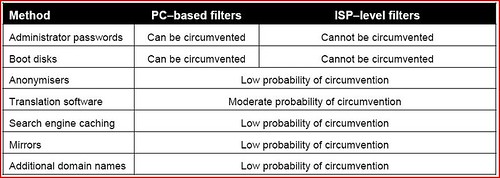
The Australian government has been running a trial of ISP-level filtering products to determine whether network-based filtering could be implemented by the government to censor certain forms of online content without a major degradation of overall network performance. The government’s report on the issue was released today: Closed-Environment Testing of ISP-Level Internet Content Filtering. It was produced by the Australian Communications & Media Authority (ACMA), which is the rough equivalent of the Federal Communications Commission here in the U.S., but with somewhat broader authority.

The Australian government has been investigating Internet filtering techniques for many years now and even gone so far to offered subsidized, government-approved PC-based filters through the Protecting Australian Families Online program. That experiment did not end well, however, as a 16-year old Australian youth cracked the filter within a half hour of its release. The Australian government next turned its attention to ISP-level filtering as a possible solution and began a test of 6 different network-based filters in Tasmania.

What makes ISP-level (network-based) filtering an attractive approach for many policymakers is that, at least in theory, it could solve the problem the Australian government faced with PC-based (client-side) filters: ISP-level filters are more difficult, if not impossible, to circumvent. That is, if you can somehow filter content and communications at the source–or within the network–then you have a much greater probability of stopping that content from getting through. Here’s a chart from the ACMA’s new report that illustrates what they see as the advantage of ISP-level filters:

ACMA 1 Continue reading →

The Register reports that Google is developing yet another suite of free tools for broadband users–this time aimed at allowing users to monitor traffic-management/shaping conducted by their ISP.

“We’re trying to develop tools, software tools…that allow people to detect what’s happening with their broadband connections, so they can let [ISPs] know that they’re not happy with what they’re getting – that they think certain services are being tampered with,” Google senior policy director Richard Whitt said this morning during a panel discussion at Santa Clara University, an hour south of San Francisco.

The article provides a short-but-interesting history of how Google’s views on Net Neutrality have evolved in recent years and about the debate inside the company as to whether to governmental prohibition of traffic management/prioritization by enshrining some conception of Net Neutrality in law.  Today, of course, the company has become perhaps the most outspoken corporate defender of Net Neutrality principles.  Google senior policy director Richard Whitt shows no sign of rethinking Google’s commitment to those principles, but suggests that the monitoring tools being developed by Google might fundamentally change the calculus of the debate:

“The forces aligned against us are real. They’ve been there for decades. Their pockets are deep. Their connections are strong with those in Washington,” he said. “Maybe we can turn this into an arms race on the application software side rather a political game.”

As Verizon’s Link Hoewing observes, these tools promise to increase dramatically the transparency of network management practices.  This increased transparency will provide a clearer picture of what ISPs are actually doing, something that is largely a subject of speculation today, while helping to remove the current uncertainty that fuels sometimes wild speculation about the “death of the Internet” and other calamities in a world without Net Neutrality.  Psychologically, transparency may thus remove much of the need for perceived need for Net Neutrality mandates.

But, of course, as defenders of traffic prioritization argue, there will be instances where ISPs “deviate from Net Neutrality principles” by prioritizing certain traffic to enable advanced voice and video services over more intelligent networks.   (Read, for example, George Ou’s post taking issue with aspects of The Register‘s story.)  Of course, some will surely point to such instances as further evidence of the perceived “need” for regulation, but the fact that these practices will be rmore readily apparent to more users than ever before will in fact provide three powerful alternative mechanisms for disciplining ISP traffic management.

Continue reading →