Son of COPA?: H.R. 4059, “The Online Age Verification and Child Safety Act”

by Adam Thierer on November 18, 2009 · Comments

Rep. Bart Stupak, (D-MI) recently introduced the ‘‘Online Age Verification and Child Safety Act’’ (H.R. 4059), which would require mandatory online age verification for “any pornographic website accessible by any computer located within the United States to display any pornographic material, including free content that may be available prior to the purchase of a subscription or product.”  The measure does not specify how such verification is to be administered, saying only that “any website or online service” must “establish and maintain a system of internal policies, procedures and controls to ensure that no such material is displayed to any user attempting to access their site without first verifying that the user is 18 years or older.”

In essence, the Stupak bill is the “Son of COPA,” or the Child Online Protection Act of 1998, a law that has been constitutionally tested and come up short during an epic, decade-long legal battle in which it was made clear that mandatory age verification is unwise, unworkable, and unconstitutional under the First Amendment.

COPA sought to make it a crime for someone to “knowingly” place materials online that were “harmful to minors.” The law provided an affirmative defense from prosecution, however, to those parties who made a “good faith” effort to “restrict[ ] access by minors to material that is harmful to minors” using credit cards or age verification schemes. COPA was immediately challenge, however, and a 10-year court battle ensued.  The law was blocked by lower courts because it was too sweeping in effect and because courts held that there were other “less restrictive means” that parents could use to deal with objectionable content — such as Internet filters.

COPA’s decade-long legal battle finally concluded in January 2009 when the U.S. Supreme Court refused to revisit the law.  COPA had already been reviewed by the Supreme Court twice before — in 2002 and 2004.  Thus, a third visit to the Supreme Court by COPA would have been something of a historical development in the world of First Amendment jurisprudence. But with the Supreme Court’s rejection of the government’s appeal in January, lower court rulings stood and COPA remained unconstitutional and unenforceable. The key recent legal battle occurred in the Third Circuit Court of Appeals, which upheld a lower court ruling striking down COPA. The Third Circuit’s full decision is here. And I penned a 3-part series on the lower court ruling by Judge Lowell Reed Jr., senior judge of the U.S. District Court for the Eastern District of Pennsylvania, here, here, and here. Also make sure to check out this summary of COPA’s legal journey that Alex Harris penned last November.

Many, many times here before I have documented my serious ongoing reservations about mandatory age verification.  [In particular, see this lengthy white paper and this event transcript for all the details.]  Moreover, as I pointed out in a recent PFF white paper (“Five Online Safety Task Forces Agree: Education, Empowerment & Self-Regulation Are the Answer“), every major online safety task force that has studied the possibility of mandatory age verification for the Internet has come to the same conclusion: It won’t work, it’s unconstitutional, and it raises serious privacy concerns. Down below the fold I have pulled some of the relevant language from the five online safety task forces that have met since 2000 and considered this issue.  Continue reading →

Comments Posted in: First Amendment, Free Speech & Online Child Safety

Transcript of 7/27 PFF Event on Child Safety, Privacy, and Free Speech

by Adam Thierer on August 18, 2009 · Comments

On July 27th, The Progress & Freedom Foundation hosted a Capitol Hill panel discussion entitled “Online Child Safety, Privacy, and Free Speech: An Overview of Challenges in Congress & the States.” The event featured remarks from:

  • Parry Aftab, Executive Director, WiredSafety.org
  • Todd Haiken, Senior Manager of Policy, Common Sense Media
  • Jim Halpert, Partner, DLA Piper
  • Berin Szoka, Senior Fellow, The Progress & Freedom Foundation

We’ve just released the transcript of the event, which I have also pasted down below the fold in a Scribd document reader. Also, the audio for this event can be heard by clicking below:

Download mp3

Here is the full event description: Continue reading →

Comments Posted in: First Amendment, Free Speech & Online Child Safety, Podcast

Five Online Safety Task Forces Have Generally Agreed

by Adam Thierer on July 9, 2009 · Comments

In an earlier post, I mentioned an important new online child safety task force report that has just been released from the “Point Smart. Click Safe.” Blue Ribbon Working Group. It’s a great report and I encourage you to read the whole thing. It was my great pleasure to serve on this task force, and as we started finalizing our conclusions and recommendations, I started thinking about how much of what we were finding and recommending was consistent with what past online safety task forces had also concluded.

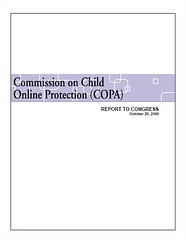
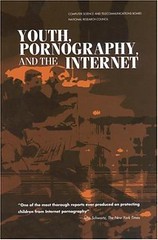
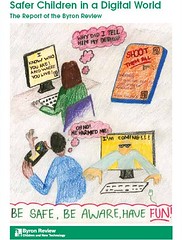
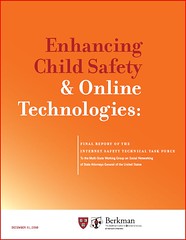
By way of background, over the past decade, five major online safety task forces or blue ribbon commissions have been convened to study online safety issues. Two of these task forces were convened in the United States and issued reports in 2000 (“COPA Commission”) and 2002 (“Thornburgh Commission“). Another was commissioned by the British government in 2007 and issued in a major report in March 2008 (“Byron Review“). Finally, two additional online safety task forces were formed in the U.S. in 2008 and concluded their work, respectively, in January (“Internet Safety Technical Task Force“) and July (“Point Smart. Click Safe.“) of 2009. [And yet another task force -- the Online Safety Technology Working Group -- was recently formed and has now gotten underway.]

In a new PFF white paper, “Five Online Safety Task Forces Agree: Education, Empowerment & Self-Regulation Are the Answer,” I walk through a chronological summary of each of these past task forces [click on covers of each report below to read them in their entirety] and highlight some of the similar themes and recommendations from them.

COPA Commission cover Thornburgh Commission cover Byron Commission report cover

ISTTF cover Point Smart Click Safe report cover
Continue reading →

Comments Posted in: First Amendment, Free Speech & Online Child Safety

COPPA 2.0: The New Battle over Privacy, Age Verification, Online Safety & Free Speech

by Berin Szoka on May 24, 2009 · Comments

Adam Thierer & I have just released a detailed examination (PDF) of brewing efforts to expand the Children’s Online Privacy Protection Act of 1998 to cover adolescents and potentially all social networking sites—an approach we call “COPPA 2.0.”

As Adam explained on Larry Magid’s CNET podcast, COPPA mandates certain online privacy protections for children under 13, most importantly that websites obtain the “verifiable consent” of a child’s parent before collecting personal information about that child or giving that child access to interactive functionality that might allow the child to share their personal information with others. The law was intended primarily to “enhance parental involvement in a child’s online activities” as a means of protecting the online privacy and safety of children.

Yet advocates of expanding COPPA—or “COPPA 2.0″—see COPPA’s verifiable parental consent framework as a means for imposing broad regulatory mandates in the name of online child safety and concerns about social networking, cyber-harassment, etc. Two COPPA 2.0 bills are currently pending in New Jersey and Illinois. The accelerated review of COPPA to be conducted by the FTC next year (five years ahead of schedule) is likely to bring to Washington serious talk of expanding COPPA—even though Congress clearly rejected covering adolescents age 13-16 when COPPA was first proposed back in 1998.

We’ll discuss some of the key points of our paper in a series of blog posts, but here are the top nine reasons for rejecting COPPA 2.0, in that such an approach would:

  • Burden the free speech rights of adults by imposing age verification mandates on many sites used by adults, thus restricting anonymous speech and essentially converging—in terms of practical consequences—with the unconstitutional Children’s Online Protection Act (COPA), another 1998 law sometimes confused with COPPA;
  • Burden the free speech rights of adolescents to speak freely on—or gather information from—legal and socially beneficial websites;
  • Hamper routine and socially beneficial communication between adolescents and adults;
  • Reduce, rather than enhance, the privacy of adolescents, parents and other adults because of the massive volume of personal information that would have to be collected about users for authentication purposes (likely including credit card data);

Continue reading →

Comments Posted in: First Amendment, Free Speech & Online Child Safety

Some Great Podcasts about Online Safety & the ISTTF

by Adam Thierer on January 27, 2009 · Comments

Just wanted draw everyone’s attention to a couple of great podcasts about online safety issues that include comments from members of the Internet Safety Technical Task Force (ISTTF). As I mentioned a few weeks ago, the ISTTF project and final report represent a major milestone in the discussion about online safety in America, and I was honored to serve as a member of this task force.

This in-depth “Radio Berkman” podcast featuring ISTTF director John Palfrey and co-director Dena Sacco is a really excellent (but lengthy!) overview of the ISTTF’s word. Here’s a shorter podcast that Prof. Palfrey did with Larry Magid of CNet. And I also recommend this excellent NPR “On the Media” podcast featuring my friend Stephen Balkam of the Family Online Safety Institute (FOSI).

For those interested, down below you will find a running list I have been keeping of coverage of the ISTTF. (I will try to keep updating this list here).

Continue reading →

Comments Posted in: First Amendment, Free Speech & Online Child Safety, Podcast

Age Verification Debate Continues; Schools Now at Center of Discussion

by Adam Thierer on September 25, 2008 · Comments

This week, I have been up at Harvard University participating in another meeting of the Internet Safety Technical Task Force (ISTTF), of which I am a member. The ISTTF was organized earlier this year pursuant to an agreement between 49 state attorneys general (AGs) and social networking giant MySpace.com. A group of experts from academia, non-profit organizations, and industry were appointed to the Task Force, which is charged with evaluating the market for online child safety tools and methods and issuing a report on the matter to the AGs at the end of this year.  ISTTF members have been meeting privately and publicly in both Cambridge, MA and Washington, D.C. The Task Force has been very ably chaired by John Palfrey, co-director of Harvard’s Berkman Center for Internet & Society.

Although the ISTTF is looking at a wide variety of tools and methods associated with online child protection (ex: filters, monitoring tools, educational campaigns, etc.), many of the AGs who crafted the agreement with MySpace that led to the Task Force’s formation have made it clear that they are most interested in having the ISTTF evaluate age verification / online verification technologies.  In fact, at the start of this week’s session at Harvard Law School, AGs Martha Coakely of Massachusetts and Richard Blumenthal of Connecticut both spoke and made it abundantly clear they expect the Task Force to develop age and identify-verification tools for social networking sites (SNS). AG Blumenthal said we need to deal with “the dangers of anonymity” and repeated his standard line about online age verification: “If we can put a man on the moon, we can make the Internet safe.”  [Of course, putting a man on the moon took hundreds of billions of dollars and a decade to accomplish, but never mind that fact! Moreover, one could also argue that if we can put a man on the moon we can cure hunger, AIDS, and the common cold, but some things are obviously easier said than done. Finally, putting a man on the moon didn't require all Americans or their kids to give up their anonymity or privacy rights in order to accomplish the feat!]

On many occasions here before, I have outlined various questions and reservations about proposals to mandate online age verification.  Last year, I also published a lengthy white paper on the issue and hosted a lively debate on Capitol Hill [transcript here] about this.  I also have discussed age verification in my book on parental controls and online child safety. [Braden Cox also talked about his experiences up at Harvard this week here, and CNet's Chris Soghoian had a brutal assessment of this week's proposals on his "Surveillance State" blog.]

In this essay, I will discuss the new fault lines in the debate over online age verification and outline where I think we are heading next on this front.  I will argue:

  • There is now widespread understanding that it is extraordinarily difficult to verify the ages and identities of minors online using the methods we typically use to verify adults. Because of this, age verification proponents are increasingly proposing two alternative models of verifying kids before they go online or visit SNS…
  • First, for those who continue to believe that we must do whatever we can to verify kids themselves, schools and school records are increasingly being viewed as the primary mechanism to facilitate that. This raises two serious questions: Do we want schools to serve as DMVs for our children? And, do we want more school records or information about our kids being accessed or put online?
  • Second, for those who are uncomfortable with the idea of verifying kids or using schools, or school records, to accomplish that task, parental permission-based forms of authentication are becoming the preferred regulatory approach. Under this scheme, which might build upon the regulatory model found in the Children’s Online Privacy Protection Act of 1998 (COPPA), parents or guardians would be verified somehow and then would vouch for their children before they were allowed on a SNS, however defined.  But how do we establish a clear link between parents and kids?  And will parents be willing to surrender a great deal more information (about themselves and their kids) before their kids can go online? And, is it sensible to use a law that was meant to protect the privacy and personal information of children to potentially gather a great deal more information about them, and their parents?
  • It remains very unclear how either of those two verification methods would make children safer online. Indeed, that could actually make kids less safe by compromising their personal information and creating a false sense of security online for them and their parents.
  • It is highly unlikely the Internet Safety Technical Task Force will be able to reach consensus on this complicated, controversial issue. A small camp will likely flock to the sort of proposals mentioned above. Another, larger camp (including me) will flock to education-based approaches to child safety as well increased reliance on other parental empowerment tools and strategies, industry self-regulatory efforts, social norms, and better intervention strategies for troubled youth. But the age verification debate will go on and, as was the case over the past two years, the legal battleground will be state capitals across America, with AGs likely pushing for age verification mandates regardless of what the Task Force concludes.

Continue reading if you are interested in the details.

Continue reading →

Comments Posted in: First Amendment, Free Speech & Online Child Safety, Privacy, Security & Government Surveillance