Posts tagged as:

It’s been a big year for tech policy books. Several important titles were released in 2008 that offer interesting perspectives about the future of the Internet and the impact digital technologies are having on our lives, culture, and economy. Back in September, I compared some of the most popular technology policy books of the past five years and tried to group them into two camps: “Internet optimists” vs. “Internet pessimists.” That post generated a great deal of discussion and I plan on expanding it into a longer article soon. In this post, however, I will merely list what I regard as the most important technology policy books of the past year. Best Tech Books of 2008 (covers)
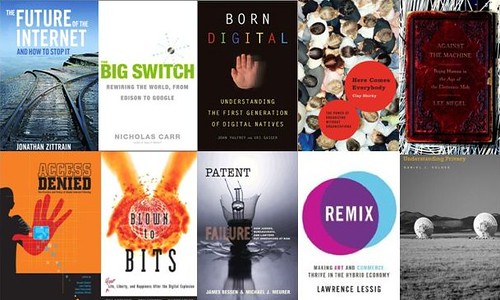
What qualifies as an “important” tech policy book? Basically, it’s a title that many people in this field are currently discussing and that we will likely be talking about for many years to come. I want to make it clear, however, that merely because a book appears on this list it does not necessarily mean I agree with everything said in it. In fact, I found much with which to disagree in my picks for the two most important books of 2008, as well as many of the other books on the list. [Moreover, after reading all these books, I am more convinced than ever that libertarians are badly losing the intellectual battle of ideas over Internet issues and digital technology policy. There’s just very few people defending a “Hands-Off-the-Net” approach anymore. But that’s a subject for another day!]

Another caveat: Narrowly focused titles lose a few points on my list. For example, as was the case in past years, a number of important IP-related books have come out this year. If a book deals exclusively with copyright or patent issues, it does not exactly qualify as the same sort of “tech policy book” as other titles found on this list since it is a narrow exploration of just one set of issues that have a bearing on digital technology policy. The same could be said of a book that deals exclusively with privacy policy, like Solove’s Understanding Privacy. It’s an important book with implications for the future of tech policy, but I demoted it a bit because of its narrow focus.

With those caveats in mind, here are my Top 10 Most Important Tech Policy Books of 2008 (and please let me know about your picks for book of the year):


Continue reading →

Over the past year, I have been monitoring a very interesting trend with important ramifications for the future of Internet policy. State Attorneys General (AGs) — often in league with the National Center for Missing and Exploited Children (NCMEC) — have been striking a variety of “voluntary” agreements with various Internet companies that deal with child safety concerns or other online issues. These agreements require the companies involved to take various steps to alter site architecture and functionality, commit to stop certain practices, or take steps to block certain users (ex: predators; escort services) or types of content (ex: child porn; online “discrimination”) altogether.

To begin, let me be very clear about one thing: Some of these activities or types of content warrant a law enforcement response. That is certainly the case with child pornography or predation, for example. However, as I will note down below, there is a legitimate question about whether state officials and a non-profit private organization should be crafting legal or regulatory policies to address such concerns for a global medium like the Internet. Regardless, these agreements are creating a new layer of Internet regulation (almost extra-legal in character) that is worthy of exploration.

First, let me itemize some of these recent “voluntary” agreements between Internet companies and the AGs and/or NCMEC:

Continue reading →

Blown to Bits coverI’ve just finished reading Blown to Bits: Your Life, Liberty, and Happiness After the Digital Explosion, by Hal Abelson, Ken Ledeen, and Harry Lewis, and it’s another title worth adding to your tech policy reading list. The authors survey a broad swath of tech policy territory — privacy, search, encryption, free speech, copyright, spectrum policy — and provide the reader with a wonderful history and technology primer on each topic.

I like the approach and tone they use throughout the book. It is certainly something more than “Internet Policy for Dummies.” It’s more like “Internet Policy for the Educated Layman”: a nice mix of background, policy, and advice. I think Ray Lodato’s Slashdot review gets it generally right in noting that, “Each chapter will alternatively interest you and leave you appalled (and perhaps a little frightened). You will be given the insight to protect yourself a little better, and it provides background for intelligent discussions about the legalities that impact our use of technology.”

Abelson, Ledeen, and Lewis aren’t really seeking to be polemical in this book by advancing a single thesis or worldview. To the extent the book’s chapters are guided by any central theme, it comes in the form of the “two basic morals about technology” they outline in Chapter 1:

The first is that information technology is inherently neither good nor bad — it can be used for good or ill, to free us or to shackle us. Second, new technology brings social change, and change comes with both risks and opportunities. All of us, and all of our public agencies and private institutions, have a say in whether technology will be used for good or ill and whether we will fall prey to its risks or prosper from the opportunities it creates. (p. 14)

Mostly, what they aim to show is that digital technology is reshaping society and, whether we like or it not, we better get used to it — and quick!  “The digital explosion is changing the world as much as printing once did — and some of the changes are catching us unaware, blowing to bits our assumptions about the way the world works… The explosion, and the social disruption that it will create, have barely begun.” (p 3)

In that sense, most chapters discuss how technology and technological change can be both a blessing and a curse, but the authors are generally more optimistic than pessimistic about the impact of the Net and digital technology on our society. What follows is a quick summary of some of the major issues covered in Blown to Bits.

Continue reading →