Wow, what a year for cyberlaw and information technology policy books! Both in terms of number of titles and the gravity of the books released, 2010 was one of the biggest years of the past decade (perhaps matched only by 2006 or 2008 in terms of significance). So, here’s my annual list of the Most Important Info-Tech Policy Books of 2010.
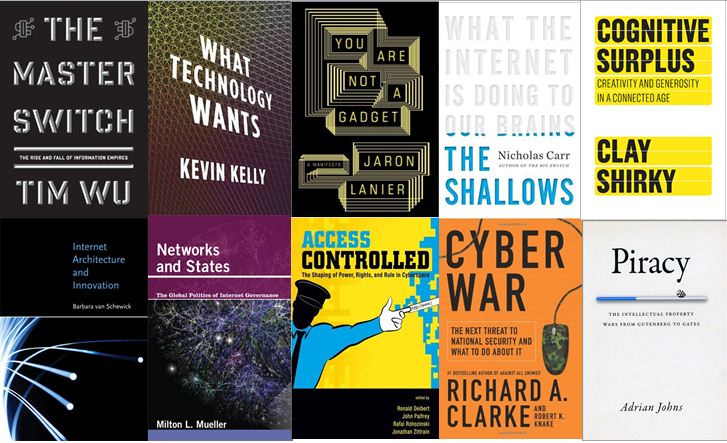 First, however, as is the case each year [see my 2008 & 2009 lists], I need to repeat a few disclaimers. First, what qualifies as an “important” info-tech policy book is highly subjective, but I would define it as a title that many people — especially scholars in the field — are currently discussing and that we will likely be referencing for many years to come. But I “weight” books in the sense that narrowly-focused titles lose a few points. For example, books that deal mostly with privacy issues, copyright law, or antitrust policy do not exactly qualify as the same sort of “info-tech policy book” as other titles that offer a broader exploration of policy issues / concerns. For that reason, “big picture” info-tech policy books tend to rank higher on my lists.
The second caveat: Merely because a book appears on my list
it does not necessarily mean I agree with everything in it. In fact, as was the case in previous years, I found much with which to disagree in my picks for the most important books of 2010 and I find that the cyber-libertarianism I subscribe to has very few fans out there.
With those caveats in mind, here are my choices for the Most Important Info-Tech Policy Books of 2010. Continue reading →
[I am currently helping Berin Szoka edit a collection of essays from various Internet policy scholars for a new PFF book called “The Next Digital Decade: Essays about the Internet’s Future.” I plan on including two chapters of my own in the book responding to the two distinct flavors of Internet pessimism that I increasingly find are dominating discussions about Internet policy. Below you will see how the first of these two chapters begins. I welcome input as I refine this draft. ]
Surveying the prevailing mood surrounding cyberlaw and Internet policy circa 2010, one is struck by the overwhelming sense of pessimism about our long-term prospects for a better future. “Internet pessimism,” however, comes in two very distinct flavors:
- Net Skeptics, Pessimistic about the Internet Improving the Lot of Mankind: The first variant of Internet pessimism is rooted in general skepticism regarding the supposed benefits of cyberspace, digital technologies, and information abundance. The proponents of this pessimistic view often wax nostalgic about some supposed “good ‘ol days” when life was much better (although they can’t seem to agree when those were). At a minimum, they want us to slow down and think twice about life in the Information Age and how it is personally affecting each of us. Other times, however, their pessimism borders on neo-Ludditism, with proponents recommending steps be taken to curtail what they feel is the destructive impact of the Net or digital technologies on culture or the economy. Leading proponents of this variant of Internet pessimism include: Neil Postman (Technopoly: The Surrender of Culture to Technology), Andrew Keen, (The Cult of the Amateur: How Today’s Internet is Killing our Culture), Lee Siegel, (Against the Machine: Being Human in the Age of the Electronic Mob), Mark Helprin, (Digital Barbarism) and, to a lesser degree, Jaron Lanier (You Are Not a Gadget) and Nicholas Carr (The Big Switch and The Shallows).
- Net Lovers, Pessimistic about the Future of Openness: A different type of Internet pessimism is on display in the work of many leading cyberlaw scholars today. Noted academics such as Lawrence Lessig, (Code and Other Laws of Cyberspace), Jonathan Zittrain (The Future of the Internet & How to Stop It), and Tim Wu (The Master Switch The Rise and Fall of Information Empires), embrace the Internet and digital technologies, but argue that they are “dying” due to a lack of sufficient care or collective oversight. In particular, they fear that the “open” Internet and “generative” digital systems are giving way to closed, proprietary systems, typically run by villainous corporations out to erect walled gardens and quash our digital liberties. Thus, they are pessimistic about the long-term survival of the wondrous Internet that we currently know and love.
Despite their different concerns, two things unite these two schools of techno-pessimism. Continue reading →
What distinguishes pragmatic Internet optimists from their starry-eyed, pollyanna-ish optimist kin is the ability to recognize the real problems raised by technology. More than anything else, that means being able to appreciate great satire on the downsides of the Digital Revolution. Robert Lanham, author of The Hipster Handbook and other satirical classics, offers the definitive guide to the “post-print world” in his “Internet-Age Writing Syllabus & Course Overview” for the fictitious college course, “ENG 371WR: Writing for Nonreaders in the Postprint Era.” If only the arch-pessimist Andrew Keen were half so funny!
As print takes its place alongside smoke signals, cuneiform, and hollering, there has emerged a new literary age, one in which writers no longer need to feel encumbered by the paper cuts, reading, and excessive use of words traditionally associated with the writing trade. Writing for Nonreaders in the Postprint Era focuses on the creation of short-form prose that is not intended to be reproduced on pulp fibers.
Instant messaging. Twittering. Facebook updates. These 21st-century literary genres are defining a new ”
LostGeneration” of minimalists who would much rather watchLost on their iPhones than toil over long-winded articles and short stories. Students will acquire the tools needed to make their tweets glimmer with a complete lack of forethought, their Facebook updates ring with self-importance, and their blog entries shimmer with literary pithiness. All without the restraints of writing in complete sentences. w00t! w00t! Throughout the course, a further paring down of the Hemingway/Stein school of minimalism will be emphasized, limiting the superfluous use of nouns, verbs, adverbs, adjectives, conjunctions, gerunds, and other literary pitfalls.
My favorite part,
Week 8: New Rules:
Students will analyze the publishing industry and learn how to be more innovative than the bards of yesteryear. They’ll be asked to consider, for instance, Thomas Pynchon. How much more successful would Gravity’s Rainbow have been if it were two paragraphs long and posted on a blog beneath a picture of scantily clad coeds? And why not add a Google search box? Or what if Susan Sontag had friended 10 million people on Facebook and then published a shorter version of The Volcano Lover as a status update: “Susan thinks a volcano is a great metaphor for primal passion. Also, streak of my hair turning white—d’oh!“
Now, as it happens, I think Strunk & White, authors of the 1918 classic
The Elements of Style, would probably have appreciated Twitter’s 140 character limit (and blogging more generally) for ruthlessly, if over-zealously, enforcing their core rule for good writing: Continue reading →
A few months ago, I penned a mega book review about the growing divide between “Internet optimists and pessimists.” I noted that the Internet optimists — people like Chris Anderson, Clay Shirky, Yochai Benkler, Kevin Kelly, and others — believe that the Internet is generally improving our culture, economy, and society for the better. They believe the Net has empowered and liberated the masses, sparked unparalleled human creativity and communication, provided greater personalization and customization of media content, and created greater diversity of thought and a more deliberative democracy. By contrast, the Internet pessimists — including Nick Carr, Andrew Keen, Lee Siegel, and others — argue that the Internet is destroying popular culture and professional media, calling “truth” and “authority” into question by over-glamorizing amateurism and user-generated content, and that increased personalization is damaging deliberative democracy by leading to homogenization, close-mindedness, and an online echo-chamber. Needless to say, it’s a very heated debate!
I am currently working on a greatly expanded version of my “Net optimists vs. pessimists” essay for a magazine in which I will draw out more of these distinctions and weigh the arguments made by those in both camps. I plan on concluding that article by arguing that the optimists generally have the better of the argument, but that the pessimists make some fair points about the downsides of the Net’s radically disintermediating role on culture and economy.
So, this got me thinking that I needed to come up with some sort of a label for my middle-of-the-road position as well as a statement of my personal beliefs. As far as labels go, I guess I would call myself a “pragmatic optimist” since I generally side with the optimists in most of these debates, but not without some occasional reservations. Specifically, I don’t always subscribe to the Pollyanna-ish, rose-colored view of the world that some optimists seem to adopt. But the outright Chicken Little-like Ludditism of some Internet pessimists is even more over-the-top at times. Anyway, what follows is my “Pragmatic (Internet) Optimist’s Creed” which better explains my views. (Again, read my old essay first for some context about the relevant battle lines in this intellectual war).
Continue reading →

 The Technology Liberation Front is the tech policy blog dedicated to keeping politicians' hands off the 'net and everything else related to technology.