I have been covering telecom and Internet policy for almost 30 years now. During much of that time – which included a nine year stint at the Heritage Foundation — I have interacted with conservatives on various policy issues and often worked very closely with them to advance certain reforms.
If I divided my time in Tech Policy Land into two big chunks of time, I’d say the biggest tech-related policy issue for conservatives during the first 15 years I was in the business (roughly 1990 – 2005) was preventing the resurrection of the so-called Fairness Doctrine. And the biggest issue during the second 15-year period (roughly 2005 – present) was stopping the imposition of “Net neutrality” mandates on the Internet. In both cases, conservatives vociferously blasted the notion that unelected government bureaucrats should sit in judgment of what constituted “fairness” in media or “neutrality” online.
Many conservatives are suddenly changing their tune, however. President Trump and Sen. Ted Cruz, for example, have been increasingly critical of both traditional media and new tech companies in various public statements and suggested an openness to increased regulation. The President has gone after old and new media outlets alike, while Sen. Cruz (along with others like Sen. Lindsay Graham) has suggested during congressional hearings that increased oversight of social media platforms is needed, including potential antitrust action.
Meanwhile, during his short time in office, Sen. Josh Hawley (R-Mo.) has become one of the most vocal Internet critics on the Right. In a shockingly-worded USA Today editorial in late May, Hawley said, “social media wastes our time and resources” and is “a field of little productive value” that have only “given us an addiction economy.” He even referred to these sites as “parasites” and blamed them for a long list of social problems, leading him to suggest that, “we’d be better off if Facebook disappeared” along with various other sites and services.
Hawley’s moral panic over social media has now bubbled over into a regulatory crusade that would unleash federal bureaucrats on the Internet in an attempt to dictate “fair” speech on the Internet. He has introduced an astonishing piece of legislation aimed at undoing the liability protections that Internet providers rely upon to provide open platforms for speech and commerce. If Hawley’s absurdly misnamed new “Ending Support for Internet Censorship Act” is implemented, it would essentially combine the core elements of the Fairness Doctrine and Net Neutrality to create a massive new regulatory regime for the Internet. Continue reading →
 The Internet’s greatest blessing — its general openness to all speech and speakers — is also sometimes its biggest curse. That is, you cannot expect to have the most widely accessible, unrestricted communications platform the world has ever known and not also have some imbeciles who use it to spew insulting, vile, and hateful comments.
It is important to put things in perspective, however. Hate speech is not the norm online. The louts who spew hatred represent a small minority of all online speakers. The vast majority of online speech is of a socially acceptable — even beneficial — nature.
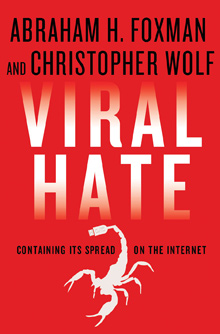
Still, the problem of hate speech remains very real and a diverse array of strategies are needed to deal with it. The sensible path forward in this regard is charted by Abraham H. Foxman and Christopher Wolf in their new book, Viral Hate: Containing Its Spread on the Internet. Their book explains why the best approach to online hate is a combination of education, digital literacy, user empowerment, industry best practices and self-regulation, increased watchdog / press oversight, social pressure and, most importantly, counter-speech. Foxman and Wolf also explain why — no matter how well-intentioned — legal solutions aimed at eradicating online hate will not work and would raise serious unintended consequences if imposed.
In striking this sensible balance, Foxman and Wolf have penned the definitive book on how to constructively combat viral hate in an age of ubiquitous information flows. Continue reading →
This week I will be attending two terrific conferences on Sec. 230 and Internet intermediary liability issues. On Thursday, the Stanford Technology Law Review hosts an all-day event on “Secondary and Intermediary Liability on the Internet” at the Stanford Law School. It includes 3 major panels on intermediary liability as it pertains to copyright, trademark, and privacy. On Friday, the amazing Eric Goldman and his colleagues at the Santa Clara Law School’s High Tech Law Institute host an all-star event on “47 U.S.C. § 230: a 15 Year Retrospective.” Berin Szoka and Jim Harper will also be attending both events (Harper is speaking at Stanford event) and Larry Downes will be at the Santa Clara event. So if you also plan to attend, come say ‘Hi’ to us. We don’t bite! (We have, however, been known to snarl.)
In the meantime, down below, I just thought I would post a few links to the many things we have said about Section 230 and online intermediary liability issues here on the TLF in the past as well as this graphic depicting some of the emerging threats to Sec. 230 from various proposals to “deputize the online middleman.” As we’ve noted here many times before, Sec. 230 is the “cornerstone of Internet freedom” that has allowed a “utopia of utopias” to develop online. It would be a shame if lawmakers rolled back its protections and opted for an onerous new legal/regulatory approach to handling online concerns. Generally speaking, education and empowerment should trump regulation and punishing liability.
Deputization of the Middleman http://d1.scribdassets.com/ScribdViewer.swf
Continue reading →
By Adam Thierer & Berin Szoka
Short but very important essay here from Santa Clara University Law School Prof. Eric Goldman about calls to alter Sec. 230 of the Communications Decency Act (CDA) to address concerns about online harassment. Generally speaking, Sec. 230 immunizes online intermediaries from punishing liability for the content that travels over their networks / services. Specifically, Sec. 230 stipulates that “No provider or user of an interactive computer service shall be treated as the publisher or speaker of any information provided by another information content provider.” In other words: Don’t shoot the messenger!
As we’ve noted here before, it is probably not an overstatement to think of Sec. 230 as the very cornerstone of Internet Freedom, since it makes possible an online “utopia for utopias,” to borrow a phrase from our favorite modern political philosopher, the late Robert Nozick. Without Sec. 230, intermediaries would likely be forced to shut down many avenues of communication and would have to become deputized conduct and morality police for every cyber-street corner.
Goldman, America’s leading expert on Sec. 230-related jurisprudence, correctly notes that, “Frequently, § 230’s critics do not attack the immunization generally, but instead advocate a new limited exception for their pet concern.” He’s got that right. Indeed, we are increasingly hearing calls from numerous quarters these days to “tweak 230” for one pet concern after another. We’ve illustrated some of those concerns in this exhibit.
Deputization of the Middleman http://d1.scribdassets.com/ScribdViewer.swf
Regulatory advocates can be found for each of these issues who like to see the protections afforded by Sec. 230 scaled back by Congress or he courts. But Goldman rightly warns:
Continue reading →
 by Adam Thierer & Berin Szoka — (Ver. 1.0 — Summer 2009)
We are attempting to articulate the core principles of cyber-libertarianism to provide the public and policymakers with a better understanding of this alternative vision for ordering the affairs of cyberspace. We invite comments and suggestions regarding how we should refine and build-out this outline. We hope this outline serves as the foundation of a book we eventually want to pen defending what we regard as “Real Internet Freedom.” [Note: Here’s a printer-friendly version, which we also have embedded down below as a Scribd document.]
I. What is Cyber-Libertarianism?
Cyber-libertarianism refers to the belief that individuals—acting in whatever capacity they choose (as citizens, consumers, companies, or collectives)—should be at liberty to pursue their own tastes and interests online.
Generally speaking, the cyber-libertarian’s motto is “Live & Let Live” and “Hands Off the Internet!” The cyber-libertarian aims to minimize the scope of state coercion in solving social and economic problems and looks instead to voluntary solutions and mutual consent-based arrangements.
Cyber-libertarians believe true “Internet freedom” is freedom
from state action; not freedom for the State to reorder our affairs to supposedly make certain people or groups better off or to improve some amorphous “public interest”—an all-to convenient facade behind which unaccountable elites can impose their will on the rest of us.
Continue reading →
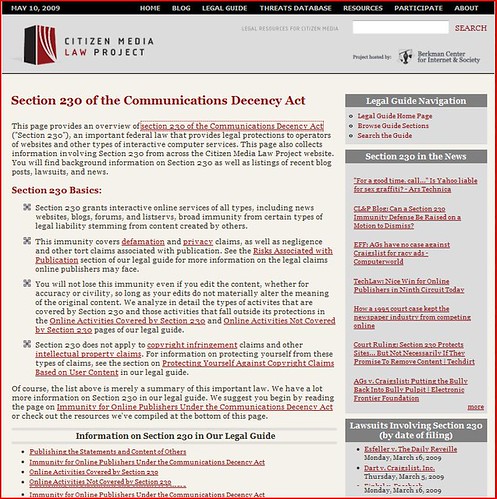
If you’re a cyberlaw geek or tech policy wonk who needs to keep close tabs on Sec. 230 developments, here’s a terrific resource from the Citizen Media Law Project up at the Harvard Berkman Center. The site offers a wealth of background info, including legislative history, all the relevant case law surrounding 230, and breaking news on this front. Just a phenomenal resource; a big THANK YOU! to the folks at CMLP who put this together.
If you’re interested in these issues, you might also want to check out this friendly debate that Harvard’s John Palfrey and I engaged in over at Ars recently as well as my essay on how Sec. 230 has spawned a “utopia of utopias” online.
 The Progress & Freedom Foundation has just launched the new Center for Internet Freedom. CIF offers an alternative to the proliferation of advocacy groups calling for government intervention online by offering timely analyses and critiques of proposals that diminish the vital role of free markets, free speech and property rights. We aim to drive the Internet policy debate in new directions by emphasizing a layered approach of technological innovation, user education, user self-help, industry self-regulation, and the enforcement of existing laws consistent with the First Amendment. Such an approach is a less restrictive—and generally more effective—alternative to increased regulation.
Here are some of the issues I’ll be working on as CIF’s Director in conjunction with my esteemed colleagues Adam Thierer, Adam Marcus, and adjunct fellows:
- Defending online advertising as the lifeblood of online content & services, especially in the “Long Tail”;
- Emphasizing market solutions to problems of privacy protection, especially regarding the use of cookies and packet inspection data;
- Protecting online speech and expression both in the U.S. and abroad;
- Defending Section 230 immunity for Internet intermediaries;
- Opposing online taxation and legal barriers to e-commerce and digital payments, especially at the state and local levels; and
- Ensuring that Internet governance remains transparent and accountable without hampering the evolution of the Internet.
Anyone interested in the long-running debate over how to balance online privacy with anonymity and free speech, whether Section 230‘s broad immunity for Internet intermediaries should be revised, and whether we need new privacy legislation must read the important and enthralling NYT Magazine piece “The Trolls Among Us” by Mattathias Schwartz about the very real problem of Internet “trolls“–a term dating to the 1980s and defined as “someone who intentionally disrupts online communities.”
While all trolls “do it for the lulz” (“for kicks” in Web-speak) they range from the merely puckish to the truly “malwebolent.” For some, trolling is essentially senseless web-harassment or “violence” (e.g., griefers), while for others it is intended to make a narrow point or even as part of a broader movement. These purposeful trolls might be thought of as the Yippies of the Internet, whose generally harmless anti-war counter-cutural antics in the late 1960s were the subject of the star-crossed Vice President Spiro T. Agnew‘s witticism:
And if the hippies and the yippies and the disrupters of the systems that Washington and Lincoln as presidents brought forth in this country will shut up and work within our free system of government, I will lower my voice.
But the more extreme of these “disrupters of systems” might also be compared to the plainly terroristic Weathermen or even the more familiar Al-Qaeda. While Schwartz himself does not explicitly draw such comparisons, the scenario he paints of human cruelty is truly nightmarish: After reading his article before heading to bed last night, I myself had Kafka-esque dreams about complete strangers invading my own privacy for no intelligible reason. So I can certainly appreciate how terrifying Schwartz’s story will be to many readers, especially those less familiar with the Internet or simply less comfortable with the increasing readiness of so many younger Internet users to broadcast their lives online.
But Schwartz leaves unanswered two important questions. The first question he does not ask:
Just how widespread is trolling? However real and tragic for its victims, without having some sense of the scale of the problem, it is difficult to answer the second question Schwartz raises but, wisely, does not presume to answer: What should be done about it? The policy implications of Schwartz’s article might be summed up as follows: Do we need new laws or should we focus on some combination of enforcing existing laws, user education and technological solutions? While Schwartz focuses on trolling, the same questions can be asked about other forms of malwebolence–best exemplified by the high-profile online defamation Autoadmit.com case, which demonstrates the effectiveness of existing legal tools to deal with such problems.
Continue reading →

 The Technology Liberation Front is the tech policy blog dedicated to keeping politicians' hands off the 'net and everything else related to technology.