The Mercatus Center at George Mason University has just released a new paper on,”Permissionless Innovation and Immersive Technology: Public Policy for Virtual and Augmented Reality,” which I co-authored with Jonathan Camp. This 53-page paper can be downloaded via the Mercatus website, SSRN or Research Gate.
Here is the abstract for the paper:
Immersive technologies such as augmented reality, virtual reality, and mixed reality are finally taking off. As these technologies become more widespread, concerns will likely develop about their disruptive social and economic effects. This paper addresses such policy concerns and contrasts two different visions for governing immersive tech going forward. The paper makes the case for permissionless innovation, or the general freedom to innovate without prior constraint, as the optimal policy default to maximize the benefits associated with immersive technologies.
The alternative vision — the so-called precautionary principle — would be an inappropriate policy default because it would greatly limit the potential for beneficial applications and uses of these new technologies to emerge rapidly. Public policy for immersive technology should not be based on hypothetical worst-case scenarios. Rather, policymakers should wait to see which concerns or harms emerge and then devise ex post solutions as needed.
To better explain why precautionary controls on these emerging technologies would be such a mistake, Camp and I provide an inventory of the many VR, AR, and mixed reality applications that are already on the market–or soon could be–and which could provide society with profound benefits. A few examples include: Continue reading →
“First electricity, now telephones. Sometimes I feel as if I were living in an H.G. Wells novel.” –Dowager Countess, Downton Abbey
Every technology we take for granted was once new, different, disruptive, and often ridiculed and resisted as a result. Electricity, telephones, trains, and television all caused widespread fears once in the way robots, artificial intelligence, and the internet of things do today. Typically it is realized by most that these fears are misplaced and overly pessimistic, the technology gets diffused and we can barely remember our life without it. But in the recent technopanics, there has been a concern that the legal system is not properly equipped to handle the possible harms or concerns from these new technologies. As a result, there are often calls to regulate or rein in their use.
In the late 1980s, video cassette recorders (VCRs) caused a legal technopanic. The concerns were less that VCRs would lead to some bizarre human mutation as in many technopanics, but rather that the existing system of copyright infringement and vicarious liability could not adequately address the potential harm to the motion picture industry. The then president of the Motion Picture Association of America Jack Valenti famously told Congress, “I say to you that the VCR is to the American film producer and the American public as the Boston Strangler is to the woman home alone.”
Continue reading →
I’m pleased to announce the publication of my latest law review article, “Guns, Limbs, and Toys: What Future for 3D Printing?” The article, which appears in Vol. 17 of the Minnesota Journal of Law, Science & Technology, was co-authored with Adam Marcus. Here’s the abstract:
We stand on the cusp of the next great industrial revolution thanks to technological innovations and developments that could significantly enhance the welfare of people across the world. This article will focus on how one of those modern inventions–3D printing–could offer the public significant benefits, but not without some serious economic, social, and legal disruptions along the way. We begin by explaining what 3D printing is and how it works. We also discuss specific applications of this technology and its potential benefits. We then turn to the policy frameworks that could govern 3D printing technologies and itemize a few of the major public policy issues that are either already being discussed, or which could become pertinent in the future. We offer some general guidance for policymakers who might be pondering the governance of 3D printing technologies going forward. Contra to the many other articles and position papers that have already been penned about 3D printing policy, which only selectively defend permissionless innovation in narrow circumstances, we endorse it as the default rule across all categories of 3D printing applications.
More specifically, we do a deep dive into 3 primary public policy “fault lines” for 3D printing: firearms, medical devices, and intellectual property concerns. Read the whole thing for more details.
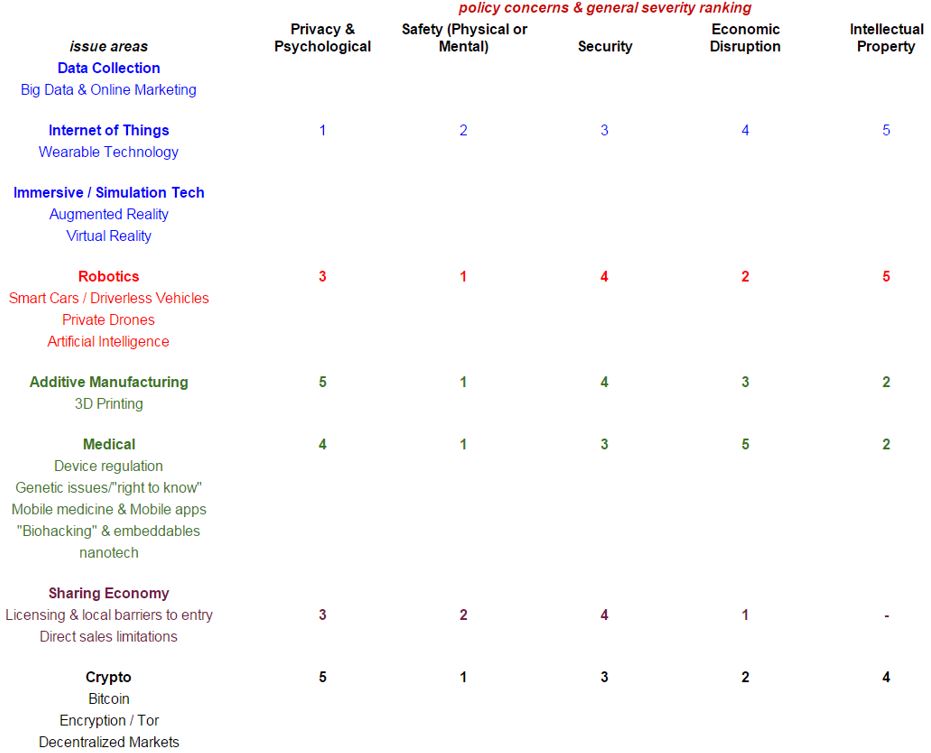
On the whiteboard that hangs in my office, I have a giant matrix of technology policy issues and the various policy “threat vectors” that might end up driving regulation of particular technologies or sectors. Along with my colleagues at the Mercatus Center’s Technology Policy Program, we constantly revise this list of policy priorities and simultaneously make an (obviously quite subjective) attempt to put some weights on the potential policy severity associated with each threat of intervention. The matrix looks like this: [Sorry about the small fonts. You can click on the image to make it easier to see.]
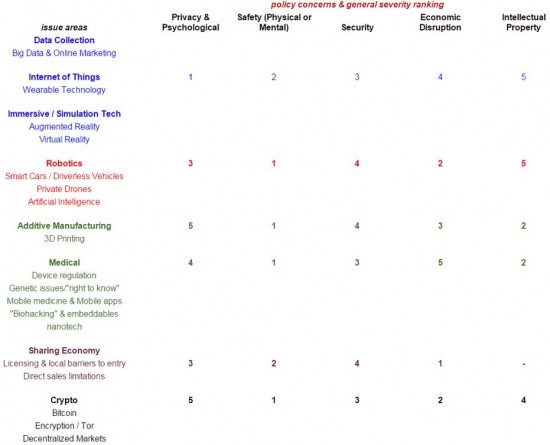
I use 5 general policy concerns when considering the likelihood of regulatory intervention in any given area. Those policy concerns are:
- privacy (reputation issues, fear of “profiling” & “discrimination,” amorphous psychological / cognitive harms);
- safety (health & physical safety or, alternatively, child safety and speech / cultural concerns);
- security (hacking, cybersecurity, law enforcement issues);
- economic disruption (automation, job dislocation, sectoral disruptions); and,
- intellectual property (copyright and patent issues).
Continue reading →
I’m pleased to announce that Alex Tabarrok and I have a new working paper out from the Mercatus Center today, “Public Choice and Bloomington School Perspectives on Intellectual Property.” The paper will appear in Public Choice in 2014.
Here’s the abstract:
We mine two underexplored traditions for insights into intellectual property: the public choice or Virginia school, centered on James Buchanan and Gordon Tullock, and the Bloomington or Institutional Analysis and Development school, centered on Elinor Ostrom and Vincent Ostrom. We apply the perspectives of each school to issues of intellectual property and develop new insights, questions, and focuses of attention. We also explore tensions and synergies between the two schools on issues of intellectual property.
The gist of the paper is that the standard case for intellectual property—that a temporary monopoly is needed in order to recoup the sunk costs of innovation or creation—ignores issues raised by the two schools we investigate.
From a public choice perspective, a temporary monopoly provides enormous opportunities for rent seeking. Copyright and patent owners are constantly manipulating the political environment to expand either the duration of the monopoly or the scope of what can be monopolized. We document the evolution of intellectual property in the United States from its modest origins to its current strong and expansive state.
From a Bloomington perspective, the standard case for IP wrongly treats the commons as a kind of wasteland. In fact, numerous innovations and sprawling creative works occur without monopolization—just look at Wikipedia. Innovation occurs when the right institutional structures are in place, and intellectual property that is too severe can hamper the smooth operation of these institutions. Too much IP can harm as much as too little.
Read the whole thing, cite it copiously, etc.
The Hill is reporting that Rep. Goodlatte, under pressure from “companies like Microsoft, IBM and Apple,” is planning to drop the provision in his patent reform bill that expands the Covered Business Method (CBM) program. Mike Masnick also has commentary.
Julie Samuels explains CBM review:
The “Covered Business Method Review” (CBM) was first introduced in 2011’s America Invents Act. It created, for a limited time, an additional avenue of patent review at the Patent Office. Unfortunately, as drafted, it really was only intended to apply to patents that deal with financial institutions.
CBM is a good program. First, we have long favored the use of Patent Office procedure to challenge patents; it is much cheaper and much quicker than going to court. Second, it allows for more ways to challenge patents than other types of Patent Office review—making it a more robust procedure that promises to knock out more improvidently granted patents. Third, it automatically puts concurrent patent litigation between the parties on hold.
Putting ongoing litigation on hold is no small thing. Patent litigation often costs each side well into the millions of dollars, while CBMs cost just a fraction of that. This means that more people will be in a position to challenge bad patents and fight back against the trolls who wield those patents.
The original Goodlatte bill would have expanded CBM review to patents beyond the financial sector.
From a public choice perspective, it is unsurprising that finance would have better patent law than the rest of the economy: finance is a concentrated industry that can go up politically against and offset another concentrated industry, the patent bar. But non-finance covered business method patents are asserted against all kinds of companies, for practices as banal as retrieving data from a database (not joking: “A method of retrieving information from a database record having plural fields“) or selling things online (“An apparatus to market and/or sell goods and/or services over an electronic network“). The fact that the victims of these patent assertions are dispersed throughout the economy means that they are not organized enough to effectively oppose the patent interests that are lobbying against the CBM program expansion.
Still, it is very disappointing that Rep. Goodlatte is caving to such lobbying. I already thought that his bill did not go far enough; now it goes even less far.
The new discussion draft from Rep. Goodlatte is now circulating publicly. Here is a good summary from the EFF of what the legislation would do:
- Heightened Pleading: Requiring a patent holder to provide basic details (such as which patents and claims are at issue, as well as exactly what products allegedly infringe and how) when it files a lawsuit.
- Fee shifting: Requiring the loser in a patent case to pay attorney’s fees and costs. This would make it harder for trolls to use the extraordinary expense of patent litigation to force a settlement.
- Transparency: The draft includes strong language requiring patent trolls to reveal the parties that would actually benefit from the litigation (called the real party in interest).
- Joinder: If the plaintiff is a shell-company patent troll, the defendant could require the real party in interest to join the litigation. Even better, a prevailing defendant could collect attorney’s fees from the real party in interest if the patent troll can’t or won’t pay.
- Staying customer suits: Requiring courts to stay patent litigation against customers when there is parallel litigation against the manufacturer.
- Discovery reform: Shutting down expensive and often harassing discovery until the court has interpreted the patent. This should make it easier for defendants to dispose of frivolous cases early before the legal fees and court costs really add up.
- Post-grant review: The bill expands an important avenue to challenge a patent’s validity at the Patent Office (known as the transitional program for covered business method patents). While this procedure is still too expensive for many of the trolls’ smaller targets, we support efforts to make it easier to knock out bad patents.
These are excellent steps forward in the fight against patent trolls, but I’m still hoping for more. The explosion in patent litigation, both troll and non-troll, is due to the astonishing increase in the number of software patents. Software patents now make up over half of all patents! Software patents are more likely to be litigated than other kinds of patents, including four times more likely than a chemical patent.
Given the extent to which the problems with our patent system are caused by software patents, it is unfortunate that none of the patent reform bills under consideration in this Congress contemplate simply excluding software from the set of patentable subject matter. By all means, slay the trolls. But also go after the source of their power.
Today, the Obama administration announced 5 executive actions it is taking and 7 legislative proposals it is making to address the problem of patent trolls. While these are incremental steps in the right direction, they are still pretty weak sauce. The reforms could alleviate some of the litigation pressure on Silicon Valley firms, but there’s a long way to go if we want to have a patent system that maximized innovation.
The proposals aim to reduce anonymity in patent litigation, improve review at the USPTO, give more protection to downstream users, and improve standards at the International Trade Commission, a venue which has been gamed by patent plaintiffs. These are all steps worth taking. But they’re not enough. The White House’s press release quotes the president as saying that “our efforts at patent reform [i.e. the America Invents Act, passed in 2011] only went about halfway to where we need to go.” Presumably the White House believes these steps will take us the rest of the way there.
But the problem with computer-enabled patents isn’t merely that they result in a lot of opportunistic litigation, though they do. The problem is that almost every new idea is actually pretty obvious, in the sense that it is “invented” at the same time by lots of companies that are innovating in the same space. Granting patents in a field where everyone is innovating in the same way at the same time is a recipe for slowing down, not speeding up, innovation. Instead of just getting on with the process of building great new products, companies have to file for patents, assemble patent portfolios, license patents from competitors who “invented” certain software techniques a few months earlier, deal with litigation, and so on. A device like a smartphone requires thousands of patents to be filed, licensed, or litigated.
If we really want to speed up innovation, we need to take bolder steps. New Zealand recently abolished software patents by declaring that software is not an invention at all. It would be terrific if the White House would get behind that kind of bold thinking. In the meantime, we’ll have to watch closely as the Obama administration’s executive actions are implemented and its legislative recommendations move through Congress. I hope for the best, but for now I’m not too impressed.
Alex Tabarrok, author of the ebook Launching The Innovation Renaissance: A New Path to Bring Smart Ideas to Market Fast discusses America’s declining growth rate in total factor productivity, what this means for the future of innovation, and what can be done to improve the situation.
Accroding to Tabarrok, patents, which were designed to promote the progress of science and the useful arts, have instead become weapons in a war for competitive advantage with innovation as collateral damage. College, once a foundation for innovation, has been oversold. And regulations, passed with the best of intentions, have spread like kudzu and now impede progress to everyone’s detriment. Tabarrok outs forth simple reforms in each of these areas and also explains the role immigration plays in innovation and national productivity.
Download
Related Links
Paul J. Heald, professor of law at the University of Illinois Urbana-Champaign, discusses his new paper “Do Bad Things Happen When Works Enter the Public Domain? Empirical Tests of Copyright Term Extension.”
The international debate over copyright term extension for existing works turns on the validity of three empirical assertions about what happens to works when they fall into the public domain. Heald discusses a study he carried out with Christopher Buccafusco that found that all three assertions are suspect. In the study, they show that audio books made from public domain bestsellers are significantly more available than those made from copyrighted bestsellers. They also demonstrate that recordings of public domain and copyrighted books are of equal quality.
Since copyrighted works will once again begin to fall into the public domain starting in 2018, Heald says, it’s likely that content owners will ask Congress for yet another term extension. He argues that his empirical findings suggest it should not be granted.
Download
Related Links

 The Technology Liberation Front is the tech policy blog dedicated to keeping politicians' hands off the 'net and everything else related to technology.