It was my pleasure to recently join Matthew Lesh, Director of Public Policy and Communications for the London-based Institute of Economic Affairs (IEA), for the IEA podcast discussion, “Should We Regulate AI?” In our wide-ranging 30-minute conversation, we discuss how artificial intelligence policy is playing out across nations and I explained why I feel the UK has positioned itself smartly relative to the US & EU on AI policy. I argued that the UK approach encourages a better ‘innovation culture’ than the new US model being formulated by the Biden Administration.
We also went through some of the many concerns driving calls to regulate AI today, including: fears about job dislocations, privacy and security issues, national security and existential risks, and much more.
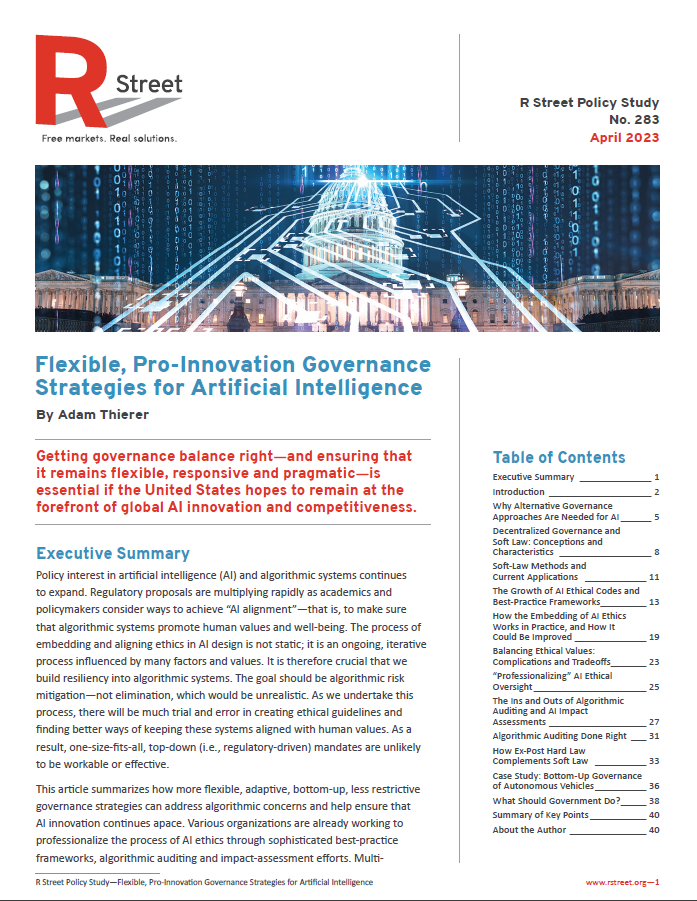
My report asks, is it possible to address AI alignment without starting with the Precautionary Principle as the governance baseline default? I explain how that is indeed possible. While some critics claim that no one is seriously trying to deal with AI alignment today, my report explains how no technology in history has been more heavily scrutinized this early in its life-cycle as AI, machine learning and robotics. The number of ethical frameworks out there already is astonishing. We don’t have too few alignment frameworks; we probably have too many!
We need to get serious about bringing some consistency to these efforts and figure out more concrete ways to a culture of safety by embedding ethics-by-design. But
there is an equally compelling interest in ensuring that algorithmic innovations are developed and made widely available to society.
In my latest R Street Institute report, I discuss the importance of “Getting AI Innovation Culture Right.” This is the first of a trilogy of major reports on what sort of policy vision and set of governance principles should guide the development of artificial intelligence (AI), algorithmic systems, machine learning (ML), robotics, and computational science and engineering more generally. More specifically, these reports seek to answer the question, Can we achieve AI safety without innovation-crushing top-down mandates and massive new regulatory bureaucracies?
These questions are particular pertinent as we just made it through a week in which we’ve seen a major open letter issued that calls for a 6-month freeze on the deployment of AI technologies, while a prominent AI ethicist argued that governments should go further and consider airstrikes data processing centers even if the exchange of nuclear weapons needed to be considered! On top of that, Italy became the first major nation to ban ChatGPT, the popular AI-enabled chatbot created by U.S.-based OpenAI.
My report begins from a different presumption: AI, ML and algorithmic technologies present society with enormously benefits and, while real risks are there, we can find better ways of addressing them. Continue reading →
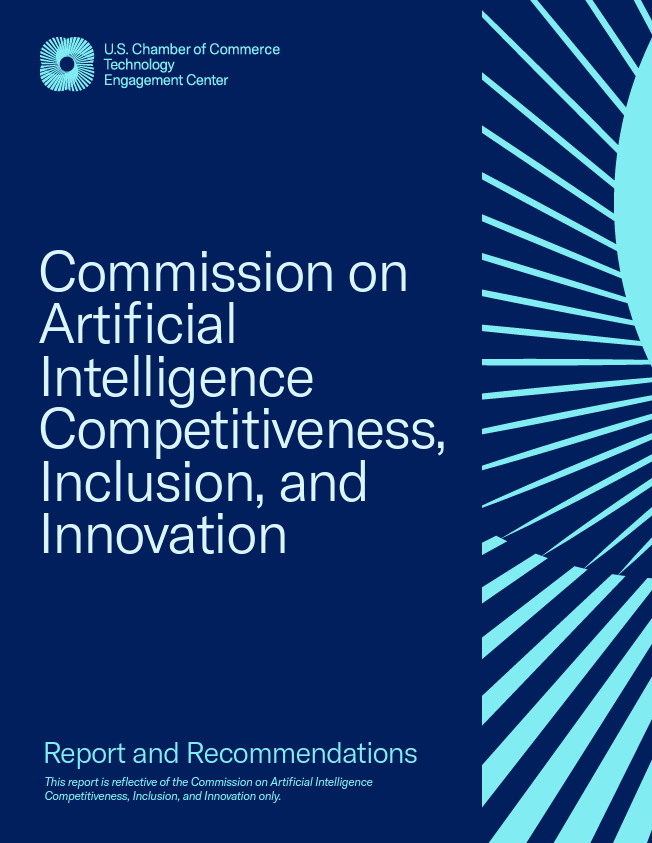
This week, the U.S. Chamber of Commerce Commission on Artificial Intelligence Competitiveness, Inclusion, and Innovation (AI Commission) released a major report on the policy considerations surrounding AI, machine learning (ML) and algorithmic systems. The 120-page report concluded that “AI technology offers great hope for increasing economic opportunity, boosting incomes, speeding life science research at reduced costs, and simplifying the lives of consumers.” It was my honor to serve as one of the commissioners on the AI Commission and contribute to the report.
Over at the R Street Institute blog, I offer a quick summary of the major findings and recommendations from the report and argue that, along with the National Institute of Standards and Technology (NIST)’s recently released AI Risk Management Framework, the AI Commission report offers, “a constructive, consensus-driven framework for algorithmic governance rooted in flexibility, collaboration and iterative policymaking. This represents the uniquely American approach to AI policy that avoids the more heavy-handed regulatory approaches seen in other countries and it can help the United States again be a global leader in an important new technological field,” I conclude. Check out the blog post and the full AI Commission report if you are following debates of algorithmic policy issues. There’s lot of important material in there.
In an earlier essay, I explored “Why the Future of AI Will Not Be Invented in Europe” and argued that, “there is no doubt that European competitiveness is suffering today and that excessive regulation plays a fairly significant role in causing it.” This essay summarizes some of the major academic literature that leads to that conclusion.
Since the mid-1990s, the European Union has been layering on highly restrictive policies governing online data collection and use. The most significant of the E.U.’s recent mandates is the 2018 General Data Protection Regulation (GDPR). This regulation established even more stringent rules related to the protection of personal data, the movement thereof, and limits what organizations can do with data. Data minimization is the major priority of this system, but there are many different types of restrictions and reporting requirements involved in the regulatory scheme. This policy framework also has ramifications for the future of next-generation technologies, especially artificial intelligence and machine learning systems, which rely on high-quality data sets to improve their efficacy.
Whether or not the E.U.’s complicated regulatory regime has actually resulted in truly meaningful privacy protections for European citizens relative to people in other countries remains open to debate. It is very difficult to measure and compare highly subjective values like privacy across countries and cultures. This makes benefit-cost analysis for privacy regulation extremely challenging — especially on the benefits side of the equation.
What is no longer up for debate, however, is the cost side of the equation and the question of what sort of consequences the GDPR has had on business formation, competition, investment, and so on. On these matters, standardized metrics exist and the economic evidence is abundantly clear: the GDPR has been a disaster for Europe. Continue reading →
President Biden began his 2023 State of the Union remarks by saying America is defined by possibilities. Correct! Unfortunately, his tech-bashing will undermine those possibilities by discouraging technological innovation & online freedom in the United States.
America became THE global leader on digital tech because we rejected heavy-handed controls on innovators & speech. We shouldn’t return to the broken model of the past by layering on red tape, economic controls & speech restrictions.
What has the tech economy done for us lately? Here is a look at the value added to the U.S. economy by the digital sector from 2005-2021. That’s $2.4 TRILLION (with a T) added in 2021. These are astonishing numbers.
FACT: According to the BEA, in 2021, “the U.S. digital economy accounted for $3.70 trillion of gross output, $2.41 trillion of value added (translating to 10.3 % of U.S. GDP), $1.24 trillion of compensation + 8.0 million jobs.”
In 2021…
$3.70 trillion of gross output
$2.41 trillion of value added (=10.3% percent GDP)
$1.24 trillion of compensation
8.0 million jobs
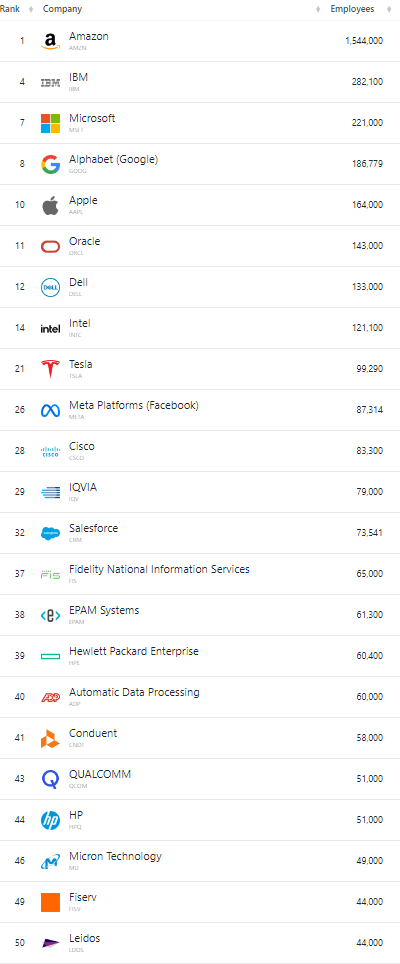
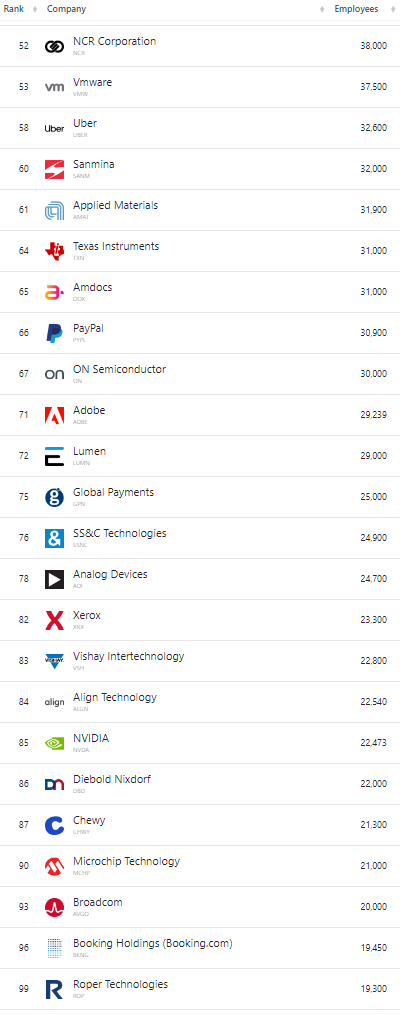
FACT: globally, 49 of the top 100 digital tech firms with most employees are US companies. Here they are. Smart public policy made this list possible.
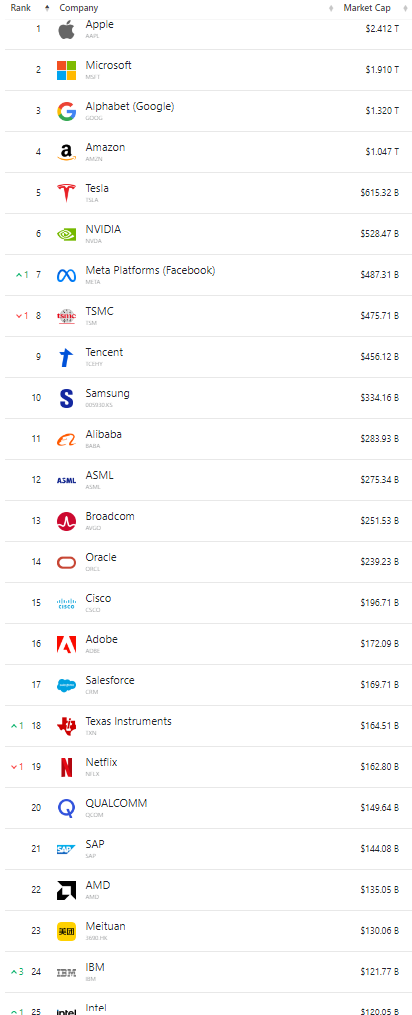
FACT: 18 of the world’s Top 25 tech companies by Market Cap are US-based firms.
It’d be a huge mistake to adopt Europe’s approach to tech regulation. As I noted recently in the Wall Street Journal, “The only thing Europe exports now on the digital-technology front is regulation.” Yet, Biden would have us import the EU model to our shores.
My R Street colleague Josh Withrow has also noted how, “the EU’s approach appears to be, in sum, ‘If you can’t innovate, regulate.’” America should not be following the disastrous regulatory path of the European Union on digital technology policy.
On antitrust regulation, here is a study by my R Street colleague Wayne Brough on the dangerous approach that the Biden administration wants, which would swing a wrecking ball through the tech economy. We have to avoid this.
It is particularly important that the US not follow the EU’s lead on artificial intelligence regulation at a time when we are in heated competition w China on the AI front as I noted here.
American tech innovators flourished thanks to a positive innovation culture rooted in permissionless innovation & policies like Section 230, which allowed American firms to become global powerhouses. And we’ve moved from a world of information scarcity to one of information abundance. Let’s keep it that way.
I spent much of 2022 writing about the growing policy debate over artificial intelligence, machine learning, robotics, and the Computational Revolution more generally. Here are some of the major highlights of my work on this front.
POLICY DEFAULTS: “The Proper Governance Default for AI” – Which policy default should we choose for algorithmic technologies: The Precautionary Principle or The Proactionary Principle? This is the single most important issue in AI policy today.
Over at Discourse magazine this week, my R Street colleague Jonathan Cannon and I have posted a new essay on how it has been “Quite a Fall for Digital Tech.” We mean that both in the sense that the last few months have witnessed serious market turmoil for some of America’s leading tech companies, but also that the political situation for digital tech more generally has become perilous. Plenty of people on the Left and the Right now want a pound of flesh from the info-tech sector, and the starting cut at the body involves Section 230, the 1996 law that shields digital platforms from liability for content posted by third parties.
With the Supreme Court recently announcing it will hear Gonzalez v. Google, a case that could significantly narrow the scope of Section 230, the stakes have grown higher. It was already the case that federal and state lawmakers were looking to chip away at Sec. 230’s protections through an endless variety of regulatory measures. But if the Court guts Sec. 230 in Gonzalez, then it will really be open season on tech companies, as lawsuits will fly at every juncture whenever someone does not like a particular content moderation decision. Cannon and I note in our new essay that, Continue reading →
We are entering a new era for technology policy in which many pundits and policymakers will use “algorithmic fairness” as a universal Get Out of Jail Free card when they push for new regulations on digital speech and innovation. Proposals to regulate things like “online safety,” “hate speech,” “disinformation,” and “bias” among other things often raise thorny definitional questions because of their highly subjective nature. In the United States, efforts by government to control these things will often trigger judicial scrutiny, too, because restraints on speech violate the First Amendment. Proponents of prior restraint or even ex post punishments understand this reality and want to get around it. Thus, in an effort to avoid constitutional scrutiny and lengthy court battles, they are engaged in a rebranding effort and seeking to push their regulatory agendas through a techno-panicky prism of “algorithmic fairness” or “algorithmic justice.”
Hey, who could possibly be against FAIRNESS and JUSTICE? Of course, the devil is always in the details as Neil Chilson and I discuss in our new paper for the The Federalist Society and Regulatory Transparency Project on, “The Coming Onslaught of ‘Algorithmic Fairness’ Regulations.” We document how federal and state policymakers from both parties are currently considering a variety of new mandates for artificial intelligence (AI), machine learning, and automated systems that, if imposed, “would thunder through our economy with one of the most significant expansions of economic and social regulation – and the power of the administrative state – in recent history.” Continue reading →
It was my pleasure this week to participate in a panel discussion about the future of innovation policy at the James Madison Institute’s 2022 Tech and Innovation Summit in Coral Gables, FL. Our conversation focused on the future of Progress Studies, which is one of my favorite topics. We were asked to discuss five major questions and below I have summarized some of my answers to them, plus some other thoughts I had about what I heard at the conference from others.
What is progress studies and why is it so needed today?
In a sense, Progress Studies is nothing new. Progress studies goes back at least to the days of Adam Smith and plenty of important scholars have been thinking about it ever since. Those scholars and policy advocates have long been engaged in trying to figure out what’s the secret sauce that powers economic growth and human prosperity. It’s just that we didn’t call that Progress Studies in the old days.
The reason Progress Studies is important is because technological innovation has been shown to be the fundamental driver in improvements in human well-being over time. When we can move the needle on progress, it helps individuals extend and improve their lives, incomes, and happiness. By extension, progress helps us live lives of our choosing. As Hans Rosling brilliantly argued, the goal of expanding innovation opportunities and raising incomes “is not just bigger piles of money” or more leisure time. “The ultimate goal is to have the freedom to do what we want.” Continue reading →
The Technology Liberation Front is the tech policy blog dedicated to keeping politicians' hands off the 'net and everything else related to technology. Learn more about TLF →



 The Technology Liberation Front is the tech policy blog dedicated to keeping politicians' hands off the 'net and everything else related to technology.