On March 19th, I had the chance to debate Franklin Foer at a Patrick Henry College event focused on the question, “Is Big Tech Big Brother?” It was billed as a debate over the role of technology in American society and whether government should be regulating media and technology platforms more generally. [The full event video is here.] Foer is the author of the new book, World Without Mind: The Existential Threat of Big Tech, in which he advocates a fairly expansive regulatory regime for modern information technology platforms. He is open to building on regulatory ideas from the past, including broadcast-esque licensing regimes, “Fairness Doctrine”-like mandates for digital intermediaries, “fiduciary” responsibilities, beefed-up antitrust intervention, and other types of controls. In a review of the book for Reason, and then again during the debate at Patrick Henry University, I offered some reflections on what we can learn from history about how well ideas like those worked out in practice.
My closing statement of the debate, which lasted just a little over three minutes, offers a concise summation of what that history teaches us and why it would be so dangerous to repeat the mistakes of the past by wandering down that disastrous path again. That 3-minute clip is posted below. (The audience was polled before and after the event and asked the same question each time: “Do large tech companies wield too much power in our economy, media and personal lives and if so, should government(s) intervene?” Apparently at the beginning, the poll was roughly Yes – 70% and No – 30%, but after the debated ended it has reversed, with only 30% in favor of intervention and 70% against. Glad to turn around some minds on this one!)
via ytCropper
I’ve been thinking about the “right to try” movement a lot lately. It refers to the growing movement (especially at the state level here in the U.S.) to allow individuals to experiment with alternative medical treatments, therapies, and devices that are restricted or prohibited in some fashion (typically by the Food and Drug Administration). I think there are compelling ethical reasons for allowing citizens to determine their own course of treatment in terms of what they ingest into their bodies or what medical devices they use, especially when they are facing the possibility of death and have exhausted all other options.
But I also favor a more general “right to try” that allows citizens to make their own health decisions in other circumstances. Such a general freedom entails some risks, of course, but the better way to deal with those potential downsides is to educate citizens about the trade-offs associated with various treatments and devices, not to forbid them from seeking them out at all.
The Costs of Control
But this debate isn’t just about ethics. There’s also the question of the costs associated with regulatory control. Practically speaking, with each passing day it becomes harder and harder for governments to control unapproved medical devices, drugs, therapies, etc. Correspondingly, that significantly raises the costs of enforcement and makes one wonder exactly how far the FDA or other regulators will go to stop or slow the advent of new technologies.
I have written about this “cost of control” problem in various law review articles as well as my little Permissionless Innovation book and pointed out that, when enforcement challenges and costs reach a certain threshold, the case for preemptive control grows far weaker simply because of (1) the massive resources that regulators would have to pour into the task on crafting a workable enforcement regime; and/or (2) the massive loss of liberty it would entail for society more generally to devise such solutions. With the rise of the Internet of Things, wearable devices, mobile medical apps, and other networked health and fitness technologies, these issues are going to become increasingly ripe for academic and policy consideration. Continue reading →
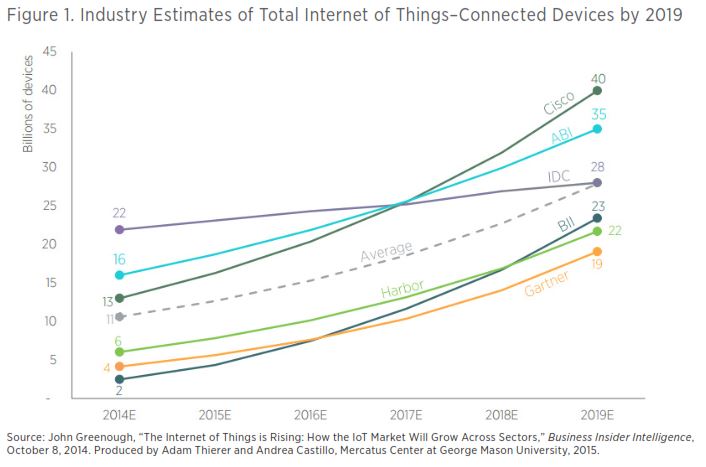
The “Internet of Things” (IoT) is already growing at a breakneck pace and is expected to continue to accelerate rapidly. In a short new paper (“Projecting the Growth and Economic Impact of the Internet of Things“) that I’ve just released with my Mercatus Center colleague Andrea Castillo, we provide a brief explanation of IoT technologies before describing the current projections of the economic and technological impacts that IoT could have on society. In addition to creating massive gains for consumers, IoT is projected to provide dramatic improvements in manufacturing, health care, energy, transportation, retail services, government, and general economic growth. Take a look at our paper if you’re interested, and you might also want to check out my 118-page law review article, “The Internet of Things and Wearable Technology: Addressing Privacy and Security Concerns without Derailing Innovation” as well as my recent congressional testimony on the policy issues surrounding the IoT.)
 I’ve just released a short new paper, co-authored with my Mercatus Center colleagues Christopher Koopman and Matthew Mitchell, on “The Sharing Economy and Consumer Protection Regulation: The Case for Policy Change.” The paper is being released to coincide with a Congressional Internet Caucus Advisory Committee event that I am speaking at today on “Should Congress be Caring About Sharing? Regulation and the Future of Uber, Airbnb and the Sharing Economy.”
In this new paper, Koopman, Mitchell, and I discuss how the sharing economy has changed the way many Americans commute, shop, vacation, borrow, and so on. Of course, the sharing economy “has also disrupted long-established industries, from taxis to hotels, and has confounded policymakers,” we note. “In particular, regulators are trying to determine how to apply many of the traditional ‘consumer protection’ regulations to these new and innovative firms.” This has led to a major debate over the public policies that should govern the sharing economy.
We argue that, coupled with the Internet and various new informational resources, the rapid growth of the sharing economy alleviates the need for much traditional top-down regulation. These recent innovations are likely doing a much better job of serving consumer needs by offering new innovations, more choices, more service differentiation, better prices, and higher-quality services. In particular, the sharing economy and the various feedback mechanism it relies upon helps solve the tradition economic problem of “asymmetrical information,” which is often cited as a rationale for regulation. We conclude, therefore, that “the key contribution of the sharing economy is that it has overcome market imperfections without recourse to traditional forms of regulation. Continued application of these outmoded regulatory regimes is likely to harm consumers.” Continue reading →
 The Mercatus Center at George Mason University has just released my latest working paper, “The Internet of Things and Wearable Technology: Addressing Privacy and Security Concerns without Derailing Innovation.” The “Internet of Things” (IoT) generally refers to “smart” devices that are connected to both the Internet and other devices. Wearable technologies are IoT devices that are worn somewhere on the body and which gather data about us for various purposes. These technologies promise to usher in the next wave of Internet-enabled services and data-driven innovation. Basically, the Internet will be “baked in” to almost everything that consumers own and come into contact with.
Some critics are worried about the privacy and security implications of the Internet of Things and wearable technology, however, and are proposing regulation to address these concerns. In my new 93-page article, I explain why preemptive, top-down regulation would derail the many life-enriching innovations that could come from these new IoT technologies. Building on a recent book of mine, I argue that “permissionless innovation,” which allows new technology to flourish and develop in a relatively unabated fashion, is the superior approach to the Internet of Things.
As I note in the paper and my earlier book, if we spend all our time living in fear of the worst-case scenarios — and basing public policies on them — then best-case scenarios can never come about. As the old saying goes: nothing ventured, nothing gained. Precautionary principle-based regulation paralyzes progress and must be avoided. We instead need to find constructive, “bottom-up” solutions to the privacy and security risks accompanying these new IoT technologies instead of top-down controls that would limit the development of life-enriching IoT innovations. Continue reading →
 I want to bring to everyone’s attention an important new white paper by Dr. Robert Graboyes, a colleague of mine at the Mercatus Center at George Mason University who specializes in the economics of health care. His new 67-page study, Fortress and Frontier in American Health Care, seeks to move away from the tired old dichotomies that drive health care policy discussions: Left versus Right, Democrat versus Republican, federal versus state, and public versus private, and so on. Instead, Graboyes seeks to reframe the debate over the future of health care innovation in terms of “Fortress versus Frontier” and to highlight what lessons we can learn from the Internet and the Information Revolution when considering health care policy.
What does Graboyes mean by “Fortress and Frontier”? Here’s how he explains this conflict of visions:
The Fortress is an institutional environment that aims to obviate risk and protect established producers (insiders) against competition from newcomers (outsiders). The Frontier, in contrast, tolerates risk and allows outsiders to compete against established insiders. . . . The Fortress-Frontier divide does not correspond neatly with the more familiar partisan or ideological divides. Framing health care policy issues in this way opens the door for a more productive national health care discussion and for unconventional policy alliances. (p. 4)
He elaborates in more detail later in the paper: Continue reading →
The sharing economy is growing faster than ever and becoming a hot policy topic these days. I’ve been fielding a lot of media calls lately about the nature of the sharing economy and how it should be regulated. (See latest clip below from the Stossel show on Fox Business Network.) Thus, I sketched out some general thoughts about the issue and thought I would share them here, along with some helpful additional reading I have come across while researching the issue. I’d welcome comments on this outline as well as suggestions for additional reading. (Note: I’ve also embedded some useful images from Jeremiah Owyang of Crowd Companies.)
1)
Just because policymakers claim that regulation is meant to protect consumers does not mean it actually does so.
- Cronyism/ Rent-seeking: Regulation is often “captured” by powerful and politically well-connected incumbents and used to their own benefit. (+ Lobbying activity creates deadweight losses for society.)
- Innovation-killing: Regulations become a formidable barrier to new innovation, entry, and entrepreneurism.
- Unintended consequences: Instead of resulting in lower prices & better service, the opposite often happens: Higher prices & lower quality service. (Example: Painting all cabs same color destroying branding & ability to differentiate).
Continue reading →
If there are two general principles that unify my recent work on technology policy and innovation issues, they would be as follows. To the maximum extent possible:
- We should avoid preemptive and precautionary-based regulatory regimes for new innovation. Instead, our policy default should be innovation allowed (or “permissionless innovation”) and innovators should be considered “innocent until proven guilty” (unless, that is, a thorough benefit-cost analysis has been conducted that documents the clear need for immediate preemptive restraints).
- We should avoid rigid, “top-down” technology-specific or sector-specific regulatory regimes and/or regulatory agencies and instead opt for a broader array of more flexible, “bottom-up” solutions (education, empowerment, social norms, self-regulation, public pressure, etc.) as well as reliance on existing legal systems and standards (torts, product liability, contracts, property rights, etc.).
I was very interested, therefore, to come across two new essays that make opposing arguments and proposals. The first is this recent
Slate oped by John Frank Weaver, “We Need to Pass Legislation on Artificial Intelligence Early and Often.” The second is Ryan Calo’s new Brookings Institution white paper, “The Case for a Federal Robotics Commission.”
Weaver argues that new robot technology “is going to develop fast, almost certainly faster than we can legislate it. That’s why we need to get ahead of it now.” In order to preemptively address concerns about new technologies such as driverless cars or commercial drones, “we need to legislate early and often,” Weaver says. Stated differently, Weaver is proposing “precautionary principle”-based regulation of these technologies. The precautionary principle generally refers to the belief that new innovations should be curtailed or disallowed until their developers can prove that they will not cause any harms to individuals, groups, specific entities, cultural norms, or various existing laws, norms, or traditions.
Calo argues that we need “the establishment of a new federal agency to deal with the novel experiences and harms robotics enables” since there exists “distinct but related challenges that would benefit from being examined and treated together.” These issues, he says, “require special expertise to understand and may require investment and coordination to thrive.
I’ll address both Weaver and Calo’s proposals in turn. Continue reading →
On Thursday, it was my great pleasure to present a draft of my forthcoming paper, “The Internet of Things & Wearable Technology: Addressing Privacy & Security Concerns without Derailing Innovation,” at a conference that took place at the Federal Communications Commission on “Regulating the Evolving Broadband Ecosystem.” The 3-day event was co-sponsored by the American Enterprise Institute and the University of Nebraska College of Law.
The 65-page working paper I presented is still going through final peer review and copyediting, but I posted a very rough first draft on SSRN for conference participants. I expect the paper to be released as a Mercatus Center working paper in October and then I hope to find a home for it in a law review. I will post the final version once it is released. [UPDATE:The final version of this working paper was released on November 19, 2014.]
In the meantime, however, I thought I would post the 46 slides I presented at the conference, which offer an overview of the nature of the Internet of Things and wearable technology, the potential economic opportunities that exist in this space, and the various privacy and security challenges that could hold this technological revolution back. I also outlined some constructive solutions to those concerns. I plan to be very active on these issues in coming months.
Continue reading →

 The Technology Liberation Front is the tech policy blog dedicated to keeping politicians' hands off the 'net and everything else related to technology.