My thanks to Linton Weeks of NPR who reached out to me for comment for a story he was doing on the impact of the Internet and digital technology on culture and our attention spans. His essay, “We Are Just Not Digging The Whole Anymore,” is an interesting exploration of the issue, although it is clear that Weeks, like Nick Carr (among others), is concerned about what the Net is doing to our brains. He says:
We just don’t do whole things anymore. We don’t read complete books — just excerpts. We don’t listen to whole CDs — just samplings. We don’t sit through whole baseball games — just a few innings. Don’t even write whole sentences. Or read whole stories like this one. We care more about the parts and less about the entire. We are into snippets and smidgens and clips and tweets. We are not only a fragmented society, but a fragment society. And the result: What we gain is the knowledge — or the illusion of knowledge — of many new, different and variegated aspects of life. What we lose is still being understood.
After reading the entire piece I realized that some of my comments to Weeks probably came off as a bit more pessimistic about things than I actually am. I told him, for example, that “Long-form reading, listening and viewing habits are giving way to browse-and-choose consumption,” and that “With the increase in the number of media options — or distractions, depending on how you look at them — something has to give, and that something is our attention span.”
Luckily, however, Weeks was kind enough to also give me the last word in the story in which I pointed out that it would be a serious mistake to conclude “that we’re all growing stupid, or losing our ability to think, or losing our appreciation of books, albums or other types of long-form content.” Instead, I argued: Continue reading →
 Information overload is a hot topic these days. I’ve really enjoyed recent essays by Aaron Saenz (“Are We Too Plugged In? Distracted vs. Enhanced Minds”), Michael Sacasas (“Technology Sabbaths and Other Strategies for the Digitized World“), and Peggy Noonan (“Information Overload is Nothing New“) discussing this concern in a thoughtful way. Thoughtful discussion about this issue is sometimes hard to find because, as I’ve noted here before, information overload is a subject that bitterly divides Internet optimists and pessimists. The pessimists tend to overplay the issue and discuss it in apocalyptic terms. The optimists, by contrast, often dismiss the concern out of hand. Certainly there must be some reasonable middle ground on this issue, no?
There is, and some of it can be found in a fine new book,
Hamlet’s BlackBerry: A Practical Philosophy for Building a Good Life in the Digital Age, by William Powers. Powers, a former staff writer for the Washington Post
, is a gifted storyteller and his walk though the history of philosophy and technology makes this slender volume an enjoyable, quick read. He begins by reminding us that:
whenever new devices have emerged, they’ve presented the kinds of challenges we face today — busyness, information overload, that sense of life being out of control. These challenges were as real two millennia ago as they are today, and throughout history, people have been grappling with them and looking for creative ways to manage life in the crowd. (p. 5)
His key insight is that humans
can adapt to new technology, but it takes time, patience, humility, and a little effort. “The key is to strike a balance,” he says, between “the call of the crowd” and the “need for time and space apart” from it. (p. 4) The problem we face today is that all the pressure is on us to be what he calls “Digital Maximalists.” That is, many of us are increasingly out to maximize the time spent in front of various digital “screens” whether we have made the determination that is really in our best interest or not. It has just gradually happened, Powers argues, because “The goal is no longer to be ‘in touch’ but to erase the possibility of ever being out of touch.” (p. 15)
Continue reading →
Ryan Radia brought to my attention this excellent Slate piece by Vaughan Bell entitled, “Don’t Touch That Dial! A History of Media Technology Scares, from the Printing Press to Facebook.” It touches on many of the themes I’ve discussed here in my essays on techno-panics, fears about information overload, and the broader optimists v. pessimist battle throughout history regarding the impact of new technologies on culture, life and learning. “These concerns stretch back to the birth of literacy itself,” Bell rightly notes:
Worries about information overload are as old as information itself, with each generation reimagining the dangerous impacts of technology on mind and brain. From a historical perspective, what strikes home is not the evolution of these social concerns, but their similarity from one century to the next, to the point where they arrive anew with little having changed except the label.
Quite right. And Bell’s essay reminds us of this gem from the great Douglas Adams about how bad we humans are at putting technological change in perspective:
Anything that is in the world when you’re born is normal and ordinary and is just a natural part of the way the world works. Anything that’s invented between when you’re fifteen and thirty-five is new and exciting and revolutionary and you can probably get a career in it. Anything invented after you’re thirty-five is against the natural order of things.
So true, and I wish I would have remembered it before I wrapped up my discussion about “adventure windows” in the review of Jaron Lanier’s new book, You Are Not a Gadget, which I published last night. As I noted in that essay:
Our willingness to try new things and experiment with new forms of culture—our “adventure window”—fades rapidly after certain key points in life, as we gradually get set in our ways. Many cultural critics and average folk alike always seem to think the best days are behind us and the current good-for-nothing generation and their new-fangled gadgets and culture are garbage.
Continue reading →
2009 was not as big of a year for Internet and information technology (“info-tech”) policy books as 2008 was, but there were still some notable titles released that offered interesting perspectives about the future of the Net and the impact the Digital Revolution is having on our lives, culture, and economy. So, like last year, I figured I would throw together my list of the 10 most important info-tech policy books of the year.
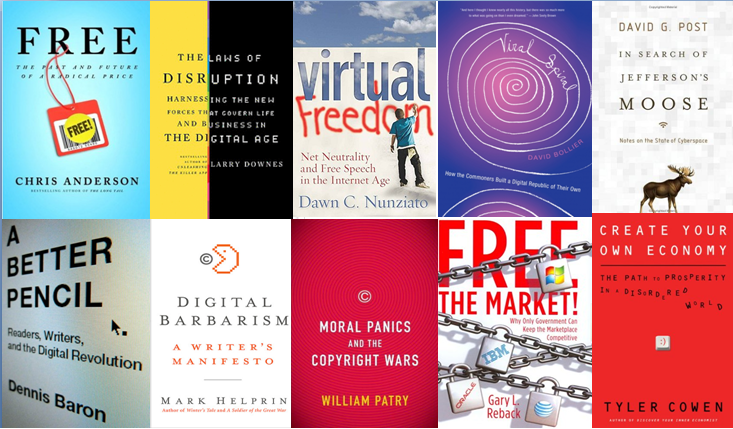 First, let me repeat a few of the same caveats and disclaimers that I set forth last year. What qualifies as an “important” info-tech policy book? Simply put, it’s a title that many people are currently discussing and that we will likely be referencing for many years to come. However, I want to be clear that merely because a book appears on my list it does not necessarily mean I agree with everything said in it. In fact, as was the case in previous years, I found much with which to disagree in my picks for the most important books of 2009 and I find that the cyber-libertarianism I subscribe to has very few fans out there.
Another caveat: Narrowly-focused titles lose a few points on my list. For example, if a book deals mostly with privacy issues, copyright law, or antitrust policy, it does not exactly qualify as the same sort of “tech policy book” as other titles found on this list since it is a narrow exploration of just one set of issues with a bearing on technology policy.
With those caveats in mind, here are my choices for the Most Important Info-Tech Policy Books of 2009. Continue reading →
In April 2008, L. Gordon Crovitz, the former publisher of the Wall Street Journal, launched his “Information Age” column with a brilliant piece entitled “Optimism and the Digital World” (which Adam lauded here). Crovitz noted the problem of “information overload,” then creeping into the public consciousness, but was unabashed in his optimism:
My own bias is that as information becomes more accessible, individuals gain choice, control and freedom. Established institutions – governments, large companies and special-interest groups – need to work harder to justify their authority. As information and knowledge spread, financial and human capital become more global and more competitive. The uncertainties and dislocations from new technology can be wrenching, but genies don’t go back into bottles.
The First Law of Technology says that “with every change in technology that affects consumer behavior, we always overestimate the impact in the short term, but then underestimate the full impact over the long term.”
Crovitz picks up where he left off in today’s column: “Information Overload? Relax: We survived copy machines. We’ll survive Twitter.”
Our era in the information age is a transition period of learning how to navigate information abundance. Rather than pitch our BlackBerrys and iPhones into the sea, imagine the benefits once we have figured out how to manage the chaos of endless data and routine multitasking, a process that will help refine our judgment about information and refocus our attention on what’s truly important….
Humans adapt, so we’ll learn how to live with information overabundance. Young people growing up multitasking are already less anxious about using technology and may well cope better than those of us in older generations. They have no choice but to get more sophisticated at separating the important from the unimportant and the authoritative from the unreliable, even while sampling from among many new kinds of information tools…
Young people will cope first as we all evolve to become more sophisticated, less anxious users of information.
Crovitz also notes, with approval, GMU economist Tyler Cowen’s new book, “Create Your Own Economy,” which Cord blogged about here. I recently heard Cowen talk about the book and thoroughly enjoyed the talk.

 The Technology Liberation Front is the tech policy blog dedicated to keeping politicians' hands off the 'net and everything else related to technology.