Here’s a thought experiment. Let’s say you believe the Internet economy needs more regulation to guard against potential privacy violations or what you regard as excessive data aggregation. Further, you believe that no amount of self-regulation, social norms, market pressure, education, empowerment, or anything else could possibly substitute for regulation. I know there are a lot of people out there today who feel this way. Regardless of the merits of such claims, here’s my question for you: Do the ends (enhanced privacy protections) justify any means (regulation at any and every level of government)? For example, what would you think about having all 50 states creating their own Privacy Offices or Data Protection Bureaus that issued regulations or recommendations about Internet best practices?
What got me thinking about this was this new blog post by Parker Higgins of EFF, “California Attorney General Releases Mobile Privacy Recommendations.” In the essay, Higgins showers praise on California Attorney General Kamala D. Harris, who just released a document (“Privacy on the Go“) that lays out a long set of privacy “best practices” for mobile app developers. Higgins writes:
EFF applauds this important step forward, and congratulates the California Attorney General on a thorough and clearly written explanation of the importance of mobile privacy and how developers can deliver. It’s true that as technology changes, the specific needs and guidelines for companies will need to adapt. We could well see a time when these principles do not adequately protect the rights and needs of consumers. However, right now these principles represent a huge step forward — going beyond existing law in a way that improves transparency, accountability, and choice for users of mobile devices.
Regardless of the merits of the principles and recommendations contained in that report — and I agree that many of them are quite sensible best practices that industry should be following — I can’t help but wonder whether it is wise for EFF to be cheering on state-based Internet meddling so openly. Continue reading →
My latest Forbes column is entitled “With Freedom of Speech, The Technological Genie Is Out of the Bottle,” and it’s a look back at the amazing events that unfolded over the past week in the U.K. regarding privacy, free speech, and Twitter. I’m speaking, of course, about the “super-injunction” mess. I relate this episode to the ongoing research Jerry Brito and I are doing examining the increasing challenges of information control.
I begin by noting that:
When it comes to freedom of speech in the age of Twitter, for better or worse, the genie is out of the bottle. Controlling information flows on the Internet has always been challenging, but new communications technologies and media platforms make it increasingly difficult for governments to crack down on speech and data dissemination now that the masses are empowered. The most recent exhibit in the information control follies comes from the United Kingdom, where in the span of just one week the country’s enhanced libel law procedure was rendered a farce.
I go on to explain how Britain’s super-injunction regulatory regime unraveled so quickly and why it’s unlikely to be effectively enforceable in the future. Read the entire essay over at
Forbes and then also check out Jerry’s Time TechLand editorial from last week, “Twitter’s Super-Duper U.K. Censorship Trouble.” I also just saw this piece by British defamation expect John Maher: “Law Playing Catch-up with New Media.” It’s worth a read.
When it comes to information control, everybody has a pet issue and everyone will be disappointed when law can’t resolve it. I was reminded of this truism while reading a provocative blog post yesterday by computer scientist Ben Adida entitled “(Your) Information Wants to be Free.” Adida’s essay touches upon an issue I have been writing about here a lot lately: the complexity of information control — especially in the context of individual privacy. [See my essays on “Privacy as an Information Control Regime: The Challenges Ahead,” “And so the IP & Porn Wars Give Way to the Privacy & Cybersecurity Wars,” and this recent FTC filing.]
In his essay, Adida observes that:
In 1984, Stewart Brand famously said that information wants to be free. John Perry Barlow reiterated it in the early 90s, and added “Information Replicates into the Cracks of Possibility.” When this idea was applied to online music sharing, it was cool in a “fight the man!” kind of way. Unfortunately, information replication doesn’t discriminate: your personal data, credit cards and medical problems alike, also want to be free. Keeping it secret is really, really hard.
Quite right. We’ve been debating the complexities of information control in the Internet policy arena for the last 20 years and I think we can all now safely conclude that information control is hugely challenging regardless of the sort of information in question. As I’ll note below, that doesn’t mean control is impossible, but the
relative difficulty of slowing or stopping information flows of all varieties has increased exponentially in recent years.
But Adida’s more interesting point is the one about the selective morality at play in debates over information control. That is, people generally expect or favor information freedom in some arenas, but then get pretty upset when they can’t crack down on information flows elsewhere. Indeed, some people can get downright religious about the whole “information-wants-to-be-free” thing in some cases and then, without missing a beat, turn around and talk like information totalitarians in the next breath. Continue reading →
On this week’s John Stossel show on Fox Business Network, I debated Internet privacy, advertising, and data collection issues with Michael Fertik of Reputation.com. In the few minutes we had for the segment, I tried to reiterate a couple of keep points that we’ve hammered repeatedly here in the past:
- There’s no free lunch. All the free sites and service we enjoy online today are powered by advertising and data collection. [see this op-ed]
- There is no clear harm in most cases, or what some argue is harm also can have many benefits that are rarely discussed. [see this paper.]
- There’s little acknowledgement of the trade-offs involved in having government create an information control regime for the Internet. [see this filing and these three essays: 1, 2, 3.]
- The ultimate code of “fair information practices” is the First Amendment, which favors free speech, openness, and transparency over secrecy and information control. [see this piece.]
- “Hands Off the Net” is a policy that has served us well. There are dangerous ramifications for our economy and long-term Internet freedoms if we continue down the road of “European-izing” privacy law here in the States. [see this essay and this filing.]
- At some point, personal responsibility needs to come into the equation. With so many privacy enhancing empowerment tools already on the market, it begs the question: If consumers don’t take steps to use those tools, why should government intervene and take action for them?
Anyway, here’s the 7-min video of the debate between Fertik and me:
http://www.youtube.com/v/rYBsOK47LUw&hl=en_US&feature=player_embedded&version=3
Like Milton, I’m very worried about the political vulnerabilities that might arise if the wireless sector grows more concentrated. Still, I think it’s a big mistake to legitimize one repressive incarnation of coercive state power (antitrust intervention) to reduce the likelihood that another incarnation (information control) will intensify. This approach is not only defeatist, as Hance argues, but it also requires a tactical assessment that rests on several dubious assumptions.
First, Milton overestimates the marginal risk that the AT&T – T-Mobile deal will pave the way for an information control regime. The wireless market isn’t static; the disappearance of T-Mobile as an independent entity (which may well occur regardless of whether this deal goes through) hardly means we’re forever “doomed” to live with 3 nationwide wireless players. With major spectrum auctions likely on the horizon, and the possibility of existing spectrum holdings being combined in creative ways, the eventual emergence of one or more nationwide wireless competitors is quite possible — especially if, as skeptics of the AT&T – T-Mobile deal often argue, the wireless market underperforms in the years following the acquisition.
More importantly, network operators, like almost all Internet gatekeepers, face mounting pressure from their users not to facilitate censorship, surveillance, and repression. Case in point: AT&T is a leading member of the Digital Due Process coalition (to which I also belong) that’s urging Congress to substantially strengthen the 1986 federal statute that governs law enforcement access to private electronic communications. Consider that AT&T’s position on this major issue is officially at odds with the official position of the same Justice Department that’s currently reviewing the AT&T – T-Mobile deal. Would a docile, subservient network operator challenge its state overseers so publicly?
Continue reading →
A headline in the USA Today earlier this week screamed, “Hello, Big Brother: Digital Sensors Are Watching Us.” It opens with an all too typical techno-panic tone, replete with tales of impending doom:
Odds are you will be monitored today — many times over. Surveillance cameras at airports, subways, banks and other public venues are not the only devices tracking you. Inexpensive, ever-watchful digital sensors are now ubiquitous.
They are in laptop webcams, video-game motion sensors, smartphone cameras, utility meters, passports and employee ID cards. Step out your front door and you could be captured in a high-resolution photograph taken from the air or street by Google or Microsoft, as they update their respective mapping services. Drive down a city thoroughfare, cross a toll bridge, or park at certain shopping malls and your license plate will be recorded and time-stamped.
Several developments have converged to push the monitoring of human activity far beyond what George Orwell imagined. Low-cost digital cameras, motion sensors and biometric readers are proliferating just as the cost of storing digital data is decreasing. The result: the explosion of sensor data collection and storage.
Oh my God! Dust off you copies of the
Unabomber Manifesto and run for your shack in the hills!
No, wait, don’t. Let’s instead step back, take a deep breath and think about this. As the article goes on to note, there will certainly be many benefits to our increasing “sensor society.” Advertising and retail activity will become more personalized and offer consumers more customized good and services. I wrote about that here at greater length in my essay on “Smart-Sign Technology: Retail Marketing Gets Sophisticated, But Will Regulation Kill It First?” More importantly, ubiquitous digital sensors and data collection/storage will also increase our knowledge of the world around us exponentially and do wonders for scientific, environmental, and medical research.
But that won’t soothe the fears of those who fear the loss of their privacy and the rise of a surveillance society in which our every move is watched or tracked. So, let’s talk about what those of you who feel that way want to do about it.
Continue reading →
 Every once and awhile it’s worth taking a step back and looking at the long view of how Internet policy developments have unfolded and consider where they might be heading next. We’ve reached such a moment as it pertains to efforts to police the Internet for copyright piracy, objectionable online content, privacy violations, and cybersecurity. We’re at an interesting crossroads in this regard since the prospects for successful cracking down on copyright piracy and pornography appear grim. Seemingly every effort that has been tried has failed. The Net is awash in online porn and pirated content. I am not expressing a normative position on this, rather, I’m just stating what now seems to be commonly accepted fact.
In the meantime, the United States is in the process of creating new information control regimes and this time its access to personal information and cybersecurity that are the focus of regulatory efforts. The goal of the privacy-related regulatory efforts is to help Netizens better protect their privacy in online environments and stop the “arms race” of escalating technological capabilities. The goal of cybersecurity efforts is to make digital networks and systems more secure or, more profoundly as we see in the Wikileaks case, it is to bottle up state secrets.
These efforts are also likely to fail. Simply stated, it’s a nightmare to bottle-up information once it’s out there. Continue reading →
I’m going to close out my series of essays about Tim Wu’s new book, The Master Switch: The Rise and Fall of Information Empires, by discussing his proposed solutions. In the first five essays in the series, [1, 2, 3, 4, 5] I’ve critiqued Wu’s look at information history as well as his use of terms like “market failure,” “laissez-faire” and “open” vs. “closed.” I argued there’s a great deal of over-simplification, even outright distortion, in his use of those terms throughout the book.
Anyway, let’s run through the basics of the book once more before getting to Wu’s proposed solutions. By my reading of
The Master Switch, Wu’s argument essentially goes something like this:
- Information industries go through cycles. After a period of “openness” and competition, they tend to drift toward “closed,” corporate-controlled, anti-consumer models and outcomes.
- The resulting “monopolists” then block much innovation, competition, and free speech.
- Consequently, “the purely economic laissez-faire approach… is no longer feasible.”
- Moreover, information industries are more important than all others (“information industries… can never be properly understood as ‘normal’ industries”) and even traditional forms of regulation, including antitrust, “are clearly inadequate for the regulation of information industries.” (p. 303).
- Thus, special rules should apply to information-related sectors of our economy.
Again, I’ve challenged some of these assertions in my previous essays, specifically, Wu’s incomplete history of cycles and the fact that he greatly underplays the role of governments in “locking-in” sub-optimal market structures or, worse yet, creating those structures through misguided public policies or regulatory capture. Wu discusses some of those factors in his book, but he tends to regard them as secondary to the inquiry, whereas I believe they are crucial to understanding how most “closed” or anti-competitive scenarios develop or endure. Instead, Wu simplistically suggests that “the purely economic laissez-faire approach… is no longer feasible,” even though no such state of affairs has ever existed within communications or media industries. They have been subjected to varying levels of indirect influence or direct control almost since their inception.
Regardless, what does Tim Wu want done about the problems he has (mis-)diagnosed? Continue reading →
[This represents a bit of a departure from the traditional format of my ongoing “Media Deconsolidiation Series,” but you will see how it ties in…]
So, some guy from the (Un)Free Press — the activist group that wants to regulate every facet of the media and broadband universe — has created a scary looking chart about “Information Control” [seen below]. It’s based loosely on the Periodic Table of Elements, you know, to give it the aura of science and fact. In reality, it’s just another silly scare tactic that tells us very little about the true nature of our modern media marketplace.
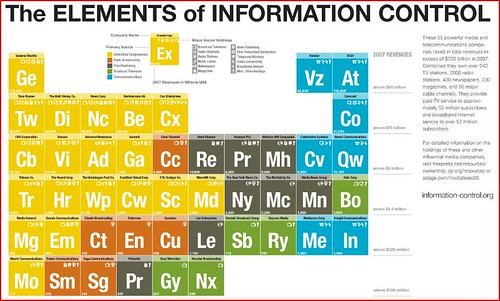
The chart is accompanied by the typical Free Press gloom-and-doom rhetoric about the unfolding media apocalypse. “Nearly everything you see, hear and read that isn’t from a friend — whether on TV, the radio, or even on the Web — comes from a for-profit gatekeeper.” And then comes the obligatory A.J. Liebling quote about how “Freedom of the press belongs to those who own one,” followed quickly by the typical punch line about how just a handful of companies (in this case 55 of ’em) are puppeteering all our thoughts in America today:
Combined, these 55 powerful media and telecommunications companies raked in total revenues in excess of $700 billion in 2007. Together they own over 540 TV stations, 2000 radio stations, 430 newspapers, 230 magazines, and 80 major cable channels in the United States. They provide paid TV service to approximately 52 million subscribers and broadband Internet service to over 57 million subscribers. They’re the bottlenecks through which our news, our entertainment, and our political discourse must travel. What they want to promote becomes prominent; what they suppress stays out of the mainstream. As such, these companies are the elements of information control.
Oh my God! We are all just brainwashed sheep!
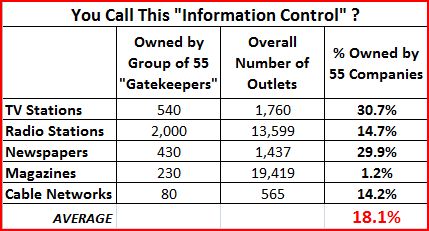
Except we’re not. It amazes me how these “information control” and “media monopoly” myths keep getting widespread circulation. But the first thing to note is how the media reformistas can’t get even their story straight when it comes to how many “monopolists” are supposedly out there today. As I noted in my 2005 book, Media Myths: Making Sense of the Debate over Media Ownership, the critics seem to just pull their numbers out of a hat. Some say as few as 3 companies control everything. Others says 5 or 6. Still others say it might be a few dozen. And now this guy says its 55. Hey, that’s progress that even the Free Press should love!
Regardless of the number, does this really represent the totality of our modern media universe? Do those 55 companies really “own most of the 21st-century presses in America” as the “Info Control” website states? Answer: NOT. EVEN. CLOSE. Here are the facts. [I happened to have compiled them for a PFF special report entitled Media Metrics: The True State of the Modern Media Marketplace to debunk myths just like this.]
Continue reading →


 The Technology Liberation Front is the tech policy blog dedicated to keeping politicians' hands off the 'net and everything else related to technology.