I didn’t have nearly as much time this year to review the steadily growing stream of information policy books that were released. The end-of-year lists I put together in the past were fairly comprehensive (see 2008, 2009, 2010, 2011 and 2012), but I got sidetracked this year with 7 law review articles and an eBook project and had almost no time for book reviews, or even general blogging for that matter.
So, I’ve just listed some of the more notable titles from 2013 even though I didn’t find the time to describe them all. The first couple are the titles that I believe will have the most lasting influence on information technology policy debates. Needless to say, just because I believe that some of these titles will have an impact on policy going forward does not mean I endorse the perspectives or recommendations in any of them. And that would certainly be the case with my choice for most important Net policy book of the year, Ian Brown and Chris Marsden’s
Regulating Code. Their book does a wonderful job mapping the unfolding universe of Internet “co-regulation” and “multi-stakeholderism,” but their defense of a more politicized information policy future leaves lovers of liberty like me utterly demoralized.
The same could be said of many other titles on the list. As I noted in concluding several reviews over the past year, liberty is increasingly a loser in Internet policy circles these days. And it’s not just neo-Marxist rants like McChesney’s
Digital Disconnect or Lanier’s restatement of the Unibomber Manifesto, Who Owns the Future? The sad reality is that pretty much everybody these days has a pet peeve they want addressed through pure power politics because, you know, something must be done! The very term “Internet freedom” has already been grotesquely contorted into something akin to an open mandate for governments to meticulously plan virtually every facet of economic and social activity in the Information Age.
Anyway, despite that caveat, many interesting books were released in 2013 on an ever-expanding array of specific information policy topics. Here’s the list of everything that landed on my desk over the past year. Continue reading →
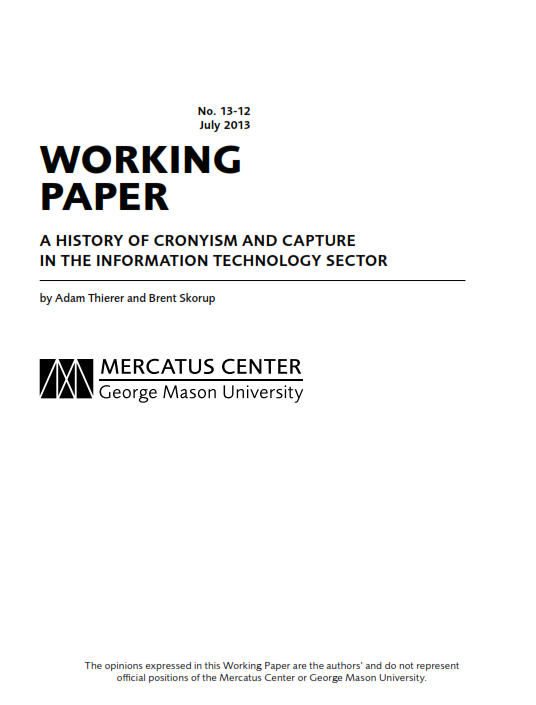
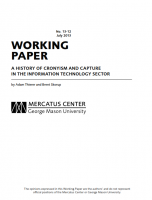 The Mercatus Center at George Mason University has just released a new paper by Brent Skorup and me entitled, “A History of Cronyism and Capture in the Information Technology Sector.” In this 73-page working paper, which we hope to place in a law review or political science journal shortly, we document the evolution of government-granted privileges, or “cronyism,” in the information and communications technology marketplace and in the media-producing sectors. Specifically, we offer detailed histories of rent-seeking and regulatory capture in: the early history of the telephony and spectrum licensing in the United States; local cable TV franchising; the universal service system; the digital TV transition in the 1990s; and modern video marketplace regulation (i.e., must-carry and retransmission consent rules, among others.
Our paper also shows how cronyism is slowly creeping into new high-technology sectors.We document how Internet companies and other high-tech giants are among the fastest-growing lobbying shops in Washington these days. According to the Center for Responsive Politics, lobbying spending by information technology sectors has almost doubled since the turn of the century, from roughly $200 million in 2000 to $390 million in 2012. The computing and Internet sector has been responsible for most of that growth in recent years. Worse yet, we document how many of these high-tech firms are increasingly seeking and receiving government favors, mostly in the form of targeted tax breaks or incentives. Continue reading →
It’s time again to look back at the major cyberlaw and information tech policy books of the year. I’ve decided to drop the top 10 list approach I’ve used in past years (see 2008, 2009, 2010) and just use a more thematic listing of major titles released in 2011. This thematic approach gets me out of hot water since I have found that people take numeric lists very seriously, especially when they are the author of one of the books and their title isn’t #1 on the list! Nonetheless, at the end, I will name what I regard as the most important Net policy book of the year.
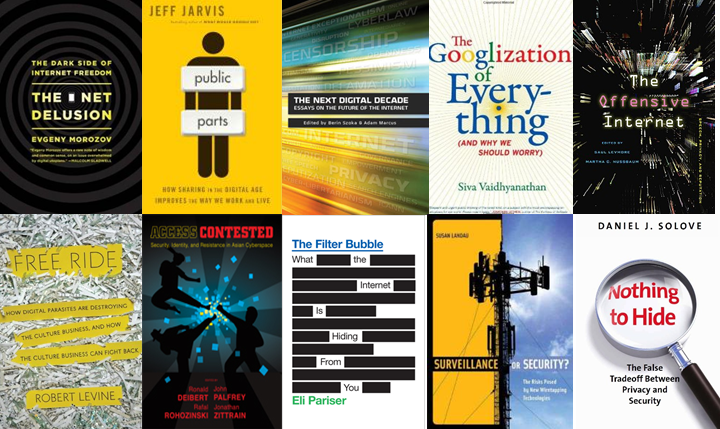
I hope I’ve included all the major titles released during the year, but I ask readers to please let me know what I have missed that belongs on this list. I want this to be a useful resource to future scholars and students in the field. [Reminder: Here’s my compilation of major Internet policy books from the past decade.] Where relevant, I’ve added links to my reviews as well as discussions with the authors that Jerry Brito conducted as part of his “Surprisingly Free” podcast series. Finally, as always, I apologize to international readers for the somewhat U.S.-centric focus of this list.
Continue reading →
Wow, what a year for cyberlaw and information technology policy books! Both in terms of number of titles and the gravity of the books released, 2010 was one of the biggest years of the past decade (perhaps matched only by 2006 or 2008 in terms of significance). So, here’s my annual list of the Most Important Info-Tech Policy Books of 2010.
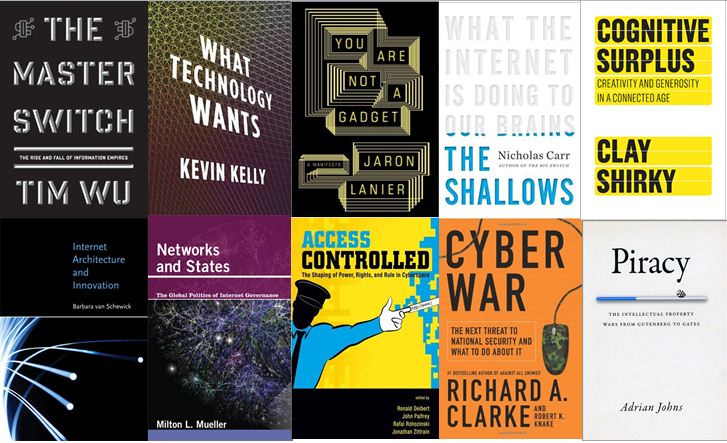 First, however, as is the case each year [see my 2008 & 2009 lists], I need to repeat a few disclaimers. First, what qualifies as an “important” info-tech policy book is highly subjective, but I would define it as a title that many people — especially scholars in the field — are currently discussing and that we will likely be referencing for many years to come. But I “weight” books in the sense that narrowly-focused titles lose a few points. For example, books that deal mostly with privacy issues, copyright law, or antitrust policy do not exactly qualify as the same sort of “info-tech policy book” as other titles that offer a broader exploration of policy issues / concerns. For that reason, “big picture” info-tech policy books tend to rank higher on my lists.
The second caveat: Merely because a book appears on my list
it does not necessarily mean I agree with everything in it. In fact, as was the case in previous years, I found much with which to disagree in my picks for the most important books of 2010 and I find that the cyber-libertarianism I subscribe to has very few fans out there.
With those caveats in mind, here are my choices for the Most Important Info-Tech Policy Books of 2010. Continue reading →
2009 was not as big of a year for Internet and information technology (“info-tech”) policy books as 2008 was, but there were still some notable titles released that offered interesting perspectives about the future of the Net and the impact the Digital Revolution is having on our lives, culture, and economy. So, like last year, I figured I would throw together my list of the 10 most important info-tech policy books of the year.
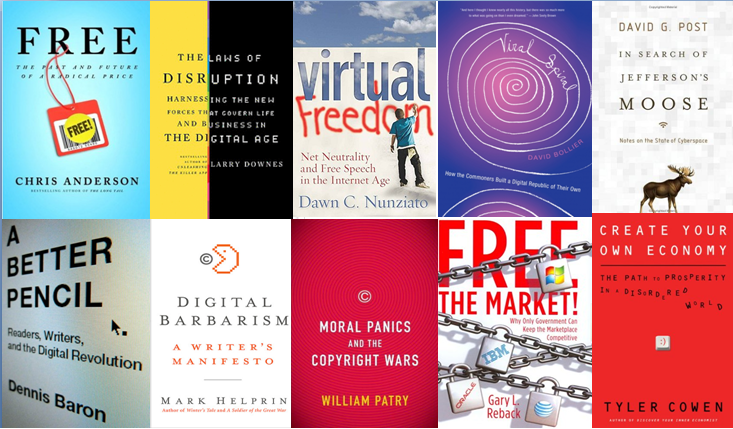 First, let me repeat a few of the same caveats and disclaimers that I set forth last year. What qualifies as an “important” info-tech policy book? Simply put, it’s a title that many people are currently discussing and that we will likely be referencing for many years to come. However, I want to be clear that merely because a book appears on my list it does not necessarily mean I agree with everything said in it. In fact, as was the case in previous years, I found much with which to disagree in my picks for the most important books of 2009 and I find that the cyber-libertarianism I subscribe to has very few fans out there.
Another caveat: Narrowly-focused titles lose a few points on my list. For example, if a book deals mostly with privacy issues, copyright law, or antitrust policy, it does not exactly qualify as the same sort of “tech policy book” as other titles found on this list since it is a narrow exploration of just one set of issues with a bearing on technology policy.
With those caveats in mind, here are my choices for the Most Important Info-Tech Policy Books of 2009. Continue reading →

 The Technology Liberation Front is the tech policy blog dedicated to keeping politicians' hands off the 'net and everything else related to technology.