[Cross posted from Huffington Post]
Does the First Amendment allow the FCC to censor “indecent” content like the occasional curse word or a brief glimpse of a bare butt on broadcast TV? The Supreme Court hears arguments on this question Tuesday in FCC v. Fox—the first time in more than 30 years the Court will squarely confront this constitutional question. The case stems from the use of “fleeting” expletives by Nicole Richie and Cher at the Billboard Music Awards Show nearly a decade ago, which prompted a draconian crackdown on broadcasters by the Bush FCC in 2004.
Our five organizations—which differ widely on many issues—have filed a joint amicus brief urging the Court to recognize that the Constitution demands an end to FCC censorship of television, given the fundamental transformation of the media landscape. In its 1978 FCC v. Pacifica decision, the Court gave broadcasting less protection than other media (like newspapers) because it was both “pervasive” in American culture and “invasive”—an “intruder” in the home from which parents were powerless to protect their children. But that rationale long ago disintegrated.
When a federal appellate court struck down the FCC’s indecency rules last year, it hit the nail on the head: “we face a media landscape that would have been almost unrecognizable in 1978.” Back then, nearly all Americans relied on broadcasting to deliver a limited range of video media to their homes. Today, only 8 to 15% percent of American households rely on over-the-air broadcasting, with the majority subscribing to cable or satellite service. More and more Americans are getting video content online from Netflix, Hulu, YouTube, and countless other sites. These services are not “intruders” in the home, but invited guests. Continue reading →
Today is the 33rd anniversary of the Supreme Court’s landmark First Amendment decision, FCC v. Pacifica Foundation. By a narrow 5-4 vote in this 1978 decision, the Court held that the FCC could impose fines on radio and TV broadcasters who aired indecent content during daytime and early evening hours. The Court used some rather tortured reasoning to defend the proposition that broadcast platforms deserved lesser First Amendment treatment than all other media platforms. The lynchpin of the decision was the so-called “pervasiveness theory,” which held that broadcast speech was “uniquely pervasive” and an “intruder” in the home, and therefore demanded special, artificial content restrictions.
Back in 2008, when
Pacifica turned 30, I penned a 6-part series critiquing the decision and discussing its impact on First Amendment jurisprudence:
In addition to those essays, I brought all my thinking together on this issue in a 2007 law review article, “Why Regulate Broadcasting: Toward a Consistent First Amendment Standard for the Information Age.” Importantly, this could be the last year we “celebrate” a Pacifica anniversary. Earlier this week, on the same day it handed down a historical video game free speech win, the Supreme Court announced that next term it will examine the constitutionality of FCC efforts to regulate “indecent” speech on broadcast TV and radio. Here’s hoping the Supreme Court takes the sensible step of undoing the unjust regulatory mess they created with Pacifica 33 years ago. Speech is speech is speech. Lawmakers should not be regulating it differently just because it’s on TV or radio instead of cable TV, satellite radio or TV, physical media, or the Internet. Continue reading →
As part of its excellent “Room for Debate” series, the New York Times has an interesting new online symposium up now asking, “Will Networks Go Wild, With No Decency Rules?” It was in response to last week’s Second Circuit decision, which again slapped down an effort by the Federal Communications Commission to defend the agency’s indecency enforcement regime. I was honored to be asked to contribute a short essay on the subject. Here are the other contributors and their essays. Take the time to check them out:
I was particularly interested in former FCC’s Chairman Michael Powell’s admission that “The [FCC’s] fleeting expletive policy was a mistake,” and that “the real problem is the now-flawed constitutional foundation on which the law is built.” Powell goes on to argue that, “We cannot have one First Amendment for broadcasting and another one for every other medium. This vestige of a bygone era provides fertile ground for mischief — culture wars, political agenda and moral mandates. It’s high time for the high court to bring our laws into the 21st century.”
I wholeheartedly agree, and I wrote a lengthy law review article on just that topic back in 2007 entitled,“
Why Regulate Broadcasting: Toward a Consistent First Amendment Standard for the Information Age.” If you find it too boring, just watch this video I made summarizing the key points, which I called “America’s First Amendment Twilight Zone.”
The Second Circuit just threw out the FCC’s broadcast indecency rules—which had led to heavy fines for “fleeting expletives”—as “unconstitutionally vague, creating a chilling effect that goes far beyond the fleeting expletives at issue here.” What’s ultimately most important about this decision is not what the court did, but what it said: The Constitutional framework that has allowed broadcast censorship has been rendered obsolete by the rise of the Internet and parental empowerment tools for new and old media.
In short, the court utterly rejected the Supreme Court’s 1978
Pacifica decision
—which gave the FCC great discretion in regulating indecency on broadcast radio and television in order to protect children who might be in the audience during daytime and early evening hours, citing the unique “pervasiveness” and “invasiveness” of broadcasting into the home. The court fully embraced what we’ve been saying for years—neither rationale holds true anymore:
we face a media landscape that would have been almost unrecognizable in 1978. Cable television was still in its infancy. The Internet was a project run out of the Department of Defense with several hundred users. Not only did Youtube, Facebook,and Twitter not exist, but their founders were either still in diapers or not yet conceived. In this environment, broadcast television undoubtedly possessed a “uniquely pervasive presence in thelives of all Americans.”
The same cannot be said today. The past thirty years has seen an explosion of media sources, and broadcast television has become only one voice in the chorus. Cable television is almost as pervasive as broadcast…. The internet, too, has become omnipresent, offering access to everything from viral videos to feature films and, yes, even broadcast television programs…. Moreover, technological changes have given parents the ability to decide which programs they will permit their children to watch. (15-16)
Thus, the Second Circuit all but begged the Supreme Court to throw out
Pacifica completely, but quickly noted that it is “bound by Supreme Court precedent, regardless of whether it reflects today’s realities” (17). Fortunately, the court was able to reach the same result on vagueness grounds. It’s worth reading this key passage to see what a consistent approach to the First Amendment would look like: Continue reading →
Glen Robinson, my favorite professor back at Virginia Law, will be giving a lecture about “Regulating Communications: Stories from the First Hundred Years” at George Mason Law School this Thursday (2/18) at 4 pm. You simply couldn’t find a better person to give that talk. Robinson isn’t quite old enough to first-hand stories all the way back to the birth of the Federal Radio Commission in 1926 and the FCC in 1934, but he started practicing communications law back in 1961, was an FCC Commissioner 1974-76, and has taught at UVA since 1976 (until finally retiring in 2008).
Reading about his long career is a bit like watching the British comedy series Black Adder: Somehow, like Rowan Atkinson’s character Black Adder, Robinson keeps popping up again and again at pivotal moments in communications law history—most notably, he worked to draft early anti-cable rules in the 1960s and voted for the FCC’s indecency prosecution against George Carlin’s “Filthy Words” monologue. But unlike Black Adder, who always happens to be at the right place at the right time, make the wrong decisions and foolishly learns nothing, Robinson sometimes made the wrong decision, but demonstrated that rare ability to rethink his approach and admit he was wrong—an intellectual honesty most famously exemplified by FA Hayek. Robinson grew to become among the most trenchant, and certainly the most sage, critic of the FCC’s constant evolution towards censorship and curtailing competition in the communications industry. His general skepticism about administrative regulation is perhaps the most thoughtful and refined you’ll find in academe—and not just in communications law. Continue reading →
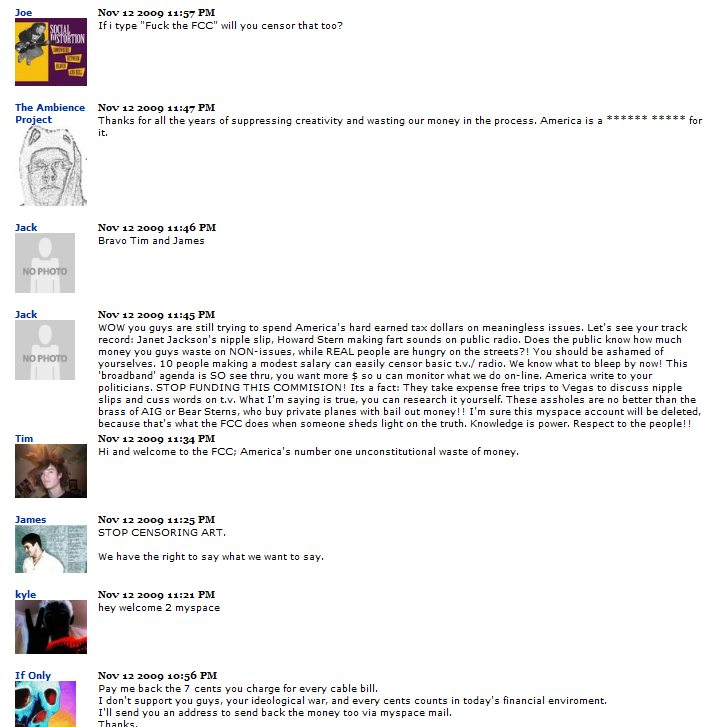
Oh my. So today, as part of its ongoing effort to look like the hip new regulatory agency on the block, the Federal Communications Commission decided to launch a MySpace page. Really. Big. Mistake.
I mean, shouldn’t someone over there have known it would take about 2 milliseconds for various cranks to launch into profanity-laced rants that would make George Carlin blush? Sure enough, the page is already littered with some of the most colorful language you’ll ever lay your eyes on, mixed in with some 9/11 conspiracy theories, a plug for the Marijuana Policy Posse, and something about the FCC “build[ing] a cone of terror in [our] homes.”
Go check it out, but avert the children’s eyes first. It ain’t pretty. Which begs the question: Will the FCC apply its Pacifica indecency standard to its own MySpace page? Seems like their site is pretty “pervasive” to me, and there could be “children in the viewing audience.” Time to censor these “fleeting expletives” on the FCC’s MySpace page!
Over at Ars Technica, Matt Lasar does a nice job pointing out how the FCC’s quarterly indecency complaint totals have again been inflated by one group: the Parents Television Council. This is something Lasar has written about before and he’s one of the few journalists who continues to ask sharp questions about the ongoing manipulation of these statistics by PTC. As Lasar notes in his latest piece:
for the first quarter of this year, show the viewers relatively calm at 578 complaints in January, then 505 in February, followed by 179,997 in March? 179,997? Um, did we miss something? Did television really get that much more indecent in March? No worries. In these situations, we know what to do. We go over and check out the Parents Television Council‘s website. And sure enough, there’s a plausible instigator—a PTC viewer action alert crusade against a March 8 episode of the animated comedy show the PTC just loves to hate, Fox TV’s Family Guy.
This “complaint box stuffing” is something I wrote quite a bit about in the past, especially in my 2005 paper, “Examining the FCC’s Complaint-Driven Broadcast Indecency Enforcement Process.” As I pointed out there, “The PTC’s increasingly effective use of computer-generated campaigns against specific TV programs is a leading factor in explaining the large jump in indecency complaints in recent years.” Specifically, as I noted in that paper (as well as a Supreme Court filing with my friends at CDT), the FCC quietly and without major notice made two methodological changes to its tallying of broadcast indecency complaints in 2003 & 2004 that PTC requested: Continue reading →
 The latest edition (Version 4.0) of my PFF special report on “Parental Controls and Online Child Protection: A Survey of Tools & Methods” is now up. For those not familiar with the report, it explores the market for parental control tools, rating schemes, education and media literacy efforts, and various other tools, methods, and initiatives aimed at promoting online child safety. After evaluating that state of this market, I conclude: “There has never been a time in our nation’s history when parents have had more tools and methods at their disposal to help them decide what constitutes acceptable media content in their homes and in the lives of their children.” Moreover, I believe that the parental controls and content management tools cataloged in the report represent a better, less restrictive alternative to government regulation.
Version 4.0 of the report is now over 250 pages long (up from 200 pages in Version 3.0) and it contains almost 70 exhibits (up from 50), 725 references (up from roughly 500), and numerous updates in all five sections of the book. Major updates have been made to the Internet, social networking, and mobile media sections, reflecting the growing importance of those sectors and issues. Other new sections or appendices have also been added to the report, including:
- a new section examining how many households really need parental control tools;
- a new appendix on the downsides of mandatory parental controls and restrictive default settings;
- a new section on the dangers of “deputizing the online middleman” solution as an approach to solving child safety concerns;
- a new appendix reviewing the findings of 5 past online safety task forces;
- … and much more.
I issue major updates once a year and 1 or 2 minor tweaks during the course of the year to reflect the evolution of the parental control and online child safety marketplace and debate. The report is available free-of-charge on the PFF website, and the previous editions of the report are housed there too in case you want to see how it has evolved over the past couple of years. For those interested in taking a quick look at the report, I have embedded it down below the fold as a Scribd file. Finally, as is always the case, I encourage readers to send me updates and suggestions for how to improve the report and I will incorporate them into future versions.
Continue reading →
 The Senate Commerce Committee held a hearing yesterday where a number of Senators as well as Julius Genachowski, the new Chairman of the Federal Communications Commission, did a lot of fretting about the state of the modern children’s television programming marketplace. According to the Wall Street Journal, Senate Commerce Committee Chairman Jay Rockefeller (D-WV):
suggested that a “little red button” be required on TVs so that a child could push the button to find out how a show is rated. Democratic Sen. Mark Pryor of Arkansas agreed that a red button might help since parents often have difficulties figuring out which shows are appropriate for their children to watch.
Well, I have some good news for the Senators: There are already quite a few little buttons on every remote control made today, and at least one of those buttons can pull up an on-screen guide to get more program info! (Another of them can turn the TV off!) Moreover, the ratings for just about every program already appear at the beginning of each show, and sometimes in between. And you can find out plenty more online about every TV show under the sun if you care to look. So, I’m not sure what that fuss is all about, and we certainly don’t need to mandate “little red buttons” on every TV set when program information can be found in so many other ways.
What is more troubling about all the hand-wringing taking place at the hearing, as well as the talk of reopening the Children’s Television Act of 1990 to potentially impose more content mandates on video programmers and distributors, is that: (1) there doesn’t seem to be much appreciation for just how much wonderful children’s programming is out there today compared to the past, and (2) there doesn’t seem to be much recognition of the serious First Amendment issues at stake when government gets involved in the messy business of regulating video programming.
Continue reading →
Ben Edelman of the Harvard Business School has just released an interesting new study in the Journal of Economic Perspectives entitled, “Red Light States: Who Buys Online Adult Entertainment?” Using data he obtained from a top-10 seller of adult entertainment, Edelman examined adult website subscriptions on the zip code level and found that conservatives seem to be every bit as interested in pornography as liberals. In fact, “Subscriptions [to adult entertainment sites] are slightly more prevalent in states that have enacted conservative legislation on sexuality” and “subscriptions are also more prevalent in states where surveys indicate conservative positions on religion, gender roles, and sexuality.” He also finds that:
In states where more people agree that “Even today miracles are performed by the power of God” and “I never doubt the existence of God,” there are more subscriptions to this service. Subscriptions are also more prevalent in states where more people agree that “I have old-fashioned values about family and marriage” and “AIDS might be God’s punishment for immoral sexual behavior.”
Even more interesting is the fact that, on a state-by-state basis, Utah* residents topped all other Americans in terms of subscriptions to online adult entertainment websites. Finally, Edelman concludes:
On the whole, these adult entertainment subscription patterns show a remarkable consistency: all but eleven states have between two and three subscribers to this service per thousand broadband households, and all but four have between 1.5 and 3.5. With interest in online adult entertainment relatively constant across regions, there’s little sign of a major divide.
But it’s not just Internet porn where we see this trend at work. As I noted in my law review article, “Why Regulate Broadcasting?” we’ve seen a similar trend at work with television. When you look at some of the TV shows that conservatives and religious groups gripe most about, you might be surprised to know that it is conservatives who make those shows as popular as they are!
Continue reading →

 The Technology Liberation Front is the tech policy blog dedicated to keeping politicians' hands off the 'net and everything else related to technology.