The success of the Internet and the modern digital economy was due to its open, generative nature, driven by the ethos of “permissionless innovation.” A “light-touch” policy regime helped make this possible. Of particular legal importance was the immunization of online intermediaries from punishing forms of liability associated with the actions of third parties.
As “software eats the world” and the digital revolution extends its reach to the physical world, policymakers should extend similar legal protections to other “generative” tools and platforms, such as robotics, 3D printing, and virtual reality.
In other words, we need a Section 230 for the “maker” movement. Continue reading →
 As I noted here a few days ago, the Federal Communications Commission held a workshop on Tuesday about “Speech, Democratic Engagement, and the Open Internet.” It was a shockingly one-sided affair with the deck being stacked almost entirely in favor of advocates of Net neutrality regulation. Worse yet, those advocates shamelessly made up spooky stories about a future of “private censorship” that could only be remedied by using the First Amendment as a club to beat private players into submission. The token opposition at this Chicken Little circus was Robert Corn-Revere, a Partner at the law firm of Davis Wright Tremaine LLP in Washington, D.C. Bob set the record straight–both in terms of baseless accusations that were flying that day as well as the revisionist histories of the First Amendment that were being put forward. I’m happy to report that Bob allowed PFF to reprint his remarks as a new white paper entitled, “The First Amendment, the Internet & Net Neutrality: Be Careful What You Wish For.”
In his essay, Corn-Revere discusses the relationship between the First Amendment and regulatory policy, particularly the treatment of new communications technologies, and he warns that government regulation of broadband networks could “provide the vehicle for advancing new First Amendment theories for media regulation” and online speech and expression more generally. “It should not be forgotten,” he argues, “that the federal government’s initial impulse was to censor the Internet and to subject it to a far lower level of First Amendment protection. It pursued this agenda for more than a decade but was blocked by a series of First Amendment rulings.” The Communications Decency Act and the Child Online Protection Act are just two notable examples. Luckily, the courts determined that “the open Internet would be at great risk if the government is allowed to exercise such power,” he notes, and they struck down such laws.
Continue reading →
 by Adam Thierer & Berin Szoka — (Ver. 1.0 — Summer 2009)
We are attempting to articulate the core principles of cyber-libertarianism to provide the public and policymakers with a better understanding of this alternative vision for ordering the affairs of cyberspace. We invite comments and suggestions regarding how we should refine and build-out this outline. We hope this outline serves as the foundation of a book we eventually want to pen defending what we regard as “Real Internet Freedom.” [Note: Here’s a printer-friendly version, which we also have embedded down below as a Scribd document.]
I. What is Cyber-Libertarianism?
Cyber-libertarianism refers to the belief that individuals—acting in whatever capacity they choose (as citizens, consumers, companies, or collectives)—should be at liberty to pursue their own tastes and interests online.
Generally speaking, the cyber-libertarian’s motto is “Live & Let Live” and “Hands Off the Internet!” The cyber-libertarian aims to minimize the scope of state coercion in solving social and economic problems and looks instead to voluntary solutions and mutual consent-based arrangements.
Cyber-libertarians believe true “Internet freedom” is freedom
from state action; not freedom for the State to reorder our affairs to supposedly make certain people or groups better off or to improve some amorphous “public interest”—an all-to convenient facade behind which unaccountable elites can impose their will on the rest of us.
Continue reading →
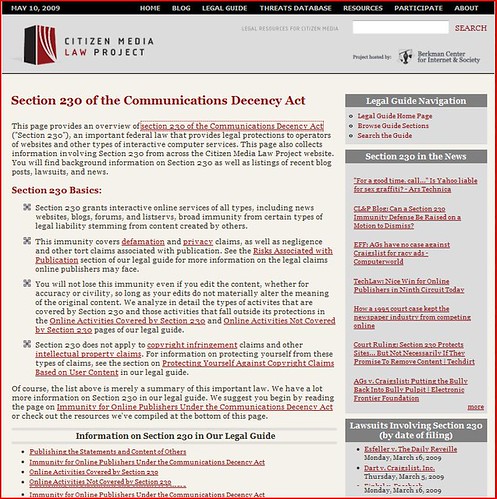
If you’re a cyberlaw geek or tech policy wonk who needs to keep close tabs on Sec. 230 developments, here’s a terrific resource from the Citizen Media Law Project up at the Harvard Berkman Center. The site offers a wealth of background info, including legislative history, all the relevant case law surrounding 230, and breaking news on this front. Just a phenomenal resource; a big THANK YOU! to the folks at CMLP who put this together.
If you’re interested in these issues, you might also want to check out this friendly debate that Harvard’s John Palfrey and I engaged in over at Ars recently as well as my essay on how Sec. 230 has spawned a “utopia of utopias” online.
David Margolick has penned a lengthy piece for Portfolio.com about the AutoAdmit case, which has important ramifications for the future of Section 230 and online speech in general. Very brief background: AutoAdmit is a discussion board for students looking to enter, or just discuss, law schools. Some threads on the site have included ugly — insanely ugly — insults about some women. A couple of those women sued to reveal the identities of their attackers and hold them liable for supposedly wronging them. The case has been slowly moving through the courts ever since. Again, read Margolick’s article for all the details. The important point here is that the women could not sue AutoAdmit directly for defamation or harassment because Section 230 of the Communications Decency Act of 1996 immunizes websites from liability for the actions of their users. Consequently, those looking to sue must go after the actual individuals behind the comments which (supposedly) caused the harm in question.
I am big defender of Section 230 and have argued that it has been the cornerstone of Internet freedom. Keeping online intermediaries free from burdensome policing requirements and liability threats has created the vibrant marketplace of expression and commerce that we enjoy today. If not for Sec. 230, we would likely live in a very different world today.
Sec. 230 has come under attack, however, from those who believe online intermediaries should “do more” to address various concerns, including cyber-bullying, defamation, or other problems. For those of us who believe passionately in the importance of Sec. 230, the better approach is to preserve immunity for intermediaries and instead encourage more
voluntary policing and self-regulation by intermediaries, increased public pressure on those sites that turn a blind eye to such behavior to encourage them to change their ways, more efforts to establish “community policing” by users such that they can report or counter abusive language, and so on.
Of course, those efforts will never be fool proof and a handful of bad apples will still be able to cause a lot of grief for some users on certain discussion boards, blogs, and so on. In those extreme cases where legal action is necessary, it would be optimal if every effort was exhausted to go after the actual end-user who is causing the problem before tossing Sec. 230 and current online immunity norms to the wind in an effort to force the intermediaries to police speech. After all, how do the intermediaries know what is defamatory? Why should they be forced to sit in judgment of such things? If, under threat of lawsuit, they are petitioned by countless users to remove content or comments that those individuals find objectionable, the result will be a massive chilling effect on online free speech since those intermediaries would likely play is safe most of the time and just take everything down. Continue reading →
 I haven’t been blogging much lately because, along with my PFF colleagues Berin Szoka and Adam Marcus, I’m working on a lengthy paper about the importance of Section 230 to Internet freedom. Section 230 is the sometimes-forgotten portion of the Communications Decency Act of 1996 that shielded Internet Service Providers (ISP) from liability for information posted or published on their systems by users or other third parties. It was enshrined into law with the passage of the historic Telecommunications Act of 1996. Importantly, even though the provisions of the CDA seeking to regulate “indecent” speech on the Internet were struck down as unconstitutional, Sec. 230 was left untouched.
Section 230 of the CDA may be the most important and lasting legacy of the Telecom Act and it is indisputable that it has been remarkably important to the development of the Internet and online free speech and expression in particular. In many ways, Section 230 is the cornerstone of “Internet freedom” in its truest and best sense of the term.
In recent years, however, Sec. 230 has come under fire from some academics, judges, and other lawmakers. Critics raise a variety of complaints — all of which we will be cataloging and addressing in our forthcoming PFF paper. But what unifies most of the criticisms of Sec. 230 is the belief that Internet “middlemen” (which increasingly includes almost any online intermediary, from ISPs, to social networking sites, to search engines, to blogs) should do more to police their networks for potentially “objectionable” or “offensive” content. That could include many things, of course: cyberbullying, online defamation, harassment, privacy concerns, pornography, etc. If the online intermediaries failed to engage in that increased policing role, they would open themselves up to lawsuits and increased liability for the actions of their users.
The common response to such criticisms — and it remains a very good one — is that the alternative approach of strict secondary liability on ISPs and other online intermediaries would have a profound “chilling effect” on online free speech and expression. Indeed, we should not lose sight of what Section 230 has
already done to create vibrant, diverse online communities. Brian Holland, a visiting professor at Penn State University’s Dickinson School of Law, has written a brilliant paper that does a wonderful job of doing just that. It’s entitled “In Defense of Online Intermediary Immunity: Facilitating Communities of Modified Exceptionalism” and it can be found on SSRN here. I cannot recommend it highly enough. It is a masterpiece.
Continue reading →
Last month, I noted that UCLA Law School professor Doug Lichtman has a wonderful new monthly podcast called the “Intellectual Property Colloquium.” This month’s show features two giants in the field of tech policy — George Washington Law Professor Daniel Solove and Santa Clara Law Professor Eric Goldman –- discussing online privacy, defamation, and intermediary liability. More specifically, in separate conversations, Solove and Goldman both consider the scope of Section 230 of the Communications Decency Act of 1996, which shields Internet intermediaries from liability for the speech and expression of their users. Sec. 230 is the subject of hot debate these days and Solove and Goldman provide two very different perspectives about the law and its impact.
Goldman calls Sec. 230 “pure cyberspace exceptionalism” in the sense that it breaks from traditional tort norms governing intermediary liability. But he argues that this new online version of intermediary liability (which is extremely limited in scope) encourages more robust speech and expression than the older, offline version of liability (which was far more strict). I completely agree with Eric Goldman, but I respect the arguments that Lichtman and Solove raise about the privacy and defamation problems raised by the purist approach that Goldman and I favor.
Goldman also does a nice job dissecting the Roomates.com and Craigslist.com cases. And Lichtman brings up the JuicyCampus.com case during the conclusion. These are important cases for the future of Sec. 230 and online liability. Incidentally, there’s also an interesting conversation between Lichtman and Solove (around the 32:00 mark) about an issue that Alex Harris and Tim Lee have been raising here about the nature of online contracts and the perils of messy EULAs / Terms of Service (TOS).
These are two absolutely terrific conversations. Very in-depth and very highly recommended. Listen here.
[Note: I recently reviewed Daniel Solove’s important new book,
Understanding Privacy, here.]
 With the publication of Understanding Privacy (Harvard University Press 2008), George Washington University Law School professor Daniel J. Solove has firmly established himself as one of America’s leading intellectuals in the field of information policy and cyberlaw. Solove had already made himself a force to be reckoned with in this field with the publication of important books like The Future of Reputation: Gossip, Rumor, and Privacy on the Internet (Yale University Press 2007), The Digital Person: Technology and Privacy in the Information Age (NYU Press 2004) and his treatise on Information Privacy Law with Paul M. Schwartz of the Berkeley School of Law (Aspen Publishing, 2d ed. 2006). But with Understanding Privacy, Solove has now elevated himself to that rarefied air of “people worth watching” in the cyberlaw field; an intellectual — like Lawrence Lessig or Jonathan Zittrain — whose every publication becomes something of an event in the field to which all eyes turn upon release.
Like those other intellectuals, however, my respect for their stature should not be confused with agreement with their positions. In fact, my disagreements with Lessig and Zittrain are frequently on display here and, we have been critical of Solove here in the past as well. [Here’s Jim Harper’s review of Solove’s last book, with which I am in wholehearted agreement.] In a similar vein, although I greatly appreciate what Prof. Solove attempts to accomplish in Understanding Privacy — and I am sure it will change the way we conceptualize and debate privacy policy in the future — I found his approach and conclusions highly problematic.
Continue reading →
 The Progress & Freedom Foundation has just launched the new Center for Internet Freedom. CIF offers an alternative to the proliferation of advocacy groups calling for government intervention online by offering timely analyses and critiques of proposals that diminish the vital role of free markets, free speech and property rights. We aim to drive the Internet policy debate in new directions by emphasizing a layered approach of technological innovation, user education, user self-help, industry self-regulation, and the enforcement of existing laws consistent with the First Amendment. Such an approach is a less restrictive—and generally more effective—alternative to increased regulation.
Here are some of the issues I’ll be working on as CIF’s Director in conjunction with my esteemed colleagues Adam Thierer, Adam Marcus, and adjunct fellows:
- Defending online advertising as the lifeblood of online content & services, especially in the “Long Tail”;
- Emphasizing market solutions to problems of privacy protection, especially regarding the use of cookies and packet inspection data;
- Protecting online speech and expression both in the U.S. and abroad;
- Defending Section 230 immunity for Internet intermediaries;
- Opposing online taxation and legal barriers to e-commerce and digital payments, especially at the state and local levels; and
- Ensuring that Internet governance remains transparent and accountable without hampering the evolution of the Internet.

 The Technology Liberation Front is the tech policy blog dedicated to keeping politicians' hands off the 'net and everything else related to technology.