Posts tagged as:

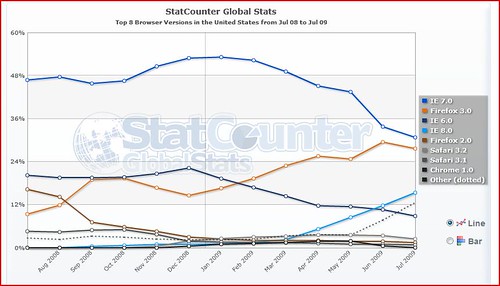
Really, what would we do without European antitrust regulators protecting us from the evils of browser innovation? If Microsoft was allowed to actually bundle its Internet Explorer browser alongside its operating system we might actually do something really crazy… like perhaps try it! After all, the latest browser stats make it pretty clear most of us have a choice and that fewer and fewer of us rely on IE. As Erick Schonfeld noted on Tech Crunch today:

The new browser wars on on. More than a decade after Microsoft killed off Netscape with Internet Explorer, competition in the browser market has never been stronger. Just last week, Mozilla released Firefox 3.5, which has now been downloaded nearly 14 million times. Earlier in June, Apple released Safari 4. In March, Microsoft introduced Internet Explorer 8, and Google came out with a speedier beta of its Chrome browser. Some early data is coming in showing relative market share and how fast people are upgrading. If you look at the chart above from Statcounter, it indicates that since March Internet Explorer has lost 11.4 percent market share to other browsers. [..] Where did that go? It went to Firefox, Safari, and Chrome. Nearly 5 percent of that, or about half, went to Firefox 3.0, which currently has 27.6 percent market share. That doesn’t count last week’s upgrade.

08-09 browser stats

Alas, as I pointed out in my essay a few weeks ago (“European Regulators Think Consumers Too Stupid to Know How to Download a Different Browser“), some Euro-crats still seem to believe that changing browsers requires great detective skills to unearth alternatives.  It’s just pure poppycock and yet another sad example of how antitrust law is usually hopelessly behind the times and has absolutely nothing to do with protecting consumers or fostering innovation.

Now, please excuse me while I get back to surfing the Net via Firefox and Chrome (and Opera on my mobile phone). My God, how did I ever find these browser alternatives!

According to Ina Fried of CNet News, Microsoft plans to remove its Internet Explorer web browser from the new versions of Windows 7 when it ships it in Europe later this year. [Additional coverage at ZDNet.]  MS is apparently doing so to assuage the concerns of EU antitrust officials, who have been obsessed with the company for the past decade. [Update: Here is MS official announcement.]

Apparently, European officials think their citizens are too stupid to find an alternative browser.  I mean, seriously, how hard is it?  Does the competition lack name recognition such that consumers can’t find them?  Hmmm… Google and Apple seem to be pretty well known brands, and their browsers (Chrome & Safari) are pretty easy to find.  And then there’s Mozilla’s Firefox browser (my PC favorite) and Opera (my mobile phone favorite), which are outstanding browsers. [Incidentally, Firefox already has 31% share of the European market.]

OK, OK, the regulators might say, but these competitors are just too expensive!  Uh, no, wait… every one of them is free. So, strike that theory.

Well, the regulators need another theory then. How about illegal tying of products and services! You know, there’s only certain sites or services you can use with IE, right?   Nope, that theory doesn’t work either.  And does anyone believe that MS could really tie OS functionality to the use of IE? How long would the world tolerate Outlook e-mails or Word documents that only allowed linking to URLs via IE??  Come on.

OK, any other theories left? Not that I can think of. Which brings us back to the only theory the Euro-crats have left: people are sheep. They’ll take whatever MS bundles into the OS free, you see, and they will use it more than they use competing products.  Thus, we regulators have to save them from their own stupidity! The masses just don’t know what’s good for them!  These free, integrated services are harming them! And, therefore, the only remaining solution is to kill innovation by crippling functionality and removing the free offering. That’s pro-consumer! … or so say the European antitrust bureaucrats.

Meanwhile, back in the real world, a whole lotta innovation continues to take place. But shhhh.. don’t tell the Euro-crats. They need a company to pick on. Welcome to the Theater of the Techno-Absurd.

Shame on Mozilla

by on February 10, 2009 · 11 comments

Over at Ars, Ryan Paul has an appropriately sharp-tongued response to the Mozilla Foundation’s troubling move to become a cheerleader for the European Commission’s ongoing antitrust efforts against Microsoft. Apparently Mozilla will assist the EC’s investigation “by offering expertise about the browser market.”

Paul focuses on what’s wrong with this in both a micro and macro sense. He rightly points out that the potential remedies here do not bode well for the future of this sector, since regulatory tinkering with high-tech product standards is bound to end badly and create a terrible precedent for future interventions. “It’s hard to find a rational argument in favor of mandatory standards enforcement,”  Paul says. “It would be punitive and unhelpful to the advancement of the web.” Moreover, Paul notes that things have never looked better on the browser front:

Claims that Microsoft’s monopoly status has eliminated competition in the browser market sound hollow in the face of the profoundly vibrant browser market that exists today. The record-setting launch of Firefox 3 added up to over 8 million downloads in the first 24 hours alone. Firefox’s global market share continues to climb every month and the browser has grabbed almost 30 percent of the European market.

And let’s not forget about those two little companies called Google and Apple who have competing products in the field! They’re making serious inroads in the browser wars. Moreover, Microsoft is struggling to hold on to whatever “dominance” they have left in their core market: OS. As Paul concludes:

To the observant tech enthusiast, all signs seem to indicate that Microsoft’s monopoly is on its way out. The Redmond giant is in no danger of annihilation, but it’s definitely not positioned to dictate terms to the rest of the industry anymore.

But what is perhaps most shocking about Mozilla’s call for intervention is the way that Mozilla Foundation chairperson Mitchell Baker minimizes the importance of not just Firefox, but the entire open source movement, when justifying EC intervention in this marketplace.

Continue reading →

When people ask me why I do what I do for a living — and, more specifically, why I focus all my attention on digital media and technology policy — I often respond by showing them the new gadgets or software I am playing with at any given time.  I just love digital technology.  I am swimming in a sea of digital gadgets, consumer electronics, online applications, computing software, video games, and all sorts of cyber-stuff.

Anyway, even though this is a technology policy blog, I sometimes highlight new digital toys or applications that have changed my life for the better. As the year winds down, therefore, I thought I would share with you five technologies that improved my life and productivity in 2008. I’d also love to hear from all of you about the technologies that you fell in love with this year in case I might have missed them. Here’s my list:

#1) Naturally Speaking 10:

Nat Speak boxThanks to Nate Anderson’s outstanding review over at Ars Technica, I finally made the plunge and bought Dragon Naturally Speaking 10 earlier this month.  Wow, what a life-changer. I had played around with an earlier version of this market-leading speech recognition technology and found it somewhat clunky and unreliable. But Ver. 10, has ironed out almost all the old problems and become an incredibly sophisticated piece of software in the process. I love the way I can use simple voice commands to navigate menus in Microsoft Word and in Firefox. Perhaps best of all, I can dictate random rants into a pocket recording device and then upload them to Naturally Speaking (via a USB connection) and have them instantly transcribed. I’m even composing blog entries like this using it! Only problem is inserting HTML code; that’s still a hassle. Also, I find that switching from one input device to another definitely affects the quality of the transcription. Once you “train” Naturally Speaking using one device, it makes sense to stick with it. It’s not just the quality of the microphone; it’s also the proximity to your mouth that makes a difference. Regardless, this is one great product and, best of all, it’s should help save my rapidly-aging hands from becoming prematurely arthritic! All those years of video games and keyboards have taken their toll. Continue reading →

By Berin Szoka & Adam Thierer

As we noted in our intro to this ongoing series, Google’s tenth anniversary has passed with Googlephobia reaching new heights of hysteria.

But is Google really too big and dangerous, or are people just too lazy to find other alternatives to each of the wonderful services that Google offers?  If one is truly paranoid about the firm’s supposed dominance, it doesn’t take much effort to live a Google-free life. To prove it, we set out to find alternatives to each of the services that Google provides.  After awhile, we got a little tired of compiling alternatives in each category and just provided links for the additional choices at your disposal.  It’s tough to see what the fuss is about with the cornucopia of choices at our disposal.  If you don’t like Google, then just don’t use it or any of its services.  The choice is yours.

In each case, we’ve listed Google first, even though Google may not be the market leader ( e.g., Google’s relatively unknown social network Orkut).

Search Engines

Continue reading →