CollegeHumor has created this amazing video, “Black Mirror Episodes from Medieval Times,” which is a fun parody of the relentless dystopianism of the Netflix show “Black Mirror.” If you haven’t watched Black Mirror, I encourage you to do so. It’s both great fun and ridiculously bleak and over-the-top in how it depicts modern or future technology destroying all that is good on God’s green earth.
The CollegeHumor team picks up on that and rewinds the clock about a 1,000 years to imagine how Black Mirror might have played out on a stage during the medieval period. The actors do quick skits showing how books become sentient, plows dig holes to Hell and unleash the devil, crossbows destroy the dexterity of archers, and labor-saving yokes divert people from godly pursuits. As one of the audience members says after watching all the episodes, “technology will truly be the ruin of us all!” That’s generally the message of not only Black Mirror, but the vast majority of modern science fiction writing about technology (and also a huge chunk of popular non-fiction writing, too.)
Oh man, I could not stop laughing at this old “Kids Guide to the Internet” video from the 90s. My thanks to my former colleague Amy Smorodin for tweeting it out today. I just had to post it here so that everyone could enjoy.
(Note: You can turn this video into a great drinking game. Just make everyone in the room raise their glass each time the lines “Does your computer have a modem?” and “Not all that cybernet stuff, OK?” are uttered.) And yes, as the opening line of the video notes, “the first thing you need to know about the Internet is that it is amazing.”
In a recent essay here “On the Line between Technology Ethics vs. Technology Policy,” I made the argument that “We cannot possibly plan for all the ‘bad butterfly-effects’ that might occur, and attempts to do so will result in significant sacrifices in terms of social and economic liberty.” It was a response to a problem I see at work in many tech policy debates today: With increasing regularity, scholars, activists, and policymakers are conjuring up a seemingly endless parade of horribles that will befall humanity unless “steps are taken” to preemptive head-off all the hypothetical harms they can imagine. (This week’s latest examples involve the two hottest technopanic topics du jour: the Internet of Things and commercial delivery drones. Fear and loathing, and plenty of “threat inflation,” are on vivid display.)
I’ve written about this phenomenon at even greater length in my recent law review article, “Technopanics, Threat Inflation, and the Danger of an Information Technology Precautionary Principle,” as well as in two lengthy blog posts asking the questions, “Who Really Believes in ‘Permissionless Innovation’?” and “What Does It Mean to ‘Have a Conversation’ about a New Technology?” The key point I try to get across in those essays is that letting such “precautionary principle” thinking guide policy poses a serious threat to technological progress, economic entrepreneurialism, social adaptation, and long-run prosperity. If public policy is guided at every turn by the precautionary mindset then innovation becomes impossible because of fear of the unknown; hypothetical worst-case scenarios trump all other considerations. Social learning and economic opportunities become far less likely under such a regime. In practical terms, it means fewer services, lower quality goods, higher prices, diminished economic growth, and a decline in the overall standard of living.
Indeed, if we live in constant fear of the future and become paralyzed by every boogeyman scenario that our creative little heads can conjure up, then we’re bound to end up looking as silly as this classic 2005 parody from
The Onion, “Everything That Can Go Wrong Listed.” Continue reading →
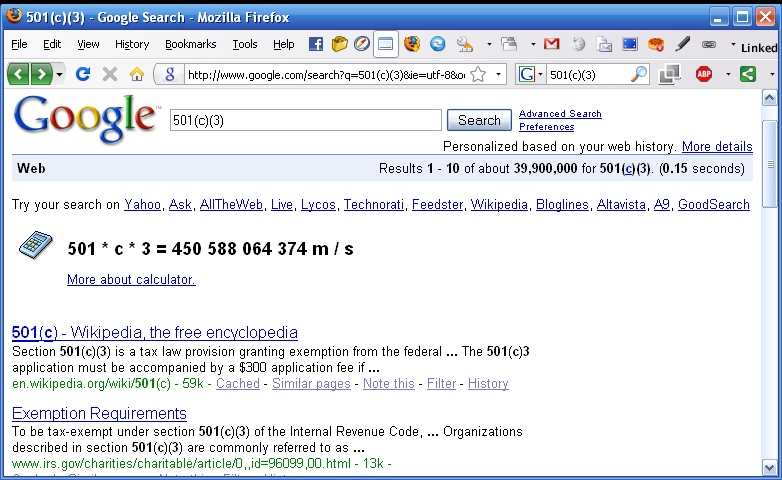
If you don’t get it, “c” this. Incidentally, you can easily add links to other search engines (as I have) by installing the CustomizeGoogle Firefox extension, among many other cool features.
The Technology Liberation Front is the tech policy blog dedicated to keeping politicians' hands off the 'net and everything else related to technology. Learn more about TLF →


 The Technology Liberation Front is the tech policy blog dedicated to keeping politicians' hands off the 'net and everything else related to technology.