Almost every argument against technological innovation and progress that we hear today was identified and debunked by Samuel C. Florman a half century ago. Few others since him have mounted a more powerful case for the importance of innovation to human flourishing than Florman did throughout his lifetime.
Chances are you’ve never heard of him, however. As prolific as he was, Florman did not command as much attention as the endless parade of tech critics whose apocalyptic predictions grabbed all the headlines. An engineer by training, Florman became concerned about the growing criticism of his profession throughout the 1960s and 70s. He pushed back against that impulse in a series of books over the next two decades, including most notably:
The Existential Pleasures of Engineering (1976), Blaming Technology: The Irrational Search for Scapegoats (1981), and The Civilized Engineer (1987). He was also a prolific essayist, penning hundreds of articles for a wide variety of journals, magazines, and newspapers beginning in 1959. He was also a regular columnist for MIT Technology Review for sixteen years.
Florman’s primary mission in his books and many of those essays was to defend the engineering profession against attacks emanating from various corners. More broadly, as he noted in a short autobiography on his personal website, Florman was interested in discussing, “the relationship of technology to the general culture.”
Florman could be considered a “rational optimist,” to borrow Matt Ridley’s notable term[1] for those of us who believe, as I have summarized elsewhere, that there is a symbiotic relationship between innovation, economic growth, pluralism, and human betterment.[2] Rational optimists are highly pragmatic and base their optimism on facts and historical analysis, not on dogmatism or blind faith in any particular viewpoint, ideology, or gut feeling. But they are unified in the belief that technological change is a crucial component of moving the needle on progress and prosperity.
Florman’s unique contribution to advancing rational optimism came in the way he itemized the various claims made by tech critics and then powerfully debunked each one of them. Continue reading →
Margaret Talbot has written an excellent New Yorker essay entitled, “The Rogue Experimenters,” which documents the growth of the D.I.Y.-bio movement. This refers to the organic, bottom-up, citizen science movement, or “leaderless do-ocracy” of tinkerers, as she notes. I highly recommend you check it out.
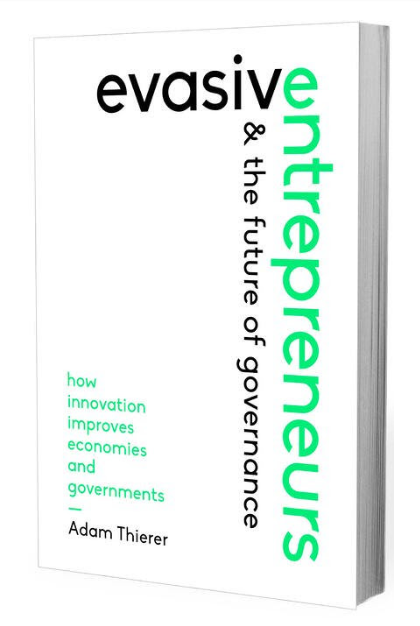
As I noted in my new book on
Evasive Entrepreneurs and the Future of Governance, “DIY health services and medical devices are on the rise thanks to the combined power of open-source software, 3D printers, cloud computing, and digital platforms that allow information sharing between individuals with specific health needs. Average citizens are using these new technologies to modify their bodies and abilities, often beyond the confines of the law.”
Talbot discusses many of the same examples I discuss in my book, including:
the Four Thieves Vinegar collective, which devised instructions for building its own version of the EpiPen;
e-nable, an international collective of thirty thousand volunteers, designs and 3-D-prints prosthetic hands and arms (and which has, more recently, distributed more than fifty thousand face shields in more than twenty-five countries.);
GenSpace and other community biohacking labs; and
Open Insulin and Open Artificial Pancreas System.
I like the way Talbot compares these movements to the hacker and start-up culture of the Digital Revolution: Continue reading →
Compliance paradox: The situation in which heightened legal or regulatory efforts fail to reverse unwanted behavior and instead lead to increased legal evasion and additional enforcement problems.
Demosclerosis: Growing government dysfunction brought on by the inability of public institutions to adapt to change, especially technological change.
Evasive entrepreneurs: Innovators who do not always conform to social or legal norms.
Free innovation: Bottom-up, noncommercial forms of innovation that often take on an evasive character. Free innovation is sometimes called “grassroots” or “household” innovation or “social entrepreneurialism.” Even though it is typically noncommercial in character, free innovation often involves regulatory entrepreneurialism and technological civil disobedience.
Innovation arbitrage: The movement of ideas, innovations, or operations to jurisdictions that provide legal and regulatory environments most hospitable to entrepreneurial activity. It can also be thought of as a form of jurisdictional shopping and can be facilitated by competitive federalism.
Innovation culture: The various social and political attitudes and pronouncements toward innovation, technology, and entrepreneurial activities that, taken together, influence the innovative capacity of a culture or nation.
Pacing problem: A term that generally refers to the inability of legal or regulatory regimes to keep up with the intensifying pace of technological change.
Permissionless innovation: The general notion that “it’s easier to ask forgiveness than it is to get permission.” As a policy vision, it refers to the idea that experimentation with new technologies and innovations should generally be permitted by default.
Precautionary principle: The practice of crafting public policies to control or limit innovations until their creators can prove that they will not cause any harm or disruptions.
Regulatory entrepreneurs: Evasive entrepreneurs who set out to intentionally challenge and change the law through their innovative activities. In essence, policy change is part of their business model.
Soft law: Informal, collaborative, and constantly evolving governance mechanisms that differ from hard law in that they lack the same degree of enforceability.
Technological civil disobedience: The technologically enabled refusal of individuals, groups, or businesses to obey certain laws or regulations because they find them offensive, confusing, time-consuming, expensive, or perhaps just annoying and irrelevant.
Technologies of freedom: Devices and platforms that let citizens openly defy (or perhaps just ignore) public policies that limit their liberty or freedom to innovate. Another term with the same meaning is “technologies of resistance.”
In coming days and weeks I will be occasionally blogging about different arguments made in the 368-page book, but here’s a quick summary of some of the key points I make in the book. These ten passages are pulled directly from the text:
“the freedom to innovate is essential to human betterment for each of us individually and for civilization as a whole. That freedom deserves to be taken more seriously today.”
“Entrepreneurialism and technological innovation are the fundamental drivers of economic growth and of the incredible advances in the everyday quality of life we have enjoyed over time. They are the key to expanding economic opportunities, choice, and mobility.”
“Unfortunately, many barriers exist to expanding innovation opportunities and our entrepreneurial efforts to help ourselves, our loved ones, and others. Those barriers include occupational licensing rules, cronyism-based industrial protectionist schemes, inefficient tax schemes, and many other layers of regulatory red tape at the federal, state, and local levels. We should not be surprised, therefore, when citizens take advantage of new technological capabilities to evade some of those barriers in pursuit of their right to earn a living, to tinker with or try doing new things, or just to learn about the world and serve it better.”
“Evasive entrepreneurs rely on a strategy of permissionless innovation in both the business world and the political arena. They push back against ‘the Permission Society,’ or the convoluted labyrinth of permits and red tape that often encumber entrepreneurial activities.”
“We should be willing to tolerate a certain amount of such outside-the-box thinking because entrepreneurialism expands opportunities for human betterment by constantly replenishing the well of important, life-enhancing ideas and applications.”
“we should better appreciate how creative acts and the innovations they give rise to can help us improve government by keeping public policies fresh, sensible, and in line with common sense and the consent of the governed.”
“Evasive entrepreneurialism is not so much about evading law altogether as it is about trying to get interesting things done, demonstrating a social or an economic need for new innovations in the process, and then creating positive leverage for better results when politics inevitably becomes part of the story. By acting as entrepreneurs in the political arena, innovators expand opportunities for themselves and for the public more generally, which would not have been likely if they had done things by the book.”
“Dissenting through innovation can help make public officials more responsive to the people by reining in the excesses of the administrative state, making government more transparent and accountable, and ensuring that our civil rights and economic liberties are respected.”
“In an age when many of the constitutional limitations on government power are being ignored or unenforced, innovation itself can act as a powerful check on the power of the state and can help serve as a protector of important human liberties.”
“Lawmakers and regulators need to consider a balanced response to evasive entrepreneurialism that is rooted in the realization that technology creators and users are less likely to seek to evade laws and regulations when public policies are more in line with common sense.”
This week I will be traveling to Montreal to participate in the 2018 G7 Multistakeholder Conference on Artificial Intelligence. This conference follows the G7’s recent Ministerial Meeting on “Preparing for the Jobs of the Future” and will also build upon the G7 Innovation Ministers’ Statement on Artificial Intelligence. The goal of Thursday’s conference is to, “focus on how to enable environments that foster societal trust and the responsible adoption of AI, and build upon a common vision of human-centric AI.” About 150 participants selected by G7 partners are expected to participate, and I was invited to attend as a U.S. expert, which is a great honor.
I look forward to hearing and learning from other experts and policymakers who are attending this week’s conference. I’ve been spending a lot of time thinking about the future of AI policy in recent books, working papers, essays, and debates. My most recent essay concerning a vision for the future of AI policy was co-authored with Andrea O’Sullivan and it appeared as part of a point/counterpoint debate in the latest edition of the Communications of the ACM. The ACM is the Association for Computing Machinery, the world’s largest computing society, which “brings together computing educators, researchers, and professionals to inspire dialogue, share resources, and address the field’s challenges.” The latest edition of the magazine features about a dozen different essays on “Designing Emotionally Sentient Agents” and the future of AI and machine-learning more generally.
In our portion of the debate in the new issue, Andrea and I argue that “Regulators Should Allow the Greatest Space for AI Innovation.” “While AI-enabled technologies can pose some risks that should be taken seriously,” we note, “it is important that public policy not freeze the development of life-enriching innovations in this space based on speculative fears of an uncertain future.” We contrast two different policy worldviews — the precautionary principle versus permissionless innovation — and argue that:
artificial intelligence technologies should largely be governed by a policy regime of permissionless innovation so that humanity can best extract all of the opportunities and benefits they promise. A precautionary approach could, alternatively, rob us of these life-saving benefits and leave us all much worse off.
That’s not to say that AI won’t pose some serious policy challenges for us going forward that deserve serious attention. Rather, we are warning against the dangers of allowing worst-case thinking to be the default position in these discussions. Continue reading →
I’ve always been perplexed by tech critiques that seek to pit “humanist” values against technology or technological processes, or that even suggest a bright demarcation exists between these things. Properly understood, “technology” and technological innovation are simply extensions of our humanity and represent efforts to continuously improve the human condition. In that sense, humanism and technology are compliments, not opposites.
I started thinking about this again after reading a recent article by Christopher Mims of The Wall Street Journal, which introduced me to the term “techno-chauvinism.” Techno-chauvinism is a new term that some social critics are using to identify when technologies or innovators are apparently not behaving in a “humanist” fashion. Mims attributes the term techno-chauvinism to Meredith Broussard of New York University, who defines it as “the idea that technology is always the highest and best solution, and is superior to the people-based solution.” [Italics added.] Later on Twitter, Mims defined and critiqued techno-chauvinism as “the belief that the best solution to any problem is technology, not changing our culture, habits or mindset.”
Everything Old is New Again
There are other terms critics have used to describe the same notion, including: “techno-fundamentalism” (Siva Vaidhyanathan), “cyber-utopianism,” and “technological solutionism” (Evgeny Morozov). In a sense, all these terms are really just variants of what scholars in the field of Science and Technology Studies (STS) have long referred to as “technological determinism.”
As I noted in a recent essay about determinism, the traditional “hard” variant of technological determinism refers to the notion that technology almost has a mind of its own and that it will plow forward without much resistance from society or governments. Critics argue that determinist thinking denies or ignores the importance of the human element in moving history forward, or what Broussard would refer to as “people-based solutions.”
The first problem with this thinking is there are no bright lines in these debates and many “softer” variants of determinism exist. The same problem is at work when we turn to discussions about both “humanism” and “technology.” Things get definitionally murky quite quickly, and everyone seemingly has a preferred conception of these terms to fit their own ideological dispositions. “Humanism is a rather vague and contested term with a convoluted history,” observes tech philosopher Michael Sacasas. And here’s an essay that I have updated many times over the years to catalog the dozens of different definitions of “technology” I have unearthed in my ongoing research. Continue reading →
On May 3rd, I’m excited to be participating in a discussion with Yale University bioethicist Wendell Wallach at the Microsoft Innovation & Policy Center in Washington, DC. (RSVP here.) Wallach and I will be discussing issues we write about in our new books, both of which focus on possible governance models for emerging technologies and the question of how much preemptive control society should exercise over new innovations.
Of all the books of technological criticism or skepticism that I’ve read in recent years—and I have read stacks of them!—
A Dangerous Master is by far the most thoughtful and interesting. I have grown accustomed to major works of technological criticism being caustic, angry affairs. Most of them are just dripping with dystopian dread and a sense of utter exasperation and outright disgust at the pace of modern technological change.
Although he is certainly concerned about a wide variety of modern technologies—drones, robotics, nanotech, and more—Wallach isn’t a purveyor of the politics of panic. There are some moments in the book when he resorts to some hyperbolic rhetoric, such as when he frets about an impending “techstorm” and the potential, as the book’s title suggests, for technology to become a “dangerous master” of humanity. For the most part, however, his approach is deeper and more dispassionate than what is found in the leading tracts of other modern techno-critics.
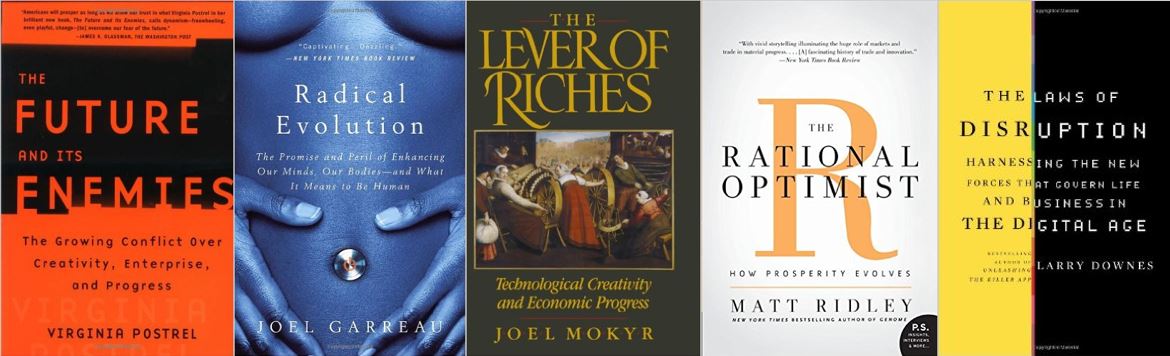
I was delivering a lecture to a group of academics and students out in San Jose recently [see the slideshow here] and someone in the crowd asked me to send them a list of some of the many books I had mentioned during my talk, which was about future policy clashes over various emerging technologies. I cut the list down to the five books that I believe best frame the nature of debates over innovation and technology policy. They are:
Virginia Postrel, The Future and Its Enemies (1998): Contrasts the conflicting worldviews of “dynamism” and “stasis” and shows how the tensions between these two visions influences debates over technological progress. No book has had a greater influence on my own thinking about debates over innovation and progress.
Joel Mokyr, Lever of Riches: Technological Creativity and Economic Progress (1990): One of the finest histories of technological innovation ever penned. It’s certainly my favorite. It explores how earlier technologies evolved and created social and economic tensions.
Matt Ridley, The Rational Optimist: How Prosperity Evolves (2010): Makes the case for “rational optimism” in debates about technology and innovation and takes on pessimistic critics of technological change.
Larry Downes, The Laws of Disruption: Harnessing the New Forces That Govern Life and Business in the Digital Age (2009): Explains how lawmaking in the information age is inexorably governed by the “law of disruption” or the fact that “technology changes exponentially, but social, economic, and legal systems change incrementally.” That fact, he explains, has profound ramifications for all technology policy debates going forward.
If you haven’t read these amazing books yet, add them to your collection
right now! They are worth reading again and again. They will forever change the way you think about debates over technology and innovation.
In a recent Senate Commerce Committee hearing on the Internet of Things, Senators Ed Markey (D-Mass.) and Richard Blumenthal (D-Conn.) “announced legislation that would direct the National highway Traffic Safety Administration (NHTSA) and the Federal Trade Commission (FTC) to establish federal standards to secure our cars and protect drivers’ privacy.” Spurred by a recent report from his office (Tracking and Hacking: Security and Privacy Gaps Put American Drivers at Risk) Markey argued that Americans “need the equivalent of seat belts and airbags to keep drivers and their information safe in the 21st century.”
Among the many conclusions reached in the report, it says, “nearly 100% of cars on the market include wireless technologies that could pose vulnerabilities to hacking or privacy intrusions.” This comes across as a tad tautological given that everything from smartphones and computers to large-scale power grids are prone to being hacked, yet the Markey-Blumenthal proposal would enforce a separate set of government-approved, and regulated, standards for privacy and security, displayed on every vehicle in the form of a “Cyber Dashboard” decal.
Leaving aside the irony of legislators attempting to dictate privacy standards, especially in the post-Snowden world, it would behoove legislators like Markey and Blumenthal to take a closer look at just what it is they are proposing and ask whether such a law is indeed necessary to protect consumers. Continue reading →
James Barrat, author of Our Final Invention: Artificial Intelligence and the End of the Human Era, discusses the future of Artificial Intelligence (AI). Barrat takes a look at how to create friendly AI with human characteristics, which other countries are developing AI, and what we could expect with the arrival of the Singularity. He also touches on the evolution of AI and how companies like Google and IBM and government entities like DARPA and the NSA are developing artificial general intelligence devices right now.
The Technology Liberation Front is the tech policy blog dedicated to keeping politicians' hands off the 'net and everything else related to technology. Learn more about TLF →


 Margaret Talbot has written an excellent New Yorker essay entitled, “
 This week I will be traveling to Montreal to participate in the
 The Technology Liberation Front is the tech policy blog dedicated to keeping politicians' hands off the 'net and everything else related to technology.