If you haven’t yet had the chance to check out the new Progress Forum, I encourage you to do so. It’s a discussion group for progress studies and all things related to it. The Forum is sponsored by The Roots of Progress. Even though the Forum is still in pre-launch phase, there are already many interesting threads worth checking out. I was my honor to contribute one of the first on the topic, “Where is ‘Progress Studies’ Going?” It’s an effort to sort through some of the questions and challenges facing the Progress Studies movement in terms of focus and philosophical grounding. I thought I would just reproduce the essay here, but I encourage you to jump over to the Progress Forum to engage in discussion about it, or the many other excellent discussions happening there on other issues.
Almost every argument against technological innovation and progress that we hear today was identified and debunked by Samuel C. Florman a half century ago. Few others since him have mounted a more powerful case for the importance of innovation to human flourishing than Florman did throughout his lifetime.
Chances are you’ve never heard of him, however. As prolific as he was, Florman did not command as much attention as the endless parade of tech critics whose apocalyptic predictions grabbed all the headlines. An engineer by training, Florman became concerned about the growing criticism of his profession throughout the 1960s and 70s. He pushed back against that impulse in a series of books over the next two decades, including most notably:
The Existential Pleasures of Engineering (1976), Blaming Technology: The Irrational Search for Scapegoats (1981), and The Civilized Engineer (1987). He was also a prolific essayist, penning hundreds of articles for a wide variety of journals, magazines, and newspapers beginning in 1959. He was also a regular columnist for MIT Technology Review for sixteen years.
Florman’s primary mission in his books and many of those essays was to defend the engineering profession against attacks emanating from various corners. More broadly, as he noted in a short autobiography on his personal website, Florman was interested in discussing, “the relationship of technology to the general culture.”
Florman could be considered a “rational optimist,” to borrow Matt Ridley’s notable term[1] for those of us who believe, as I have summarized elsewhere, that there is a symbiotic relationship between innovation, economic growth, pluralism, and human betterment.[2] Rational optimists are highly pragmatic and base their optimism on facts and historical analysis, not on dogmatism or blind faith in any particular viewpoint, ideology, or gut feeling. But they are unified in the belief that technological change is a crucial component of moving the needle on progress and prosperity.
Florman’s unique contribution to advancing rational optimism came in the way he itemized the various claims made by tech critics and then powerfully debunked each one of them. Continue reading →
Here’s a new animated explainer video that I narrated for the Federalist Society’s Regulatory Transparency Project. The 3-minute video discusses how earlier “tech giants” rose and fell as technological innovation and new competition sent them off to what the New York Times once appropriately called “The Hall of Fallen Giants.” It’s a continuing testament to the power of “creative destruction” to upend and reorder markets, even as many pundits insist that there’s no possibility change can happen.
Slate recently published an astonishing piece of revisionist history under the title, “Bring Back the Golden Age of Broadcast Regulation,” which suggested that the old media regulatory model of the past would be appropriate for modern digital media providers and platforms. In the essay, April Glaser suggests that policymakers should resurrect the Fairness Doctrine and a host of old Analog Era content controls to let regulatory bureaucrats address Digital Age content moderation concerns.
In a tweetstorm, I highlighted a few examples of why the so-called Golden Era wasn’t so golden in practice. I began by noting that the piece ignores the troubling history of FCC speech controls and unintended consequences of regulation. That regime gave us limited, bland choices–and a whole host of First Amendment violations. We moved away from that regulatory model for very good reasons.
If there are two general principles that unify my recent work on technology policy and innovation issues, they would be as follows. To the maximum extent possible:
We should avoid preemptive and precautionary-based regulatory regimes for new innovation. Instead, our policy default should be innovation allowed (or “permissionless innovation”) and innovators should be considered “innocent until proven guilty” (unless, that is, a thorough benefit-cost analysis has been conducted that documents the clear need for immediate preemptive restraints).
We should avoid rigid, “top-down” technology-specific or sector-specific regulatory regimes and/or regulatory agencies and instead opt for a broader array of more flexible, “bottom-up” solutions (education, empowerment, social norms, self-regulation, public pressure, etc.) as well as reliance on existing legal systems and standards (torts, product liability, contracts, property rights, etc.).
Weaver argues that new robot technology “is going to develop fast, almost certainly faster than we can legislate it. That’s why we need to get ahead of it now.” In order to preemptively address concerns about new technologies such as driverless cars or commercial drones, “we need to legislate early and often,” Weaver says. Stated differently, Weaver is proposing “precautionary principle”-based regulation of these technologies. The precautionary principle generally refers to the belief that new innovations should be curtailed or disallowed until their developers can prove that they will not cause any harms to individuals, groups, specific entities, cultural norms, or various existing laws, norms, or traditions.
Calo argues that we need “the establishment of a new federal agency to deal with the novel experiences and harms robotics enables” since there exists “distinct but related challenges that would benefit from being examined and treated together.” These issues, he says, “require special expertise to understand and may require investment and coordination to thrive.
I’ll address both Weaver and Calo’s proposals in turn. Continue reading →
I spend a lot of time reading books and essays about technology; more specifically, books and essays about technology history and criticism. Yet, I am often struck by how few of the authors of these works even bother defining what they mean by “technology.” I find that frustrating because, if you are going to make an attempt to either study or critique a particular technology or technological practice or development, then you probably should take the time to tell us how broadly or narrowly you are defining the term “technology” or “technological process.”
Of course, it’s not easy. “In fact, technology is a word we use all of the time, and ordinarily it seems to work well enough as a shorthand, catch-all sort of word,” notes the always-insightful Michael Sacasas in his essay “Traditions of Technological Criticism.” “That same sometimes useful quality, however, makes it inadequate and counter-productive in situations that call for more precise terminology,” he says.
Quite right, and for a more detailed and critical discussion of how earlier scholars, historians, and intellectuals have defined or thought about the term “technology,” you’ll want to check out Michael’s other recent essay, “What Are We Talking About When We Talk About Technology?” which preceded the one cited above. We don’t always agree on things — in fact, I am quite certain that most of my comparatively amateurish work must make his blood boil at times! — but you won’t find a more thoughtful technology scholar alive today than Michael Sacasas. If you’re serious about studying technology history and criticism, you should follow his blog and check out his book, The Tourist and The Pilgrim: Essays on Life and Technology in the Digital Age, which is a collection of some of his finest essays.
Anyway, for what it’s worth, I figured I would create this post to list some of the more interesting definitions of “technology” that I have uncovered in my own research. I suspect I will add to it in coming months and years, so please feel free to suggest other additions since I would like this to be a useful resource to others. Continue reading →
First, my old colleague Dan Rothschild was kind enough to ask me to contribute a post to the R Street Blog entitled, “Bucking the ‘Mother, May I?’ Mentality.” In it, I offered this definition and defense of permissionless innovation as a policy norm:
Permissionless innovation is about the creativity of the human mind to run wild in its inherent curiosity and inventiveness, even when it disrupts certain cultural norms or economic business models. It is that unhindered freedom to experiment that ushered in many of the remarkable technological advances of modern times. In particular, all the digital devices, systems and networks that we now take for granted came about because innovators were at liberty to let their minds run wild.
Steve Jobs and Apple didn’t need a permit to produce the first iPhone. Jeff Bezos and Amazon didn’t need to ask anyone for the right to create a massive online marketplace. When Sergey Brin and Larry Page wanted to release Google’s innovative search engine into the wild, they didn’t need to get a license first. And Mark Zuckerberg never had to get anyone’s blessing to launch Facebook or let people freely create their own profile pages.
All of these digital tools and services were creatively disruptive technologies that altered the fortunes of existing companies and challenged various social norms. Luckily, however, nothing preemptively stopped that innovation from happening. Today, the world is better off because of it, with more and better information choices than ever before.
I also posted an essay over on Medium entitled, ”
Why Permissionless Innovation Matters.” It’s a longer essay that seeks to answer the question: Why does economic growth occur in some societies & not in others? I build on the recent comments of venture capitalist Fred Wilson of Union Square Ventures noted during recent testimony: “If you look at the countries around the world where the most innovation happens, you will see a very high, I would argue a direct, correlation between innovation and freedom. They are two sides of the same coin.” Continue reading →
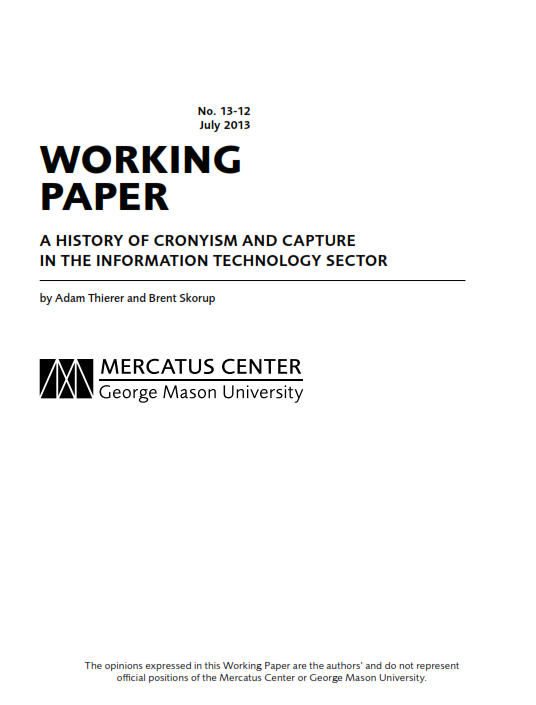
The Mercatus Center at George Mason University has just released a new paper by Brent Skorup and me entitled, “A History of Cronyism and Capture in the Information Technology Sector.” In this 73-page working paper, which we hope to place in a law review or political science journal shortly, we document the evolution of government-granted privileges, or “cronyism,” in the information and communications technology marketplace and in the media-producing sectors. Specifically, we offer detailed histories of rent-seeking and regulatory capture in: the early history of the telephony and spectrum licensing in the United States; local cable TV franchising; the universal service system; the digital TV transition in the 1990s; and modern video marketplace regulation (i.e., must-carry and retransmission consent rules, among others.
Our paper also shows how cronyism is slowly creeping into new high-technology sectors.We document how Internet companies and other high-tech giants are among the fastest-growing lobbying shops in Washington these days. According to the Center for Responsive Politics, lobbying spending by information technology sectors has almost doubled since the turn of the century, from roughly $200 million in 2000 to $390 million in 2012. The computing and Internet sector has been responsible for most of that growth in recent years. Worse yet, we document how many of these high-tech firms are increasingly seeking and receiving government favors, mostly in the form of targeted tax breaks or incentives. Continue reading →
Andy Greenberg, technology writer for Forbes and author of the new book “This Machine Kills Secrets: How WikiLeakers, Cypherpunks, and Hacktivists Aim to Free the World’s Information,” discusses the rise of the cypherpunk movement, how it led to WikiLeaks, and what the future looks like for cryptography.
Greenberg describes cypherpunks as radical techie libertarians who dreamt about using encryption to shift the balance of power from the government to individuals. He shares the rich history of the movement, contrasting one of t the movement’s founders—hardcore libertarian Tim May—with the movement’s hero—Phil Zimmerman, an applied cryptographer and developer of PGP (the first tool that allowed regular people to encrypt), a non-libertarian who was weary of cypherpunks, despite advocating crypto as a tool for combating the power of government.
According to Greenberg, the cypherpunk movement did not fade away, but rather grew into a larger hacker movement, citing the Tor network, bitcoin, and WikiLeaks as example’s of its continuing influence. Julian Assange, founder of WikiLeaks, belonged to a listserv followed by early cypherpunks, though he was not very active at the time, he says.
Greenberg is excited for the future of information leaks, suggesting that the more decentralized process becomes, the faster cryptography will evolve.
Here’s a presentation I’ve been using lately for various audiences about “Cronyism: History, Costs, Case Studies and Solutions.” In the talk, I offer a definition of cronyism, explain its origins, discuss how various academics have traditionally thought about it, outline a variety of case studies, and then propose a range of solutions. Readers of this blog might be interested because I briefly mention the rise of cronyism in the high-tech sector. Brent Skorup and I have a huge paper in the works on that topic, which should be out early next year.
The Technology Liberation Front is the tech policy blog dedicated to keeping politicians' hands off the 'net and everything else related to technology. Learn more about TLF →



 The Technology Liberation Front is the tech policy blog dedicated to keeping politicians' hands off the 'net and everything else related to technology.