Posts tagged as:

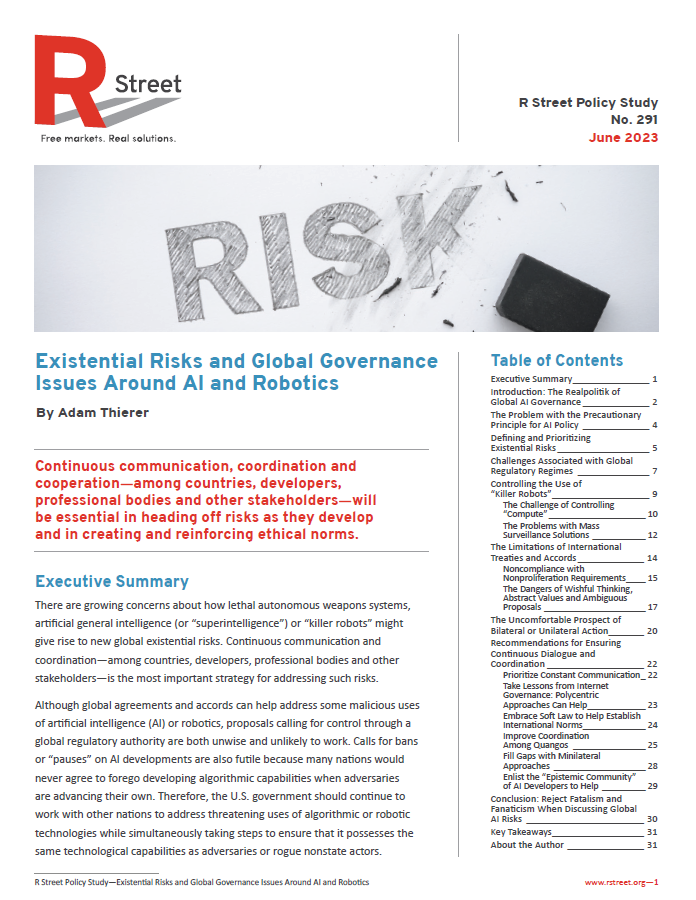
Can we advance AI safety without new international regulatory bureaucracies, licensing schemes or global surveillance systems? I explore that question in my latest R Street Institute study, “Existential Risks & Global Governance Issues around AI & Robotics.” (31 pgs)  My report rejects extremist thinking about AI arms control & stresses how the “realpolitik” of international AI governance is such that things cannot and must not be solved through silver-bullet gimmicks and grandiose global government regulatory regimes.

The report uses Nick Bostrom’s “vulnerable world hypothesis” as a launching point and discusses how his five specific control mechanisms for addressing AI risks have started having real-world influence with extreme regulatory proposals now being floated. My report also does a deep dive into the debate about a proposed global ban on “killer robots” and looks at how past treaties and arms control efforts might apply, or what we can learn from them about what won’t work.

I argue that proposals to impose global controls on AI through a worldwide regulatory authority are both unwise and unlikely to work. Calls for bans or “pauses” on AI developments are largely futile because many nations will not agree to them. As with nuclear and chemical weapons, treaties, accords, sanctions and other multilateral agreements can help address some threats of malicious uses of AI or robotics. But trade-offs are inevitable, and addressing one type of existential risk sometimes can give rise to other risks.

A culture of AI safety by design is critical. But there is an equally compelling interest in ensuring algorithmic innovations are developed and made widely available to society. The most effective solution to technological problems usually lies in more innovation, not less. Many other multistakeholder and multilateral efforts can help AI safety. Final third of my study is devoted to a discussion of that. Continuous communication, coordination, and cooperation—among countries, developers, professional bodies and other stakeholders—will be essential. Continue reading →

This week, I appeared on the Tech Freedom Tech Policy Podcast to discuss “Who’s Afraid of Artificial Intelligence?” It’s an in-depth, wide-ranging conversation about all things AI related. Here’s a summary of what host what Corbin Barthold and I discussed:

  1. The “little miracles happening every day” thanks to AI

  2. Is AI a “born free” technology?

  3. Potential anti-competitive effects of AI regulation

  4. The flurry of joint letters

  5. new AI regulatory agency political realities

  6. the EU’s Precautionary Principle tech policy disaster

  7. The looming “war on computation” & open source

  8. The role of common law for AI

  9. Is Sam Altman breaking the very laws he proposes?

  10. Do we need an IAEA for AI or an “AI Island”

  11. Nick Bostrom’s global control & surveillance model

  12. Why “doom porn” dominates in academic circles

  13. Will AI take all the jobs?

  14. Smart regulation of algorithmic technology

  15. How the “pacing problem” is sometimes the “pacing benefit”


[Cross-posted from Medium.]

In an age of hyper-partisanship, one issue unites the warring tribes of American politics like no other: hatred of “Big Tech.” You know, those evil bastards who gave us instantaneous access to a universe of information at little to no cost. Those treacherous villains! People are quick to forget the benefits of moving from a world of Information Poverty to one of Information Abundance, preferring to take for granted all they’ve been given and then find new things to complain about.

But what mostly unites people against large technology platforms is the feeling that they are just too big or too influential relative to other institutions, including government. I get some of that concern, even if I strongly disagree with many of their proposed solutions, such as the highly dangerous sledgehammer of antitrust breakups or sweeping speech controls. Breaking up large tech companies would not only compromise the many benefits they provide us with, but it would undermine America’s global standing as a leader in information and computational technology. We don’t want that. And speech codes or meddlesome algorithmic regulations are on a collision course with the First Amendment and will just result in endless litigation in the courts.

There’s a better path forward. As President Ronald Reagan rightly said in 1987 when vetoing a bill to reestablish the Fairness Doctrine, “History has shown that the dangers of an overly timid or biased press cannot be averted through bureaucratic regulation, but only through the freedom and competition that the First Amendment sought to guarantee.” In other words, as I wrote in a previous essay about “The Classical Liberal Approach to Digital Media Free Speech Issues,” more innovation and competition are always superior to more regulation when it comes to encouraging speech and speech opportunities.

Continue reading →

I recently joined Rep. Dan Crenshaw on his Hold These Truths podcast to discuss, “What’s Wrong with Industrial Policy.” We chatted for 25 minutes about a wide range of issues related to the the growing push for grandiose industrial policy schemes in the US, including the massive new 3,000-page, $350 billion “COMPETES Act” legislation that recently passed in the House and which will soon be conferenced with a Senate bill that already passed.

On the same day this podcast was released this week, I also had a new op-ed appear in  The Hill on “The Coming Industrial Policy Hangover.” In both that essay and the podcast with Rep. Crenshaw, I stress that, beyond all the other problems with these new industrial policy measures, no one is talking about the fiscal cost of it all. As I note:

In the rush to pass legislation, we’ve barely heard a peep about the $250-$350 billion price tag. This follows a massive splurge of recent government borrowing, which led to the U.S. national debt hitting another lamentable new record: $30 trillion. China already owns over $1 trillion of that debt, making one wonder if we’re really countering China by adopting a massive, new and unfunded industrial policy that they will end up financing indirectly.

Read my oped for more details and for a deeper dive of what’s wrong with the bills, see my earlier essay here on “Thoughts on the America COMPETES Act: The Most Corporatist & Wasteful Industrial Policy Ever.”

Continue reading →

The Mercatus Center has just released a new special study that I co-authored with Connor Haaland entitled, “Does the United States Need a More Targeted Industrial Policy for High Tech?” With industrial policy reemerging as a major issue — and with Congress still debating a $250 billion, 2,400-page industrial policy bill — our report does a deep dive into the history various industrial policy efforts both here and abroad over the past half century. Our 64-page survey of the historical record leads us to conclude that, “targeted industrial policy programs cannot magically bring about innovation or economic growth, and government efforts to plan economies from the top down have never had an encouraging track record.”

We zero in on the distinction between general versus targeted economic development efforts and argue that:

whether we are referring to federal, state, or local planning efforts—the more highly tar­geted development efforts typically involve many tradeoffs that are often not taken into consider­ation by industrial policy advocates. Downsides include government steering of public resources into unproductive endeavors, as well as more serious problems, such as cronyism and even corruption.

We also stress the need to more tightly define the term “industrial policy” to ensure rational evaluation is even possible. We argue that, “industrial policy has intentionality and directionality, which distinguishes it from science policy, innovation policy, and economic policy more generally.” We like the focus definition used by economist Nathaniel Lane, who defines industrial policy as “intentional political action meant to shift the industrial structure of an economy.”

Our report examines the so-called “Japan model” of industrial policy that was all the rage in intellectual circles a generation ago and then compares it to the Chinese and European industrial policy efforts of today, which many pundits claim that the US needs to mimic. Continue reading →

[Last updated 3/25/22]

Industrial Policy is a red-hot topic once again with many policymakers and pundits of different ideological leanings lining up to support ambitious new state planning for various sectors — especially 5G, artificial intelligence, and semiconductors. A remarkably bipartisan array of people and organizations are advocating for government to flex its muscle and begin directing more spending and decision-making in various technological areas. They all suggest some sort of big plan is needed, and it is not uncommon for these industrial policy advocates to suggest that hundreds of billions will need to be spent in pursuit of those plans.

Others disagree, however, and I’ll be using this post to catalog some of their concerns on an ongoing basis. Some of the criticisms listed here are portions of longer essays, many of which highlight other types of steps that governments can take to spur innovative activities. Industrial policy is an amorphous term with many definitions of a broad spectrum of possible proposals. Almost everyone believes in  some form of industrial policy if you define the term broadly enough. But, as I argued in a September 2020 essay “On Defining ‘Industrial Policy,” I believe it is important to narrow the focus of the term such that we can continue to use the term in a rational way. Toward that end, I believe a proper understanding of industrial policy refers to targeted and directed efforts to plan for specific future industrial outputs and outcomes.

The collection of essays below is merely an attempt to highlight some of the general concerns about the most ambitious calls for expansive industrial policy, many of which harken back to debates I was covering in the late 1980s and early 1990s, when I first started a career in policy analysis. During that time, Japan and South Korea were the primary countries of concern cited by industrial policy advocates. Today, it is China’s growing economic standing that is fueling calls for ambitious state-led targeted investments in “strategic” sectors and technologies. To a lesser extent, grandiose European industrial policy proposals are also prompting new US counter-proposals.

All this activity is what has given rise to many of the critiques listed below. If you have suggestions for other essays I might add to this list, please feel free to pass them along. FYI: There’s no particular order here.

Continue reading →

[Cross-posted to Medium.]

The spread of “sanctuary cities”—local governments that resist federal laws or regulations in some fashion, and typically for strongly-held moral reasons—is one of the most interesting and controversial governance developments of recent decades. Unfortunately, the concept receives only a selective defense from people when it fits their narrow political objectives, such as sanctuary movements for immigration and gun rights.

But there is broader case to be made for sanctuaries in many different contexts as a way to encourage experiments in alternative governance models and just let people live lives of their choosing. The concept faces many challenges in practice, however, and I remain skeptical that sanctuary cities will ever scale up and become a widespread governance phenomenon. There’s just too much for federal officials to lose and they likely will crush any particular sanctuary movement that gains serious steam.

Sanctuary Cities as Political Civil Disobedience

First, let’s think about what local officials are really doing when they declare themselves a sanctuary. (Because they can be formed by city, county, or state governments, I will just use “sanctuaries” as a shorthand throughout this essay.)

Academics use the term “rule departure” when referencing “deliberate failures, often for conscientious reasons, to discharge the duties of one’s office.” [Joel Feinberg, “Civil Disobedience in the Modern World,” in Humanities in Society, Vol. 2, No. 1, 1979, p 37.] In this sense, sanctuary cities could be viewed as a type of collective civil disobedience by public officials because these governance arrangements are typically defended on moral grounds and represent an active form of resistance to policies imposed by higher-ups. Continue reading →

Economist Mariana Mazzucato has a full spread in the Wired UK humbling suggesting that she “has a plan to fix capitalism.” The plan is an outgrowth of her 2013 book The Entrepreneurial State , which contends that government involvement in research and development (R&D), loans, and other business subsidies are the true drivers of innovation, not the private sector. Her plan is simple: governments need to do better on funding innovation.  

It goes without saying that the government is massively involved in innovation and for good reason. Open any introductory economics text and you’re likely to see an argument for why. Private actors are short sighted and often fail to plan for the long term by investing in R&D that will lead to technological progress. Basic research also might lead to advances or products outside of the company’s niche. Knowing that they won’t be able to capture all of the gains from research, private entities will choose a lower level of investment than is optimal, leading to a market failure. Governments solve this market failure by allocating resources to expanding scientific and technological knowledge.    

While Mazzucato might be finding an audience with policy makers in the UK and doers in Silicon Valley, innovation economists are a little more wary of her state first theory of innovation. Here are some things worth considering when reading her work: Continue reading →

Originally published on 9/9/19 at The Bridge as, “Beware Calls for Government to ‘Save the Press‘”
—– by Adam Thierer & Andrea O’Sullivan Anytime someone proposes a top-down, government-directed “plan for journalism,” we should be a little wary. Journalism should not be treated like it’s a New Deal-era public works program or a struggling business sector requiring bailouts or an industrial policy plan. Such ideas are both dangerous and unnecessary. Journalism is still thriving in America, and people have more access to more news content than ever before. The news business faces serious challenges and upheaval, but that does not mean central planning for journalism makes sense. Unfortunately, some politicians and academics are once again insisting we need government action to “save journalism.” Senator and presidential candidate Bernie Sanders (D-VT) recently penned an op-ed for the  Columbia Journalism Review that adds media consolidation and lack of union representation to the parade of horrors that is apparently destroying journalism. And a recent University of Chicago report warns that “digital platforms” like Facebook and Google “present formidable new threats to the news media that market forces, left to their own devices, will not be sufficient” to continue providing high-quality journalism. Critics of the current media landscape are quick to offer policy interventions. “The Sanders scheme would add layers of regulatory supervision to the news business,” notes media critic Jack Shafer. Sanders promises to prevent or rollback media mergers, increase regulations on who can own what kinds of platforms, flex antitrust muscles against online distributors, and extend privileges to those employed by media outlets. The academics who penned the University of Chicago report recommend public funding for journalism, regulations that “ensure necessary transparency regarding information flows and algorithms,” and rolling back liability protections for platforms afforded through Section 230 of the Communications Decency Act. Both plans feature government subsidies, too. Sen. Sanders proposes “taxing targeted ads and using the revenue to fund nonprofit civic-minded media” as part of a broader effort “to substantially increase funding for programs that support public media’s news-gathering operations at the local level.” The Chicago plan proposed a taxpayer-funded $50 media voucher that each citizen will then be able to spend on an eligible media operation of their choice. Such ideas have been floated before and the problems are still numerous. Apparently, “saving journalism” requires that media be placed on the public dole and become a ward of the state. Socializing media in order to save it seems like a bad plan in a country that cherishes the First Amendment. Continue reading →

The Mercatus Center at George Mason University has just released a new paper on,”Permissionless Innovation and Immersive Technology: Public Policy for Virtual and Augmented Reality,” which I co-authored with Jonathan Camp. This 53-page paper can be downloaded via the Mercatus websiteSSRN or Research Gate.

Here is the abstract for the paper:

Immersive technologies such as augmented reality, virtual reality, and mixed reality are finally taking off. As these technologies become more widespread, concerns will likely develop about their disruptive social and economic effects. This paper addresses such policy concerns and contrasts two different visions for governing immersive tech going forward. The paper makes the case for permissionless innovation, or the general freedom to innovate without prior constraint, as the optimal policy default to maximize the benefits associated with immersive technologies. The alternative vision — the so-called precautionary principle — would be an inappropriate policy default because it would greatly limit the potential for beneficial applications and uses of these new technologies to emerge rapidly. Public policy for immersive technology should not be based on hypothetical worst-case scenarios. Rather, policymakers should wait to see which concerns or harms emerge and then devise ex post solutions as needed.

To better explain why precautionary controls on these emerging technologies would be such a mistake, Camp and I provide an inventory of the many VR, AR, and mixed reality applications that are already on the market–or soon could be–and which could provide society with profound benefits. A few examples include:  Continue reading →