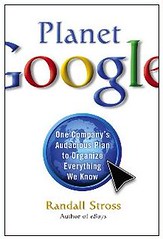
 I finally got around to reading Planet Google: One Company’s Audacious Plan to Organize Everything We Know, by Randall Stross. It’s very well done. Stross is a frequently contributor to the New York Times and the author of several other interesting books on the technology industry. He knows how to weave a story together, and it helps that Google’s story is a pretty amazing one.
Each chapter discusses a different part of Google’s growing family of services — GMail, Google Maps, Google Earth, Book Search, and YouTube. Of course, it all started with search and Stross does a good job explaining how the ingenious Google search algorithm has grown from dorm room project to the greatest aggregator of human knowledge that the world has ever known. This, in turn, has powered Google’s hugely successful online advertising system. The real secret of their success with online advertising, Stross argues, is that “Google’s impersonal, mathematical approach search also provides you with the ability to serve advertisements that are tailored to a search, rather than to the person submitting the search request, whose identity would have to be known.”
Despite the benefits of such generally anonymous searching, as Google has grown and added new services and capabilities, concerns about the sheer volume of data that the company collects have led to heightened privacy concerns. Indeed, privacy is a core theme that Stross uses in the book to tie many of the chapters and issues together. Google is constantly struggling to strike the right balance between providing more access to the world’s information while also being careful not to raise privacy concerns. But it’s unclear exactly how much more information collection that users (or public officials) will tolerate before advocating stricter limits on Google’s reach. As Stross points out:
Guided by its founding mission, to organize all the world’s information, Google has created storage capacity that allows it to gain control of what its users are you doing in a comprehensive way that no other company has done, and to preserve those records indefinitely, without the need to clear out old records to make way for new ones. Moreover, Google differentiates its service by refining its own proprietary software formula to mine and massage the data, technology that it zealously protects from the sight of rivals. This sets up a conflict between Google’s wish to operate a “black box” (completely opaque to the outside) and its users’ wish for transparency.
Continue reading →
Those who criticize Google as a “monopoly” usually focus on the search and advertising markets. Google may indeed have a huge lead in those markets, but it is by no means a “monopoly” in the strict sense of the word as the only (“mono-“) seller in that market.
If the critics are concerned about about true “monopoly” or at least something close to it, perhaps they ought to focus on Feedburner, the free service Google acquired back in 2007. If one takes a very narrow definition of the service Feedburner offers, one could argue that there is no real alternative to Feedburner. But on the other hand:
I have a very simple solution. I use my own RSS feed I don’t need some other company providing a enhanced solution. I have never understood why people used feedburner at all.
Getting statistics from a feed is elementary. There are several services out their that provide podcast statistics.
Stupidity in giving someone else control over ones feed is something I will never get. I have no sympathy for those having feedburner issues.
Regardless, some leading bloggers have expressed outrage over Feedburner’s less-than-perfect reliability—see this recent rant by Michael Arrington. But we call in the federales to “fix” the “problem”—if one properly apply that term to a free service beloved by (nearly all) bloggers everywhere just because it’s not absolutely, positively 100% reliable or instantaneous or simply because some people don’t like the idea of using yet another Google product, no matter how good it is—let’s see what Feedsqueezer, a soon-to-be-launched service, will offer.
Note: The word “monopoly” is now commonly used to mean “control that makes possible the manipulation of prices.” It’s not obvious what that would mean in the case of those Google services, that are both free to the user and not directly related to any price paid by, say an advertiser—as distinct from, say, Adwords or Adsense, where there are at least prices that might, in theory, be controlled.
Over the past year or so, many market-oriented critics of Google, like Scott Cleland and Richard Bennett, have criticized the company for aligning itself with Left-leaning causes and intellectuals. Lately, however, what I find interesting is how many leading leftist intellectuals and organizations have begun turning on the company and becoming far more critical of the America’s greatest capitalist success story of the past decade. The reason this concerns me is that I see a unholy Right-Left alliance slowly forming that could lead to more calls for regulation not just of Google, but the entire search marketplace. In other words, “Googlephobia” could bubble over into something truly ugly.
Consider the comments of Tim Wu and Lawrence Lessig in Jeff Rosen’s huge
New York Times Magazine article this weekend, “Google’s Gatekeepers.” Along with Yochai Benkler, Lessig and Wu form the Holy Trinity of the Digital Left; they set the intellectual agenda for the Left on information technology policy issues. Rosen quotes both Wu and Lessig in his piece going negative on Google. Wu tells Rosen that “To love Google, you have to be a little bit of a monarchist, you have to have faith in the way people traditionally felt about the king.” Moreover:
Continue reading →
By Berin Szoka & Adam Thierer
As we noted in our intro to this ongoing series, Google’s tenth anniversary has passed with Googlephobia reaching new heights of hysteria.
But is Google really too big and dangerous, or are people just too lazy to find other alternatives to each of the wonderful services that Google offers? If one is truly paranoid about the firm’s supposed dominance, it doesn’t take much effort to live a Google-free life. To prove it, we set out to find alternatives to each of the services that Google provides. After awhile, we got a little tired of compiling alternatives in each category and just provided links for the additional choices at your disposal. It’s tough to see what the fuss is about with the cornucopia of choices at our disposal. If you don’t like Google, then just don’t use it or any of its services. The choice is yours.
In each case, we’ve listed Google first, even though Google may not be the market leader (
e.g., Google’s relatively unknown social network Orkut).
Search Engines
Continue reading →
By Berin Szoka & Adam Thierer
as part of an
ongoing series

With Google celebrating its 10th anniversary this week, many panicky pundits are using the occasion to claim that Google has become the Great “Satan” of the Internet. Nick Carr wonders what the future holds for “The OmniGoogle.” The normally level-headed Mike Malone worries that Google is “turning into Big Brother.” And Washington Post’s Rob Dubbin says that he can’t escape Google’s “tentacles,” even for just 24 hours. Meanwhile, speculation abounds that the Justice Department is preparing a major antitrust lawsuit against Google concerning its advertising partnership with Yahoo! or perhaps even a broader suit concerning Google’s “dominance” of online advertising generally.
Carr quotes Google co-founder Sergey Brin’s now-famous 2003 interview:
I think people tend to exaggerate Google’s significance in both directions. Some say Google is God. Others say Google is Satan. But if they think Google is too powerful, remember that with search engines, unlike other companies, all it takes is a single click to go to another search engine. People come to Google because they choose to. We don’t trick them.
In the last five years, Google has become far more than just a search engine. As Google’s suite of suite of complementary products continues to grow, so too does the specter of Google as an all-knowing and therefore all-powerful economic colossus. Yet Google isn’t even close to being the sort of nefarious monopolist out to destroy user privacy at every turn, as some seem to imply—if not exclaim. Indeed, in our view, the Net is overall a far better place because of the existence of Google and the many free services it provides consumers.
Our point is not that Google should be immune from criticism. Indeed, healthy criticism of corporate actions plays a vital role in the free market by disciplining corporate policies and behavior—often thus providing an effective alternative to government regulation. This is particularly important in the area of consumer privacy protection, as demonstrated by Google’s quick response to public concern about its Chrome EULA. Continue reading →

 The Technology Liberation Front is the tech policy blog dedicated to keeping politicians' hands off the 'net and everything else related to technology.