Posts tagged as:

Congressmen working on national intelligence and homeland security either don’t know how to secure their own home Wi-Fi networks (it’s easy!) or don’t understand why they should bother. If you live outside the Beltway, you might think the response to this problem would be to redouble efforts to educate everyone about the importance of personal responsibility for data security, starting with Congressmen and their staffs. But of course those who live inside the Beltway know that the solution isn’t education or self-help but… you guessed it… to excoriate Google for spying on members of Congress (and bigger government, of course)!

Consumer Watchdog (which doesn’t actually claim any consumers as members) held a press conference this morning about their latest anti-Google stunt, announced last night on their “Inside Google” blog: CWD drove by five Congressmen’s houses in the DC area last week looking for unencrypted Wi-Fi networks. At Jane Harman’s (D-CA) home, they found two unencrypted networks named “Harmanmbr” and “harmantheater” that suggest the networks are Harman’s. So they sent Harman a letter demanding that she hold hearings on Google’s collection of Wi-Fi data, charging Google with “WiSpying.” This is a classic technopanic and the most craven, cynical kind of tech politics—dressed in the “consumer” mantle.

The Wi-Fi/Street View Controversy

Rewind to mid-May, when Google voluntarily disclosed that the cars it used to build a photographic library of what’s visible from public streets for Google Maps Street View had been unintentionally collecting small amounts of information from unencrypted Wi-Fi hotspots like Harman’s. These hotspots can be accessed by anyone who might drive or walk by with a Wi-Fi device—thus potentially exposing data sent over those networks between, say, a laptop in the kitchen, and the wireless router plugged into the cable modem.

Google’s Street View allows you to virtually walk down any public street and check out the neighborhood Continue reading →

There’s been a lot of hand-wringing lately about Google’s recent acquisitions of Teracent (ad-personalization) and AdMob (mobile ads), as well as Apple’s response, buying AdMob’s rival Quattro Wireless. Jeff Chester, true To form, quickly fired off an angry letter to FTC Chairman Jon Leibowitz, ranting about how the Google/AdMob deal would harm consumer privacy with the same vague fulminations as ever:

Google amasses a goldmine of data by tracking consumers’ behavior as they use its search engine and other online services. Combining this information with information collected by AdMob would give Google a massive amount of consumer data to exploit for its benefit.

Yup, that’s right, it’s all part of Google’s grand conspiracy to exploit (and eventually enslave) us all—and Apple is just a latecomer to this dastardly game. It’s not as if that data about users’ likely interests might, oh, I don’t know… actually help make advertising more relevant—and thus increase advertising revenues for the mobile applications/websites that depend on advertising revenues to make their business models work. No, of course not! Greedy capitalist scum like Google and Apple don’t care about anyone but themselves, and just want to extract every last drop of “surplus value” (as Marx taught us) from The Worker. (Never mind that in 4Q2009 Google generated $1.47 billion for website owners who use Google AdSense to sell ads on their sites—up 17% over 4Q2008—or that Apple has a strong incentive to maximize revenues for its iPhone app developers.) Internet users of the world, unite!  You have nothing to lose but all those “free” content and services thrown at your feet! Continue reading →

Googles Data Liberation FrontGoogle today unveiled the Data Liberation Front, a team of engineers in Chicago dedicated to ensuring that Google build “liberated products”—ones that have “built in features that make it easy (and free) to remove your data from the product in the event that you’d like to take it elsewhere.” We’ve spent a lot of time here warning about the dangers of Googlephobia, but now that Google has brazenly appropriated the TLF’s unique mock-Communist iconography, we’re starting to think that Jeff Chester and Scott Cleland may be right: Maybe Google really is trying to take over the world!

So we regret to announce our filing of a lawsuit in the Twelfth Circuit Court of Appeals to challenge Google’s infringement of our mark. We demand 50% of the $0.00 Google earns every time they “allow” users to port their application data out of Google to a competitor’s services! We will, of course, dedicate these royalties to the important project of educating and empowering users about how they can determine their own destiny online.

But seriously… We heartily agree with our Data Liberation Front comrades that users should be fully empowered to switch from one service to another online. This kind of competition is clearly the best protection for consumers in the Digital Age. Making switching easy should assuage not just antitrust concerns, but also concerns about how much privacy or security each web service offers to its users, no matter how big its market share: If you don’t like what a service offers, just take your data and leave! Who needs the government micro-managing the Internet when users have that kind of control?

Viva la (Technology) Revolution!

P.S. In case you haven’t seen it the Monty Python video we’re all riffing on:

Continue reading →

Interesting piece from Jeff Jarvis about “Google Bigotry,” or his belief that “media people are going after Google’s success for no good reason other than their own jealousy.”  Jarvis argues that reporters penning hard-nosed stories about Google are, in reality, just a bunch of envious cry-babies:

newspaper people will use their last drops of ink to complain about Google’s success and try to blame it for their own failures rather than changing their own businesses. ..  It’s not just that they dislike the competition – and they do, for it is a new experience for too many of them. If they were smart, they’d use Google to get more audience and make more money but they don’t know how to (or rather, they’d prefer not to change). No, the problem is that Google represents change and a new world they’ve refused to understand.

Well, yes and no.  I don’t believe that every story penned about Google by a mainstream media reporter is rooted in envy, and certainly not the one that Jarvis alludes to as prompting him to pen this piece.  Jarvis apparently received an inquiry from a French journalist at Le Monde asking for comment about “an article about Google facing a rising tide of discontent concerning privacy and monopoly.”  That doesn’t necessarily sound like an unreasonable journalistic inquiry to me. So, I’m not sure it’s fair to accuse every journalist who calls with a hard-nosed question about privacy and antitrust as being guilty of “Google bigotry.”

That being said, some journalists are likely feeling a bit miffed about Google’s recent success, thinking it comes at their expense, and, therefore, their envy might be prompting some of them to pen attack stories on the company.  I think Jarvis in on stronger ground, however, in asserting that most privacy and antitrust complaints about Google are unfounded, and also based on envy. Indeed, Berin Szoka and I have have been cataloging the complaints that we believe are driven by an irrational form of corporate envy we call “Googlephobia.”  And in prior years we saw a similar form of Microsoft-bashing at work that we still have with us today. That’s why I think Jarvis is on to something when he notes that Google-bashing represents a broader sociological phenomenon: Continue reading →

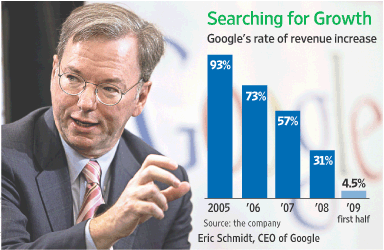
Google Searching for GrowthThe Google juggernaut’s revenue growth has slowed steadily in the last five years, causing the Wall Street Journal to caution investors about buying Google stock. While much of the slow-down in Google’s revenue may be attributed to the recession, the WSJ cautions that:

  • Microsoft is offering stiffer competition in search, which will only intensify once antitrust regulators approve its partnership with Yahoo! and the two companies actually implement their partnership (which could take another year);
  • YouTube’s promise as an ad platform remains uncertain;
  • Google lags behind Apple and Research in Motion in developing mobile phone operating systems, with Android still unproven;
  • It remains unclear how successful the company will be in expanding beyond its existing lead in small text  ads into the potentially lucrative realm of banner ads.

Somehow I doubt Google’s fall to Earth will do much to allay the concerns of those who see Google as the kind of evil monopolist Microsoft was made out to be in the 90s.

As the Journal concludes, “It would be foolish to predict that Google won’t have another business success, of course… Google may itself discover the next Google-like business.” As long as someone’s out there working to turn today’s idle fantasies into tomorrow’s multi-billion dollar businesses, consumers win—whoever that bold innovator might be.

We’ve just published an op-ed over at Forbes.com about today’s big Yahoo!-Microsoft deal.


Searching For Success: Web 1.0 Titans Struggle to Reinvent Themselves by Berin Szoka & Adam Thierer

Yahoo! and Microsoft on Wednesday announced a partnership in which Microsoft’s Bing search engine technology will power search for both companies, but Yahoo! will manage advertising sales and content creation.

This should be cause for celebration as a good thing for consumers. By providing a strong competitor with a combined 28% market share, the deal should also be a source of relief at Google, which has come under increasing attack for its supposed market dominance. But if recent concerns about online search, advertising, competition and privacy are any guide, many will fail to appreciate why the deal is pro-consumer, or what it says about the rapid evolution of the Internet.

It’s easy to forget that just a decade ago most of us still hadn’t done our first Google search, Microsoft was still focused on the desktop and Yahoo! was still serving up the online equivalent of the Yellow Pages. AltaVista, AOL, CompuServe and Geocities still ruled the roost.

Today, as we enjoy the fruits of a true cyber-renaissance, cyberspace circa 1999 increasingly looks like the Digital Dark Ages: The old online walled gardens have crumbled, desktop applications have migrated to the cloud and search has redefined our experience of the Web.

Oh, and did we mention just about all of it is “free“? Sounds like exactly the sort of vigorous innovation, expanding consumer choice, falling prices and cut-throat competition that policymakers should want, right?

Alas, regulators seem stuck in the past. European officials in particular seem hell-bent on continuing the antitrust crusade of the ’90s against Microsoft, myopically focused on fading paradigms (desktop operating systems and Web browsers). But instead of narrowly defining high-tech markets based on yesterday’s technologies or market structures, policymakers should embrace the one constant of the Internet economy: dynamic, disruptive and irrepressible change.

Continue reading →

Cory Doctorow has called for a Wikipedia-style effort to build an open source, non-profit search engine. From his column in The Guardian:

What’s more, the way that search engines determine the ranking and relevance of any given website has become more critical than the editorial berth at the New York Times combined with the chief spots at the major TV networks. Good search engine placement is make-or-break advertising. It’s ideological mindshare. It’s relevance… It’s a terrible idea to vest this much power with one company, even one as fun, user-centered and technologically excellent as Google. It’s too much power for a handful of companies to wield. The question of what we can and can’t see when we go hunting for answers demands a transparent, participatory solution. There’s no dictator benevolent enough to entrust with the power to determine our political, commercial, social and ideological agenda. This is one for The People. Put that way, it’s obvious: if search engines set the public agenda, they should be public.

He goes on to claim that “Google’s algorithms are editorial decisions.”   For Doctorow, this is an outrage: “so much editorial power is better vested in big, transparent, public entities than a few giant private concerns.”

I wish Doctorow well in his effort to crowdsource a Google-killer, but I’m more than a little skeptical that anyone would actually want to use his search engine of The People.  My guess is that, like most things produced in the name of “The People” (Soviet toilet paper comes to mind), it will probably won’t be much fun to use, and will likely chafe noticeably. (For the record, I love and regularly use Wikipedia; I just don’t think that model is unlikely to produce a particularly useful search engine.  As Doctorow himself has noted of Google, “they make incredibly awesome search tools.”)

But I’m glad to see that Doctorow has conceded an important point of constitutional law: The First Amendment protects the editorial discretion of search engines, like all private companies, to decide what to content to communicate.  For a newspaper, that means deciding which articles or editorials to run.  For a library or bookstore, it means which books to carry.  For search engines, it means how to write their search algorithims. Continue reading →

It seems Microsoft is facing much the same problem Pepsi faced in the 70s, when it created the Pepsi challenge (a blind taste test between Coke and Pepsi):

A stark sign of the challenge Yusuf Mehdi faces as a point man for Microsoft in the company’s battle with Google comes from the company’s own research into the habits of consumers online. During regular “blind taste tests,” in which Microsoft asks randomly-selected consumers to score the quality of results from various Internet search engines, the quality of Microsoft’s search results have so improved that people can’t tell the difference between Microsoft and Google search results, says Mr. Mehdi, senior vice president of Microsoft’s online audience business group. But when Microsoft slaps the Google brand name on the results from Microsoft’s own search engine during another portion of its tests, users invariably score them highest. “Just by putting the name up, people think it’s more relevant,” he says. … Microsoft still faces the problem of the strong association in consumers’ minds between Google and Internet search. In theory, it’s far easier for a consumer to switch Internet search engines than it is for them to switch other forms of software. But Mr. Mehdi–a veteran of the Web browser wars of the late 90s in which Microsoft managed to overtake the pioneer in the category, Netscape Communications–says in reality it’s very hard to convince consumers to change their search behavior.

So, Microsoft faces an uphill battle.  Happily for the Internet marketplace, it seems they’re embracing the challenge cheerily by attempting to kill two birds with one stone:  launching an innovative new semantic search engine capable of answering users’ questions more directly while also creating a fresh new brand for what Microsoft acknowledges is a “confusing jumble of brand names for its search efforts.”  I, for one am looking forward to Microsoft’s forthcoming search engine, dubbed “Kumo.”

But I think there’s a bigger lesson here:  Google’s most valuable asset is its brand. Continue reading →

Leave it to the English—famous for their superior fluency in the language that bears their name—to reach unparalleled heights of hysteria in the war of words being waged against Google. The Guardian’s Henry Porter claims that “Google is just an amoral menace: The ever-growing empire produces nothing but seems determined to control everything.”

Porter declares that Google is the world’s “most prominent WWM,” his acronym for the “worldwide monopolies that sweep all before them with exuberant contempt for people’s rights, their property and the past.”

Google is in the final analysis a parasite that creates nothing, merely offering little aggregation, lists and the ordering of information generated by people who have invested their capital, skill and time. On the back of the labour of others it makes vast advertising revenues – in the final quarter of last year its revenues were $5.7bn, and it currently sits on a cash pile of $8.6bn.

Let’s review Google’s 2008 Annual Report. Of Google’s 2008 Revenue ($21.78 billion), two-thirds ($14.41 billion) came from advertising on Google sites and just under one-third ($6.71 billion) came from advertising on Google Content Network (GCN) web sites (made up of publishers that sell their ad space to advertisers through Google AdSense). On this revenue, Google made a net profit of $4.2 billion after taxes. To put these numbers in context, Microsoft (Google’s closest peer) earned three times ($60.42 billion) Google’s revenue and produced 4.21 times ($17.68 billion) Google’s profit. Google’s revenue was just 0.1528% of 2008 U.S. GDP and its net income, 0.0294%.

So what does Google actually create with all that revenue? The answer is free content and services.

First, Google cross-subsidizes dozens of its own free services—starting with its search engine but also including email, a free browser, YouTube, a word processing suite, IM, maps, news, and much more.

Second, as the world’s leading ad network, Google supports a significant percentage of the free content and services offered by others. In 2008, Google paid out $5.28 billion (24.22% of revenue) to GCN publishers—significantly more than the $4.2 billion Google earned in net income (19.3% of revenue). Continue reading →

Monday’s USA TODAY ran a long article discussing the tracking capabilities of the T-Mobile G1 smartphone, which is currently the only mobile device available that ships with Google’s Android operating system. I have a different take on the G1 phone, as I explain in a letter to the editor that appeared in today’s USA TODAY:

USA TODAY’s story on the G1 phone, which describes Google’s “surveillance” capabilities, does not do justice to the relationship that online service providers need to maintain with their users (“Feel like someone’s watching you?,” Cover story, Money, Monday). Google cannot freely use the data it collects from owners of its G1 phone. Far from it, the G1’s privacy policy describes clearly what Google can and cannot do with user information. And the policy is legally binding. Google has everything to lose and nothing to gain from a data breach. A single privacy flub can send consumers fleeing from not only the G1 but also from Google’s other online services. This is why Google maintains robust privacy safeguards. Google’s innovations in search, mail and other applications have helped make the Web a far more accessible and useful resource. Online users need to be careful with their information, but hyping privacy fears is unwarranted.

To be sure, using the G1 phone is not without risks, and some especially risk-averse individuals might want to steer clear of Android entirely. But when you consider the privacy risks many of us live with every day, Android’s privacy risks don’t seem all that great. In fact, the ubiquitous personal computer is probably the most vulnerable device owned by the average person–Internet architect Vint Cerf  has estimated that up to 1 in 4 PCs worldwide is infected with malware. The G1 may be a marketer’s goldmine, but that doesn’t mean it can’t also offer strong privacy assurances.