 I am pleased to announce the release of my latest book, “Permissionless Innovation: The Continuing Case for Comprehensive Technological Freedom.” It’s a short manifesto (just under 100 pages) that condenses — and attempts to make more accessible — arguments that I have developed in various law review articles, working papers, and blog posts over the past few years. I have two goals with this book.
First, I attempt to show how the central fault line in almost all modern technology policy debates revolves around “the permission question,” which asks:
Must the creators of new technologies seek the blessing of public officials before they develop and deploy their innovations? How that question is answered depends on the disposition one adopts toward new inventions. Two conflicting attitudes are evident.
One disposition is known as the “precautionary principle.” Generally speaking, it refers to the belief that new innovations should be curtailed or disallowed until their developers can prove that they will not cause any harms to individuals, groups, specific entities, cultural norms, or various existing laws, norms, or traditions.
The other vision can be labeled “permissionless innovation.” It refers to the notion that experimentation with new technologies and business models should generally be permitted by default. Unless a compelling case can be made that a new invention will bring serious harm to society, innovation should be allowed to continue unabated and problems, if they develop at all, can be addressed later.
I argue that we are witnessing a grand clash of visions between these two mindsets today in almost all major technology policy discussions today. Continue reading →
Last month, it was my great pleasure to serve as a “provocateur” at the IAPP’s (Int’l Assoc. of Privacy Professionals) annual “Navigate” conference. The event brought together a diverse audience and set of speakers from across the globe to discuss how to deal with the various privacy concerns associated with current and emerging technologies.
My remarks focused on a theme I have developed here for years: There are no simple, silver-bullet solutions to complex problems such as online safety, security, and privacy. Instead, only a “layered” approach incorporating many different solutions–education, media literacy, digital citizenship, evolving society norms, self-regulation, and targeted enforcement of existing legal standards–can really help us solve these problems. Even then, new challenges will present themselves as technology continues to evolve and evade traditional controls, solutions, or norms. It’s a never-ending game, and that’s why education
must be our first-order solution. It better prepares us for an uncertain future. (I explained this approach in far more detail in this law review article.)
Anyway, if you’re interested in an 11-minute video of me saying all that, here ya go. Also, down below I have listed several of the recent essays, papers, and law review articles I have done on this issue.
Continue reading →
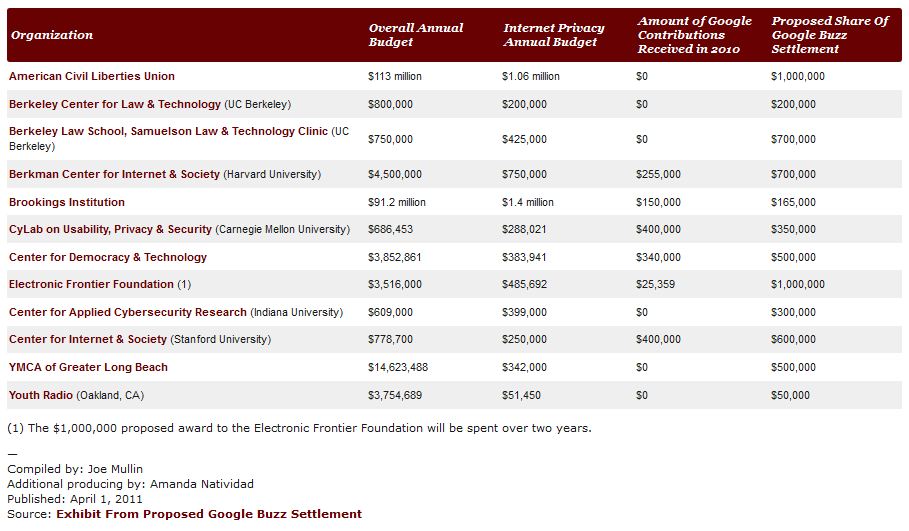
PaidContent.org has posted a chart showing “Who’s Getting Buzz Settlement Money.” This refers to the $9.5 million payout following the Federal Trade Commission settlement with Google a class action suit over its “Buzz” social networking service. Last week, the Federal Trade Commission entered into a consent decree with Google over its botched rollout of Buzz saying the search giant violated its own privacy policy. Google will also pay out to various advocacy groups according to the distribution seen in the chart as part of a separate class action. Payouts to advocates like this are not uncommon, although they are more often the result of a class action settlement than a regulatory agency consent decree. [Update/Correction 5:13 pm: I should have made it clear that this payout was the result of a class action lawsuit against Google and not the direct result of the FTC settlement. Apologies for that mistake, but still interested in the questions raised below.]
But that got me wondering whether this might make for good fodder for a case study by a public choice economist or political scientist. There are some really interesting questions raised by settlements like this that would be worth studying.
Continue reading →
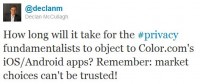 Last night, Declan McCullagh of CNet posted two tweets related to the concerns already percolating in the privacy community about a new Apple and Android app called “Color,” which allows those who use it to take photos and videos and instantaneously share them with other people within a 150-ft radius to create group photo/video albums. In other words, this new app marries photography, social networking, and geo-location.
 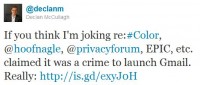 And because the app’s default setting is to share every photo and video you snap openly with the world, Declan wonders “How long will it take for the #privacy fundamentalists to object to Color.com’s iOS/Android apps?” After all, he says facetiously, “Remember: market choices can’t be trusted!” He then reminds us that there’s really nothing new under the privacy policy sun and that we’ve seen this debate unfold before, such as when Google released its GMail service to the world back in 2004.
Indeed, for me, this debate has a “Groundhog Day” sort of feel to it. I feel like I’ve been fighting the same fight with many privacy fundamentalists for the past decade. The cycle goes something like this: Continue reading →
Over at Silicon Alley Insider, Gregory Galant has a wonderful post about “18 Awesome Tech Things We Didn’t Have 10 Years Ago.” It serves as another great example of the amazing technological progress we have witnessed over the past decade. He’s asking people for suggestions for what else should be on the list, so head over there and let him know. Seems like wi-fi technologies should be on there somehow. FiOS deserves a shout-out, too. And where’s Firefox & Chrome? Also, I’ll put in a special word for some amazing new home theater technologies: high-def flat-screens and projectors; media servers & Windows Media Center; BluRay; and 3 incredible gaming / media consoles (Wii, PS3, & XBox). Anyway, here’s Galant’s list:
Wikipedia
Gmail
Facebook
YouTube
Twitter
AdWords
Amazon AWS
RSS (started in ‘99 but didn’t catch on till the ’00s)
Meetup
iPod
Google Maps
Podcasts
Mint
Skype/VOIP
iPhone
Google Docs
Creative Commons
Flickr
Interesting piece by Farhad Manjoo of Slate today entitled “So Gmail Was Down. Get Over It.” Manjoo notes that Google’s Gmail service went down briefly this week — for an hour and a half — and that led to a lot of people “freaking out” over the downtime. He asks” “Google’s e-mail service works 99.9 percent of time. Why do we freak out during the other 0.1 percent?”
That’s an good question, but I actually didn’t hear all that many people bitching about it this time around. In fact, I am rather surprised
how little I heard about this incident. I think that’s because many of us are gradually growing accustomed to a world in which communications networks and digital devices deliver something less than the holy grail of “five 9s” uptime. That was the standard for telephony and computing in the world I grew up in: 99.999% was the magic number that network engineers aspired to and that many of us in the public generally demanded.
Today, however, we settle for something less. As Manjoo’s piece about Gmail suggests, we’ll settle “three 9s,” as in 99.9% reliability. And sometimes we’ll settle for far less than that. Why is that? I think Robert Capps has part of the answer in his recent
Wired essay, “The Good Enough Revolution: When Cheap and Simple Is Just Fine.” Capps points out the modern Digital Age has seen the “triumph of what might be called Good Enough tech. Cheap, fast, simple tools are suddenly everywhere.” He continues: Continue reading →
What Unites Advocates of Speech Controls & Privacy Regulation? [pdf]
by Adam Thierer & Berin Szoka
The Progress & Freedom Foundation,
Progress on Point No. 16.19
Anyone who has spent time following debates about speech and privacy regulation comes to recognize the striking parallels between these two policy arenas. In this paper we will highlight the common rhetoric, proposals, and tactics that unite these regulatory movements. Moreover, we will argue that, at root, what often animates calls for regulation of both speech and privacy are two remarkably elitist beliefs:
- People are too ignorant (or simply too busy) to be trusted to make wise decisions for themselves (or their children); and/or,
- All or most people share essentially the same values or concerns and, therefore, “community standards” should trump household (or individual) standards.
While our use of the term “elitism” may unduly offend some understandably sensitive to populist demagoguery, our aim here is not to launch a broadside against elitism as
Time magazine culture critic William H. Henry once defined it: “The willingness to assert unyieldingly that one idea, contribution or attainment is better than another.”[1] Rather, our aim here is to critique that elitism which rises to the level of political condescension and legal sanction. We attack not so much the beliefs of some leaders, activists, or intellectuals that they have a better idea of what it in the public’s best interest than the public itself does, but rather the imposition of those beliefs through coercive, top-down mandates.
That sort of elitism—elitism enforced by law—is often the objective of speech and privacy regulatory advocates. Our goal is to identify the common themes that unite these regulatory movements, explain why such political elitism is unwarranted, and make it clear how it threatens individual liberty as well as the future of free and open Internet. As an alternative to this elitist vision, we advocate an empowerment agenda: fostering an environment in which users have the tools and information they need to make decisions for themselves and their families. Continue reading →
A key point that Berin and I try to get across in our Forbes editorial today about the Yahoo!-Microsoft deal is that the high-tech marketplace evolves too rapidly for creaky Analog Era antitrust laws to keep up. We wanted to say more on that point in our piece, but we had a tight deadline (and a strict word limit!) Well, turns out that we really don’t need to do so now because Farhad Manjoo of Slate has done a better job than we ever could have making that point in this essay today entitled, “The Case Against the Case Against Google“:
But if the government was right on the facts [in the Microsoft case], it was wrong on the big picture. The theory behind the prosecution was that Microsoft’s mobster tactics would raise the price of software and slow down innovation. But that didn’t happen. In 2002, Microsoft settled the antitrust case with the Bush administration; it faced no substantial penalties for its years of bad behavior. At that point, it still looked unbeatable—it had the same OS monopoly, office-software monopoly, and Web-browser monopoly. And you know what happened? It got beat anyway. Many of Microsoft’s assets turned out not to matter, because upstarts like Google and old foes like Apple found ways to innovate around them.
Continue reading →
Internet policy Shame Artist extraordinaire Chris Soghoian has struck again! Chris recently shamed the online advertising industry into improving their privacy practices with his Targeted Advertising Cookie Opt-Out (TACO) plug-in for Firefox. Now Chris has set his sight on the security practices of cloud service providers.
A letter released this morning, signed by 37 leading online security experts (and organized by Chris), calls on Google to offer persistent SSL (HTTPS) encryption by default for all Google services—or at the very least, to make more visible the option currently given to users to opt-in to use SSL for all communications. Google, in its response, indicated that it was already “looking into whether it would make sense to turn on HTTPS as the default for all Gmail users.”
While Google’s response identifies some clear problems with implementing persistent SSL for all users (esp. connection speed), few would deny that it makes sense for webmail providers to encrypt all traffic using SSL, rather than sending email data “in the clear,” which risks interception by hackers. We at PFF hold no brief for Google, in fact we have found ourselves disagreeing with them on many other occasions on a range of issues (most notably net neutrality mandates). Nonetheless, on this front, Google has long been a leader, having offered SSL since Gmail launched and having begun providing the persistent HTTPS option last summer while most of their competitors still use SSL only for the initial authentication that occurs when a user first signs in. While the letter focuses on Google and webmail in particular, this issue has far broader implications for all online cloud service providers.
No Free Lunch: The Costs of Encryption
Gmail, Yahoo! Mail, Hotmail, etc. are, of course, “free” (
i.e., ad-supported). Google in particular has lead the way in increasing the functionality offered in Gmail, not just constantly increasing the total storage space provided to every user (now over 7GB), but regularly adding innovative new features—at no charge to users. Continue reading →
 I finally got around to reading Planet Google: One Company’s Audacious Plan to Organize Everything We Know, by Randall Stross. It’s very well done. Stross is a frequently contributor to the New York Times and the author of several other interesting books on the technology industry. He knows how to weave a story together, and it helps that Google’s story is a pretty amazing one.
Each chapter discusses a different part of Google’s growing family of services — GMail, Google Maps, Google Earth, Book Search, and YouTube. Of course, it all started with search and Stross does a good job explaining how the ingenious Google search algorithm has grown from dorm room project to the greatest aggregator of human knowledge that the world has ever known. This, in turn, has powered Google’s hugely successful online advertising system. The real secret of their success with online advertising, Stross argues, is that “Google’s impersonal, mathematical approach search also provides you with the ability to serve advertisements that are tailored to a search, rather than to the person submitting the search request, whose identity would have to be known.”
Despite the benefits of such generally anonymous searching, as Google has grown and added new services and capabilities, concerns about the sheer volume of data that the company collects have led to heightened privacy concerns. Indeed, privacy is a core theme that Stross uses in the book to tie many of the chapters and issues together. Google is constantly struggling to strike the right balance between providing more access to the world’s information while also being careful not to raise privacy concerns. But it’s unclear exactly how much more information collection that users (or public officials) will tolerate before advocating stricter limits on Google’s reach. As Stross points out:
Guided by its founding mission, to organize all the world’s information, Google has created storage capacity that allows it to gain control of what its users are you doing in a comprehensive way that no other company has done, and to preserve those records indefinitely, without the need to clear out old records to make way for new ones. Moreover, Google differentiates its service by refining its own proprietary software formula to mine and massage the data, technology that it zealously protects from the sight of rivals. This sets up a conflict between Google’s wish to operate a “black box” (completely opaque to the outside) and its users’ wish for transparency.
Continue reading →
 I am pleased to announce the release of my latest book, “Permissionless Innovation: The Continuing Case for Comprehensive Technological Freedom.” It’s a short manifesto (just under 100 pages) that condenses — and attempts to make more accessible — arguments that I have developed in various law review articles, working papers, and blog posts over the past few years. I have two goals with this book.
 The Technology Liberation Front is the tech policy blog dedicated to keeping politicians' hands off the 'net and everything else related to technology.