Posts tagged as:

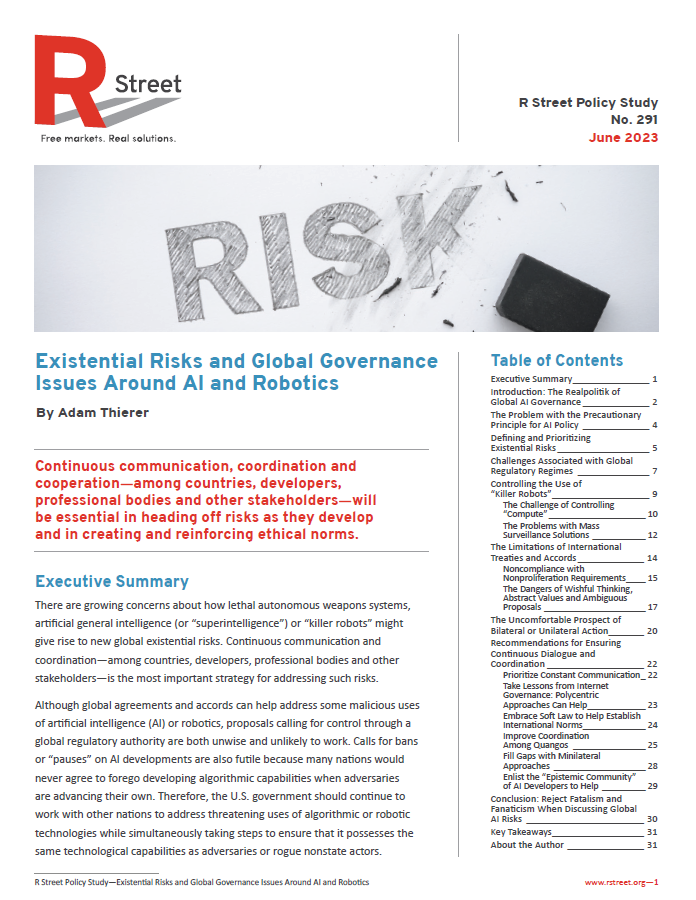
Can we advance AI safety without new international regulatory bureaucracies, licensing schemes or global surveillance systems? I explore that question in my latest R Street Institute study, “Existential Risks & Global Governance Issues around AI & Robotics.” (31 pgs)  My report rejects extremist thinking about AI arms control & stresses how the “realpolitik” of international AI governance is such that things cannot and must not be solved through silver-bullet gimmicks and grandiose global government regulatory regimes.

The report uses Nick Bostrom’s “vulnerable world hypothesis” as a launching point and discusses how his five specific control mechanisms for addressing AI risks have started having real-world influence with extreme regulatory proposals now being floated. My report also does a deep dive into the debate about a proposed global ban on “killer robots” and looks at how past treaties and arms control efforts might apply, or what we can learn from them about what won’t work.

I argue that proposals to impose global controls on AI through a worldwide regulatory authority are both unwise and unlikely to work. Calls for bans or “pauses” on AI developments are largely futile because many nations will not agree to them. As with nuclear and chemical weapons, treaties, accords, sanctions and other multilateral agreements can help address some threats of malicious uses of AI or robotics. But trade-offs are inevitable, and addressing one type of existential risk sometimes can give rise to other risks.

A culture of AI safety by design is critical. But there is an equally compelling interest in ensuring algorithmic innovations are developed and made widely available to society. The most effective solution to technological problems usually lies in more innovation, not less. Many other multistakeholder and multilateral efforts can help AI safety. Final third of my study is devoted to a discussion of that. Continuous communication, coordination, and cooperation—among countries, developers, professional bodies and other stakeholders—will be essential. Continue reading →


[Cross-posted from Medium.]

[last updated 4/3/2025 – Check my Medium page for latest posts]

This a running list of all the essays and reports I’ve already rolled out on the governance of artificial intelligence (AI), machine learning (ML), and robotics. Why have I decided to spend so much time on this issue? Because this will become the most important technological revolution of our lifetimes. Every segment of the economy will be touched in some fashion by AI, ML, robotics, and the power of computational science. It should be equally clear that public policy will be radically transformed along the way.

Eventually, all policy will involve AI policy and computational considerations. As AI “eats the world,” it eats the world of public policy along with it. The stakes here are profound for individuals, economies, and nations. As a result, AI policy will be the most important technology policy fight of the next decade, and perhaps next quarter century. Those who are passionate about the freedom to innovate need to prepare to meet the challenge as proposals to regulate AI proliferate.

There are many socio-technical concerns surrounding algorithmic systems that deserve serious consideration and appropriate governance steps to ensure that these systems are beneficial to society. However, there is an equally compelling public interest in ensuring that AI innovations are developed and made widely available to help improve human well-being across many dimensions. And that’s the case that I’ll be dedicating my life to making in coming years.

Here’s the list of what I’ve done so far. I will continue to update this as new material is released: Continue reading →

Financial Help for Gamblers: How to Get Find ReliefIn my latest column for The Hill, I consider that dangers of government gambling our tax dollars on risky industrial policy programs. I begin by noting:

Roll the dice at a casino enough times, and you are bound to win a few games. But knowing the odds are not in your favor, how much are you willing to risk losing by continuing to gamble? This is the same issue governments confront when they gamble taxpayer dollars on industrial policy efforts, which can best be described as targeted and directed efforts to plan for specific future industrial outputs and outcomes. Throwing enough money at risky ventures might net a few wins, but at what cost? Could those resources have been better spent? And do bureaucrats really make better bets than private investors?

I continue on to note that, while the US is embarking on a major new industrial policy push, history does not provide us with a lot of hope regarding Uncle Sam’s betting record when he starts rolling those industrial policy dice. “How much tolerance should the public have for government industrial policy gambling?” I ask. I continue on:

Generally speaking, “basic” support (broad-based funding for universities and research labs) is wiser than “applied” (targeted subsidies for specific firms or sectors). With basic R&D funding, the chances of wasting resources on risky investments can be contained, at least as compared to highly targeted investments in unproven technologies and firms.

I also argue that “The riskiest bets on new technologies and sectors are better left to private investors,” and note how, “America’s venture capital industry remains the envy of the world because it continues to power world-beating advanced technology.” Accordingly, I conclude: Continue reading →

[Co-authored with Connor Haaland and originally published on The Bridge as, “Do Our Leaders Believe in Free Speech and Online Freedom Anymore?”]

The president is a counterpuncher': Trump on familiar ground in ...A major policy battle has developed regarding the wisdom of regulating social media platforms in the United States, with the internet’s most important law potentially in the crosshairs. Leaders in both major parties are calling for sweeping regulation.
Specifically, President Trump and his presumptive opponent in the coming presidential election, former Vice President Joe Biden, have both called for “Section 230” of the Communications Decency Act to be repealed. Last week, the president took a misguided step in this direction by signing an executive order that, if fully carried out, will result in significantly greater regulation of the internet and of speech.

A Growing Call to Regulate Internet Platforms

The ramifications of these threats and steps could not be more profound. Without Section 230—also known as “the 26 words that created the internet”—we would have a much less advanced internet ecosystem. Twitter, Facebook, YouTube, and Wikipedia would have never grown as quickly. Indeed, the repeal of Section 230 means many fewer jobs, less information distribution, and, frankly, less joy.

Shockingly, by backing Trump’s recent push for regulating these internet platforms, many conservatives are betraying their own principles—the ones that support freedom of expression and the ability to run private businesses without government interference.

Section 230 limits the liability online intermediaries face for the content and communications that travel over their networks. The immunities granted by Section 230 let online speech and commerce flow freely, without the constant threat of legal action or onerous liability looming overhead for digital platforms. To put it another way, without this provision, today’s vibrant internet ecosystem likely would not exist. Continue reading →

In recent essays and papers, I have discussed the growth of “innovation arbitrage,” which I defined as, “The movement of ideas, innovations, or operations to those jurisdictions that provide a legal and regulatory environment more hospitable to entrepreneurial activity.” A new Economist article about “Why startups are leaving Silicon Valley,” discusses innovation arbitrage without calling it such. The article notes that, for a variety of reasons, Valley innovators and investors are looking elsewhere to set up shop or put money into new ventures. The article continues:

Other cities are rising in relative importance as a result. The Kauffman Foundation, a non-profit group that tracks entrepreneurship, now ranks the Miami-Fort Lauderdale area first for startup activity in America, based on the density of startups and new entrepreneurs. Mr Thiel is moving to Los Angeles, which has a vibrant tech scene. Phoenix and Pittsburgh have become hubs for autonomous vehicles; New York for media startups; London for fintech; Shenzhen for hardware. None of these places can match the Valley on its own; between them, they point to a world in which innovation is more distributed. If great ideas can bubble up in more places, that has to be welcome. There are some reasons to think the playing-field for innovation is indeed being levelled up. Capital is becoming more widely available to bright sparks everywhere: tech investors increasingly trawl the world, not just California, for hot ideas. There is less reason than ever for a single region to be the epicentre of technology. Thanks to the tools that the Valley’s own firms have produced, from smartphones to video calls to messaging apps, teams can work effectively from different offices and places.

That’s the power of innovation arbitrage at work.  Continue reading →

[originally published on Plaintext on June 21, 2017.]

This summer, we celebrate the 20th anniversary of two developments that gave us the modern Internet as we know it. One was a court case that guaranteed online speech would flow freely, without government prior restraints or censorship threats. The other was an official White House framework for digital markets that ensured the free movement of goods and services online.

The result of these two vital policy decisions was an unprecedented explosion of speech freedoms and commercial opportunities that we continue to enjoy the benefits of twenty years later.

While it is easy to take all this for granted today, it is worth remembering that, in the long arc of human history, no technology or medium has more rapidly expanded the range of human liberties — both speech and commercial liberties — than the Internet and digital technologies. But things could have turned out much differently if not for the crucially important policy choices the United States made for the Internet two decades ago. Continue reading →

The future of emerging technology policy will be influenced increasingly by the interplay of three interrelated trends: “innovation arbitrage,” “technological civil disobedience,” and “spontaneous private deregulation.” Those terms can be briefly defined as follows:

  • Innovation arbitrage” refers to the idea that innovators can, and will with increasingly regularity, move to those jurisdictions that provide a legal and regulatory environment more hospitable to entrepreneurial activity. Just as capital now fluidly moves around the globe seeking out more friendly regulatory treatment, the same is increasingly true for innovations. And this will also play out domestically as innovators seek to play state and local governments off each other in search of some sort of competitive advantage.
  • Technological civil disobedience” represents the refusal of innovators (individuals, groups, or even corporations) or consumers to obey technology-specific laws or regulations because they find them offensive, confusing, time-consuming, expensive, or perhaps just annoying and irrelevant. New technological devices and platforms are making it easier than ever for the public to openly defy (or perhaps just ignore) rules that limit their freedom to create or use modern technologies.
  • Spontaneous private deregulation” can be thought of as de facto rather than the de jure elimination of traditional laws and regulations owing to a combination of rapid technological change as well the potential threat of innovation arbitrage and technological civil disobedience. In other words, many laws and regulations aren’t being formally removed from the books, but they are being made largely irrelevant by some combination of those factors. “Benign or otherwise, spontaneous deregulation is happening increasingly rapidly and in ever more industries,” noted Benjamin Edelman and Damien Geradin in a Harvard Business Review article on the phenomenon.[1]

I have previously documented examples of these trends in action for technology sectors as varied as drones, driverless cars, genetic testing, Bitcoin, and the sharing economy. (For example, on the theme of global innovation arbitrage, see all these various essays. And on the growth of technological civil disobedience, see, “DOT’s Driverless Cars Guidance: Will ‘Agency Threats’ Rule the Future?” and “Quick Thoughts on FAA’s Proposed Drone Registration System.” I also discuss some of these issues in the second edition of my Permissionless Innovation book.)

In this essay, I want to briefly highlight how, over the course of just the past month, a single company has offered us a powerful example of how both global innovation arbitrage and technological civil disobedience— or at least the threat thereof—might become a more prevalent feature of discussions about the governance of emerging technologies. And, in the process, that could lead to at least the partial spontaneous deregulation of certain sectors or technologies. Finally, I will discuss how this might affect technological governance more generally and accelerate the movement toward so-called “soft law” governance mechanisms as an alternative to traditional regulatory approaches. Continue reading →

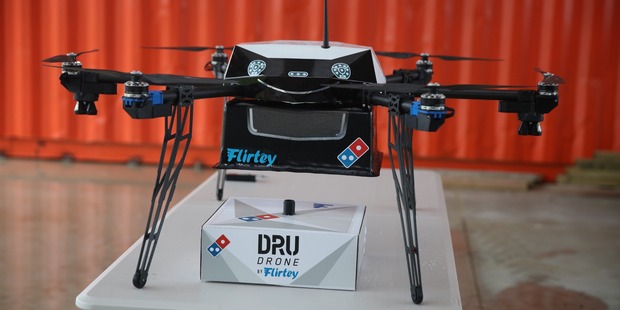
Dominos pizza drone
Just three days ago I penned another installment in my ongoing series about the growing phenomenon of “global innovation arbitrage” — or the idea that “innovators can, and increasingly will, move to those countries and continents that provide a legal and regulatory environment more hospitable to entrepreneurial activity.” And now it’s already time for another entry in the series!

My previous column focused on driverless car innovation moving overseas, and earlier installments discussed genetic testingdrones, and the sharing economy. Now another drone-related example has come to my attention, this time from New Zealand. According to the New Zealand Herald:

Aerial pizza delivery may sound futuristic but Domino’s has been given the green light to test New Zealand pizza delivery via drones. The fast food chain has partnered with drone business Flirtey to launch the first commercial drone delivery service in the world, starting later this year.

Importantly, according to the story, “If it is successful the company plans to extend the delivery method to six other markets – Australia, Belgium, France, The Netherlands, Japan and Germany.” That’s right, America is not on the list. In other words, a popular American pizza delivery chain is looking overseas to find the freedom to experiment with new delivery methods. And the reason they are doing so is because of the seemingly endless bureaucratic foot-dragging by federal regulators at the FAA. Continue reading →

In previous essays here I have discussed the rise of “global innovation arbitrage” for genetic testing, drones, and the sharing economy. I argued that: “Capital moves like quicksilver around the globe today as investors and entrepreneurs look for more hospitable tax and regulatory environments. The same is increasingly true for innovation. Innovators can, and increasingly will, move to those countries and continents that provide a legal and regulatory environment more hospitable to entrepreneurial activity.” I’ve been working on a longer paper about this with Samuel Hammond, and in doing research on the issue, we keep finding interesting examples of this phenomenon.

The latest example comes from a terrific new essay (“Humans: Unsafe at Any Speed“) about driverless car technology by Wall Street Journal technology columnist L. Gordon Crovitz. He cites some important recent efforts by Ford and Google and he notes that they and other innovators will need to be given more flexible regulatory treatment if we want these life-saving technologies on the road as soon as possible. “The prospect of mass-producing cars without steering wheels or pedals means U.S. regulators will either allow these innovations on American roads or cede to Europe and Asia the testing grounds for self-driving technologies,” Crovitz observes. “By investing in autonomous vehicles, Ford and Google are presuming regulators will have to allow the new technologies, which are developing faster even than optimists imagined when Google started working on self-driving cars in 2009.”  Continue reading →