Oh my. So today, as part of its ongoing effort to look like the hip new regulatory agency on the block, the Federal Communications Commission decided to launch a MySpace page. Really. Big. Mistake.
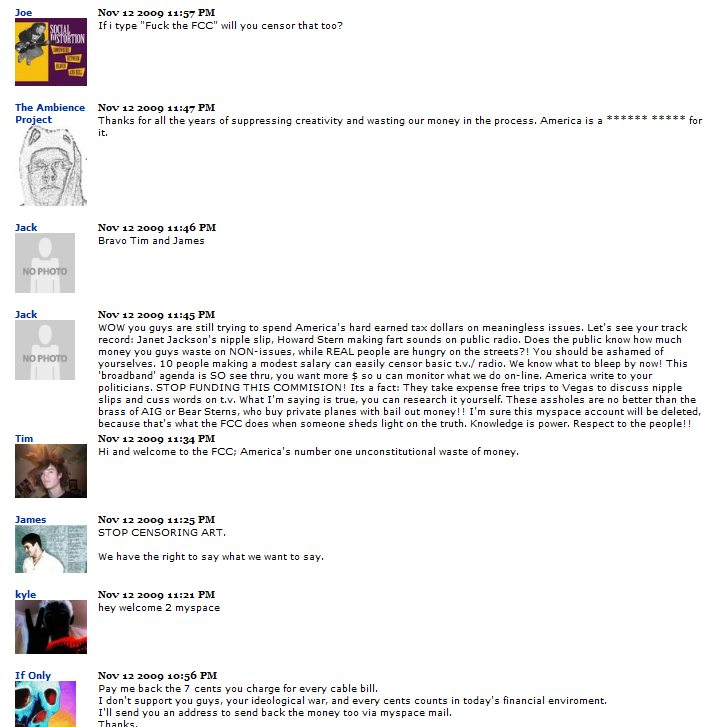
I mean, shouldn’t someone over there have known it would take about 2 milliseconds for various cranks to launch into profanity-laced rants that would make George Carlin blush? Sure enough, the page is already littered with some of the most colorful language you’ll ever lay your eyes on, mixed in with some 9/11 conspiracy theories, a plug for the Marijuana Policy Posse, and something about the FCC “build[ing] a cone of terror in [our] homes.”
Go check it out, but avert the children’s eyes first. It ain’t pretty. Which begs the question: Will the FCC apply its Pacifica indecency standard to its own MySpace page? Seems like their site is pretty “pervasive” to me, and there could be “children in the viewing audience.” Time to censor these “fleeting expletives” on the FCC’s MySpace page!
Today, it was my great privilege to guest lecture at Princeton University’s Center for Information Technology Policy. Under the leadership of Ed Felten, who also runs the excellent “Freedom to Tinker” blog, the CITP has quickly become one of America’s premier institutions in the field of IT policy matters. David Robinson, who some of you will remember from his days as an editor at The American, serves as associate director of the CITP program and was kind enough to invite me to speak. And our own Tim Lee is currently studying there as well. I wish I was smart enough to get into that program!
The topic of my talk was “The Future of the First Amendment in an Age of Technological Convergence” and I used the opportunity to create a narrated video of this presentation, which I have made to several other groups through the years. In this presentation, I talk about “America’s First Amendment Twilight Zone,” which refers to the fact that identical words and images are being regulated in completely different ways today depending on the mode of transmission. This illogical and unfair situation could eventually threaten the Internet, video games, and all new media with many of the misguided regulations that have long been imposed on broadcast television and radio operators. In my presentation, which you can watch below, I make the case for changing our First Amendment regime to ensure “bit equality”; all speech and media platforms should be accorded the gold standard of First Amendment protection.
http://www.youtube.com/v/xJo3tVMScyI&hl=en&fs=1
Continue reading →
Just FYI, the latest update of my booklet on “Parental Controls and Online Child Protection: A Survey of Tools & Methods” is now live. The new version, Version 3.1, provides minor updates to all sections of the book and a new appendix of relevant research in the field. I issue major updates early each year and 1 or 2 tweaks during the course of the year to reflect the evolution of the parental control and online child safety market and debate. 
For those not familiar with the report, it explores the market for parental control tools, rating schemes, education efforts, and initiatives aimed at promoting online child safety. I believe that the parental controls and content management tools cataloged in the report represent a better, less restrictive alternative to government regulation. As I conclude after evaluating that state of the market: “There has never been a time in our nation’s history when parents have had more tools and methods at their disposal to help them decide what constitutes acceptable media content in their homes and in the lives of their children.”
The report is available free-of-charge on the PFF website, and the previous editions of the report are housed there too in case you want to see how it has evolved over the past two years. For those interested in taking a quick look at the report, I have embedded it down below the fold as a Scribd file. Finally, as is always the case, I encourage readers to send me updates and suggestions for how to improve the report and I will incorporate them into future versions.
Continue reading →
Lately I’ve been writing about potentially historic upcoming First Amendment case of FCC v. Fox Television Stations. The Supreme Court will hear the case on Tuesday, November 4th. All the briefs in the case are in and can be found on the ABA website here. But I’ve pasted the links for all of them below as well. In coming days and weeks I might be highlighting some of the comments from the briefs. [The docket number for the case is 07-582]. The amicus brief I filed with my friends at CDT can be found here, and I wrote about it last week here on the TLF.
The
FCC v. Fox case is the indecency case involving the FCC’s new policy for “fleeting expletives.” I wrote about the Second Circuit Court of Appeals decision here. The full decision is here. The FCC v. Fox case could become the most important First Amendment-related Supreme Court case since FCC v. Pacifica Foundation, which just turned 30 years old last month. Anyway, here are all the briefs in the case, starting with the merit briefs by the lead parties:
Continue reading →
 Along with my friends John Morris and Sophia Cope of the Center for Democracy & Technology, I have just submitted an amicus brief to the Supreme Court in the potentially historic free speech case FCC v. Fox, which will be heard in November.
[Reminder: The
FCC v. Fox case is the indecency case involving the FCC’s new policy for “fleeting expletives.” I wrote about the Second Circuit Court of Appeals decision here. The full decision is here. By contrast, the so-called “Janet Jackson case” — CBS v. FCC — took place in the Third Circuit Court of Appeals and that court recently handed down a decision that also went against the FCC. I wrote about the Third Circuit’s decision here.]
The
FCC v. Fox case could become the most important First Amendment-related Supreme Court case since FCC v. Pacifica Foundation, which just turned 30 years old last month. Of course, it could be that the Supreme Court simply sticks to the procedural questions regarding whether the FCC moved too far, too fast in reversing it’s long-standing policy of restraint regarding “fleeting expletives.” That’s essentially what the Second Circuit did. On the other hand, the Supremes might reach the substantive First Amendment issues tied up in the Pacifica case. We just won’t know for sure until the case is handed down.
Regardless, in the joint CDT-PFF amicus brief filed today, we argue that the FCC has both gone too far procedurally and that “the time is rapidly approaching for this Court to find that broadcast, like the Internet and other means of mass communication, ‘is entitled to the highest protection from government intrusion’ and that there is no longer a factual ‘basis for qualifying the level of First Amendment scrutiny that should be applied to this medium.'” Citing
Reno v. ACLU, 521 U.S. at 863, 870.”
A more detailed summary of our argument follows below.
Continue reading →
[Note: This is the fourth in a series of essays about the legacy of the Supreme Court’s FCC v. Pacifica Foundation decision, which celebrates its 30th anniversary on July 3rd. Part 1, presented a general overview of the issue. Part 2 sketched a short history of FCC indecency regulation. Part 3 discussed the misguided logic of the Court’s reasoning in Pacifica as it stood in 1978. This installment will examine why that logic is even more misguided in light of modern developments.]
Whatever legitimacy
Pacifica’s “pervasiveness rationale” might have once had, it has been largely eroded by modern media developments.
First, the pervasiveness rationale for media regulation fails today because new content tailoring technologies make it easier than ever before for parents to manage media in their homes and in their lives of their children. It is impossible to consider video programming an “intruder” in the home when tools exist that can help parents almost perfectly tailor viewing experiences to individual household preferences.
When Justice Stevens argued in
Pacifica that broadcast signals represented an “intruder” in the home, he supported that claim by noting that: “Because the broadcast audience is constantly tuning in and out, prior warnings cannot completely protect the listener or viewer from unexpected program content.” While that may have reflected the state of technology and TV viewing at the time, it is completely at odds with modern realities. In 1978, the viewing experience was a more passive affair and consumers had very few ways to control that experience unless they turned off the television altogether. Today, by contrast, viewers (including parents) have the tools to “tune in and out” at will, and they have abundant “prior warnings” about program content thanks to the existence of ratings, program information, and electronic program guides. These tools help parents restrict or tailor the viewing experience in advance according to their values and preferences.
Continue reading →
[Note: This is the third in a series of essays about the legacy of the Supreme Court’s FCC v. Pacifica Foundation decision, which celebrates its 30th anniversary on July 3rd. Part 1, presented a general overview of the issue. Part 2 sketched a short history of FCC indecency regulation. This installment will examine the misguided logic of the Court’s reasoning in Pacifica as it stood in 1978. Part 4 will then examine why that logic is even more misguided in light of modern developments.]
For the past three decades, regulation of television programming has been premised on the “pervasiveness rationale” as articulated in the landmark Supreme Court case
FCC v. Pacifica Foundation. In Pacifica, in a 5-4 plurality decision, the Court held:
Of all forms of communication, broadcasting has the most limited First Amendment protection. Among the reasons for specially treating indecent broadcasting is the uniquely pervasive presence that medium of expression occupies in the lives of our people. Broadcasts extend into the privacy of the home and it is impossible completely to avoid those that are patently offensive. Broadcasting, moreover, is uniquely accessible to children.
In one portion of the decision, Justice John Paul Stevens, who authored the majority opinion, even referred to broadcast signals as an “intruder” into the home.
There were always serious problems with the “media-as-invader” logic of Pacifica.
Continue reading →

 The Technology Liberation Front is the tech policy blog dedicated to keeping politicians' hands off the 'net and everything else related to technology.