We hear a lot today about the importance of “disruptive innovation,” “deep technologies,” “moonshots,” and even “technological miracles.” What do these terms mean and how are they related? Are they just silly clichés used to hype techno-exuberant books, articles, and speeches? Or do these terms have real meaning and importance?
This article explores those questions and argues that, while these terms are confronted with definitional challenges and occasional overuse, they retain real importance to human flourishing, economic growth, and societal progress.
Basic Concepts
Don Boudreaux defines moonshots as, “radical but feasible solutions to important problems” and Mike Cushing has referred to them as “innovation that achieves the previously unthinkable.” “Deep technology” is another buzzword being used to describe such revolutionary and important innovations. Swati Chaturvedi of investment firm Propel[x] says deep technologies are innovations that are “built on tangible scientific discoveries or engineering innovations” and “are trying to solve big issues that really affect the world around them.”
“Disruptive technology” or “game-changing innovations” are other terms that are often used in reference to technologies and inventions with major societal impacts. “Transformative technologies” is another increasingly popular term, albeit one focused mostly on health and wellness-related innovations. Continue reading →
The future of emerging technology policy will be influenced increasingly by the interplay of three interrelated trends: “innovation arbitrage,” “technological civil disobedience,” and “spontaneous private deregulation.” Those terms can be briefly defined as follows:
“Innovation arbitrage” refers to the idea that innovators can, and will with increasingly regularity, move to those jurisdictions that provide a legal and regulatory environment more hospitable to entrepreneurial activity. Just as capital now fluidly moves around the globe seeking out more friendly regulatory treatment, the same is increasingly true for innovations. And this will also play out domestically as innovators seek to play state and local governments off each other in search of some sort of competitive advantage.
“Technological civil disobedience” represents the refusal of innovators (individuals, groups, or even corporations) or consumers to obey technology-specific laws or regulations because they find them offensive, confusing, time-consuming, expensive, or perhaps just annoying and irrelevant. New technological devices and platforms are making it easier than ever for the public to openly defy (or perhaps just ignore) rules that limit their freedom to create or use modern technologies.
“Spontaneous private deregulation” can be thought of as de facto rather than the de jure elimination of traditional laws and regulations owing to a combination of rapid technological change as well the potential threat of innovation arbitrage and technological civil disobedience. In other words, many laws and regulations aren’t being formally removed from the books, but they are being made largely irrelevant by some combination of those factors. “Benign or otherwise, spontaneous deregulation is happening increasingly rapidly and in ever more industries,” noted Benjamin Edelman and Damien Geradin in a Harvard Business Reviewarticle on the phenomenon.[1]
In this essay, I want to briefly highlight how, over the course of just the past month, a single company has offered us a powerful example of how both global innovation arbitrage and technological civil disobedience—
or at least the threat thereof—might become a more prevalent feature of discussions about the governance of emerging technologies. And, in the process, that could lead to at least the partial spontaneous deregulation of certain sectors or technologies. Finally, I will discuss how this might affect technological governance more generally and accelerate the movement toward so-called “soft law” governance mechanisms as an alternative to traditional regulatory approaches. Continue reading →
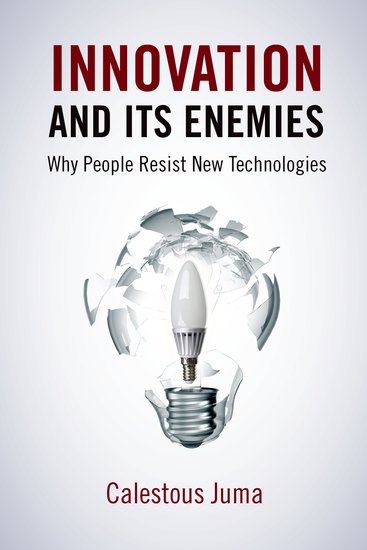
“The quickest way to find out who your enemies are is to try doing something new.” Thus begins Innovation and Its Enemies, an ambitious new book by Calestous Juma that will go down as one of the decade’s most important works on innovation policy.
Juma, who is affiliated with the Harvard Kennedy School’s Belfer Center for Science and International Affairs, has written a book that is rich in history and insights about the social and economic forces and factors that have, again and again, lead various groups and individuals to oppose technological change. Juma’s extensive research documents how “technological controversies often arise from tensions between the need to innovate and the pressure to maintain continuity, social order, and stability” (p. 5) and how this tension is “one of today’s biggest policy challenges.” (p. 8)
What Juma does better than any other technology policy scholar to date is that he identifies how these tensions develop out of deep-seated psychological biases that eventually come to affect attitudes about innovations among individuals, groups, corporations, and governments. “Public perceptions about the benefits and risks of new technologies cannot be fully understood without paying attention to intuitive aspects of human psychology,” he correctly observes. (p. 24) Continue reading →
Forensic experts are increasingly relying on DNA as “a genetic eyewitness,” says Jack Ballantyne, associate director for research at the National Center for Forensic Science at the University of Central Florida in Orlando, who is studying whether a DNA sample can reveal a person’s age. “We’d like to say if the DNA found on a bomb fragment comes from the young man who carried the bomb or from the wizened old mastermind who built it.”
The push to predict physical features from genetic material is known as DNA forensic phenotyping, and it’s already helped crack some difficult investigations. In 2004, police caught a Louisiana serial killer who eyewitnesses had suggested was white, but whose crime-scene DNA suggested — correctly — that he was black. Britain’s forensic service uses a similar “ethnic inference” test to trace murderers and rapists.
It goes almost without saying that the first impulse of many is to ban this evolving area of technology:
Worried about the ethical and social challenges, Germany doesn’t permit the forensic use of DNA to infer ethnicity or physical traits. Nor do a handful of U.S. states, including Indiana, Wyoming and Rhode Island. The U.K. and the Netherlands allow it.
The main downside I can see to the use of this technology in crime-fighting is that it would be disastrous for the genre of crime fiction. While it certainly
sounds like something out of GATTACA (my favorite movie of all time), it would have killed the plot: The genetic-GESTAPO probably would have known that our genetically-defective hero Vincent Freeman (Ethan Hawke) was not in fact, the genetically-engineered-but-crippled superman Jerome Morrow (Jude Law) he claimed to be—and the whole plot would have gone up in smoke. How much fun would that have been?
Interestingly, it seems Hulu once made the entire film available online but no longer does so. Fie on them and their conspiracy to suppress the future! Damn it, Hulu, don’t you know that “There Is No Gene For The Human Spirit?”
The Technology Liberation Front is the tech policy blog dedicated to keeping politicians' hands off the 'net and everything else related to technology. Learn more about TLF →

 The Technology Liberation Front is the tech policy blog dedicated to keeping politicians' hands off the 'net and everything else related to technology.