Posts tagged as:

by Larry Downes and Geoffrey A. Manne

Now that the election is over, the Federal Communications Commission is returning to the important but painfully slow business of updating its spectrum management policies for the 21st century. That includes a process the agency started in September to formalize its dangerously unstructured role in reviewing mergers and other large transactions in the communications industry.

This followed growing concern about “mission creep” at the FCC, which, in deals such as those between Comcast and NBCUniversal, AT&T and T-Mobile USA, and Verizon Wireless and SpectrumCo, has repeatedly been caught with its thumb on the scales of what is supposed to be a balance between private markets and what the Communications Act refers to as the “public interest.” Continue reading →

Broadband Baselines

by on April 1, 2010 · 0 comments

The national broadband plan drafted by Federal Communications Commission staff has a lot of goals in it. Goals for broadband infrastructure deployment include:

  1. Make broadband with 4 Mbps download speeds available to every American
  2. Over the long term, have broadband with 100 Mbps download and 50 Mbps upload speeds available to 100 million American homes, with 50 Mbps downloads available to 100 million homes by 2015
  3. Have the fastest and most extensive wireless broadband networks in the world
  4. Ensure that no state lags significantly behind in 3G wireless coverage
  5. Ensure that every community has access to 1 Gbps broadband service in institutions like schools, libraries, and hospitals

The plan also outlines a number of policy steps that the FCC and other federal agencies could take to help accomplish these goals.

So far, so good. But to truly hold federal agencies accountable for achieving these objectives, we need more than goals, measures, and a list of policy proposals. We also need a realistic baseline that tells us how the market is likely to progress toward these goals in the absence of new federal action, and some way to determine how much the specific policy initiatives affect the amount of the goal achieved.

Here’s what will happen in the absence of a well-defined baseline and analysis that shows how much improvement in the goals is actually caused by federal policies: The broadband plan announces goals. The government will take some actions. Measurement will show that broadband deployment improved, moving the nation closer to achieving the goals. The FCC and other decisionmakers will then claim that their chosen policies have succeeded, because broadband deployment improved.

But in the absence of proof that the policies cause a measurable change in outcomes, this is like the rooster claiming that his crowing makes the sun rise. Scientists call this the ” post hoc, ergo propter hoc” fallacy: “B happened after A, therefore A must have caused B.” (Brush up on your Latin a little more, and you’ll even find out what Mercatus means. But I digress.)

Enough abstractions. Let me give a few examples.

The first goal listed above is to ensure that all Americans have access to broadband with 4 Mbps download speeds. In his second comment on my March 17 “Broadband Funding Gap” post, James Riso notes that the plan acknowledges that 5 out of the 7 million households that currently lack access to 4 Mbps broadband will soon be covered by 4th generation wireless. That means coverage for 83 percent of the households that lack 4 Mbps broadband is already “baked into the cake.” 

Accurate accountability must avoid giving future policy changes credit for this increase in deployment, because it was going to happen anyway.  (Of course, policymakers need to avoid taking steps that would discourage this deployment, such as levying the 15 percent universal service fee on 4th generation wireless.) The relevant question for evaluating future policy changes is, “How do they affect deployment to the remaining 2 million households?”

Similarly, the goal of 50 Mbps to 100 million households by 2015 seems to have been chosen because cable and fiber broadband providers indicate that they plan to cover more than that many homes by 2013 with broadband capable of delivering those speeds (pp. 21-22). Future policy initiatives should get zero credit for contributing toward this goal unless analysis demonstrates that the initiatives increased deployment of very high speed broadband over and above what the companies were already planning.

If you think this point is so basic that it’s not worth mentioning, you haven’t read enough government reports. Post hoc, ergo propter hoc is endemic, and not just on technology-related topics. For example, both sides regularly display this fallacy whenever the unemployment figures get released: “Unemployment increased after Obama’s election, therefore his administration caused the unemployment.” “The recession started when Bush was president, therefore his administration caused the unemployment.” These are at best hypotheses whose truth, untruth, and quantititive significance needs to be established by analysis that controls for other factors affecting the results.

Just take this as an advance warning on reporting results of the national broadband plan: Tone down the triumphalism.  

Note: For those of you who just can’t get enough discussion of the national broadband plan, Jerry Brito and I will have a dialog on other aspects of the plan in a future podcast that will be available here on Surprisingilyfree.com.

The FCC today released an executive summary of its National Broadband Plan, which is supposed to be delivered to Congress tomorrow.  Of course, executive summaries by their nature are brief and usually don’t explain the underlying logic and evidence supporting the conclusions. Here are a few highlights, some possible interpretations, and things to look for when the full plan gets released tomorrow:

Recommendation: “Undertake a comprehensive review of wholesale competition rules to help ensure competition in fixed and mobile broadband.” This could signal that the FCC plans to re-impose “unbundling” or “line sharing” regulations, which would require broadband companies to let competitors use their lines and other facilities at regulated rates. Such initiatives would likely undermine broadband deployment and investment.  Economic research by my GMU colleague Tom Hazlett and others finds that broadband investment, competition, deployment in the US took off only after the FCC eliminated line-sharing requirements. Christina Forsberg and I summarized a lot of this research here.

Recommendation: “Make 500 Mhz of spectrum available for broadband within ten years … Enable incentives and mechanisms to repurpose spectrum.” This is a fantastic recommendation. A Mercatus Center review of the costs of federal telecommunications regulations found that federal spectrum allocation, which prevents spectrum from being reallocated to uses that consumers value highly (like broadband), is by far the costliest federal regulation affecting telecom and the Internet. This recommendation indicates the FCC leadership would like to auction a lot more spectrum and share the proceeds with existing users (like broadcasters) in order to overcome resistance to reallocation. It’s not quite a market in spectrum, but it might be the closest the FCC can come.

Recommendation: “Broaden the USF contribution base to ensure USF remains sustainable over time.” Uh-oh. I’m not sure what this means, but if means that broadband subscribers will have to start payng into the FCC’s universal service fund (USF), watch out! Most economic studies find that consumer demand for broadband is very price-sensitive. That means if the FCC slaps broadband with universal service fees (which currently exceed 10 percent), we’ll see a big drop in broadband subscribership — maybe by 4-7 million subscribers. This is , of course, precisely the opposite of what the FCC wants to accomplish!

Recommendation: “Reform intercarrier compensation, which provides implicit subsidies to telephone companies by eliminating per minute charges over the next ten years…” Another excellent idea.  “Intercarrier compensation” refers to payments phone companies make when they hand traffic off to each other. Small, rural phone companies usually receive the highest per minute payments — as much as 15-30 cents per minute! This is a huge markup on long-distance phone service — another price-sensitive service!

Recommendation: Provide subsidies so that rural areas can have broadband with download speeds of 4 MB.  It will be interesting to read in the full plan where this 4 MB figure came from. Does it reflect the speed of service that a lot of Americans currently have, so these subsidies are just supposed to help equalize opportunities for rural residents? Or does it reflect some balancing of the costs and benefits of subsidizing broadband in rural areas?  Or is this a magic number experts believe subscribers need, regardless of the choices consumers actually make in the marketplace and regardless of what it costs?

The executive summary also lists a set of goals, such as ensuring that every American has the ability to subscribe to “robust” broadband service, having 100 million households with access to 100 MB broadband, and ensuring that the US has the fastest and most extensive wireless networks of any nation.  When the full plan comes out, look carefully at whether or how the FCC plans to measure accomplishment of these goals.  More importantly, look to see whether the FCC explains how it will quantify how much its own policies actually contribute to these goals over time. The FCC is famous for NOT doing these kinds of things, so let’s see if the broadband plan signals a new era in accountability.

Railroading Broadband?

by on February 18, 2010 · 0 comments

FCC Chairman Julius Genachowski’s comparison of broadband with electricity in a speech this week has generated mixed reviews in the blogosphere. Manny Ju says that this shows Genachowski “gets it” — that he understands the transformational power of broadband and how it will come to be regarded as a ubiquitous necessity in the years ahead. Scott Cleland is more alarmed: “The open question here is electricity transmission is regulated as a public utility. Is the FCC Chairman’s new metaphor intended to extend to how broadband should be regulated?”

It may surprise some technophiles, but this kind of discussion even predates electricity. The advent of the railroads in the 19th century brought similar arguments.  Railroads were usually a heck of a lot cheaper way of hauling goods and people across land than the next best alternative at the time: wagons. Railroads were “The Next Big Thing” that no town could do without — especially if the town lacked access to navigable waters. Lawmakers handed out subsidies (often in the form of land grants), then regulated railroads to control perceived abuses, such as discriminatory pricing for different kinds of traffic or traffic between different locations. Henry Carter Adams, the godfather of economic regulation in the U.S., said all shippers deserved “equality before the railroads.” Even today, commentators lament the rural towns that people abandoned because they lacked rail access. Deja vu all over again! 

As long as we’re deja-vuing, let’s remember a few little problems America encountered down the railroad regulatory track:

  1. Subsidies created “excess capacity” — that is, more capacity than customers were willing to pay for. In some cases, subsidies attracted shady operators into the railroad business whose main goal was to get land grants or sell diluted stock offerings to the public, not build and operate railroads. 

  2. Regulation ended up caretlizing railroads and propping up rail rates, which faced downward pressure because of the excess capacity.

  3. When another low-cost, convenient alternative (trucking) came along in the 1930s, truckers got pulled into the cartel when they too were placed under Interstate Commerce Commission regulation to keep them from undercutting rail rates.

  4. Despite cartelization, by the late 1970s, 21 percent of the nation’s railroad track was operated by bankrupt railroads, even though the railroads had shed unprofitable passenger service to Amtrak earlier in the decade. Part of the reason was excessive costs: Because access to freight rail service was still considered a right, regulation prevented railroads from abandoning money-losing lines. Part of the reason was restraints on competition: The regulatory passion for “fair” pricing kept railroads from competing aggressively with each other or with truckers. When the Southern Railway introduced its 100-ton “Big John” grain hopper cars in the 1960s, for example, it couldn’t offer shippers lower rates in exchange for high volume until it appealed an Interstate Commerce Commission all the way to the Supreme Court.

By the late 1970s, a Democratic president, a bipartisan majority in Congress, and economists across the political spectrum agreed that railroad regulation needed a radical overhaul. Regulatory reforms made it easier for railroads to abandon unprofitable service, in many cases turning track over to new, lower-cost short lines and regional railroads. Prices for more than 90 percent of rail traffic were effectively deregulated. At the same time, Congress deregulated rates and entry on interstate trucking routes. This encouraged rail-truck competition and also allowed each mode to specialize in serving those markets it could serve at lowest cost.

Rail rates fell, and railroads came out of bankruptcy. The current system is hardly perfect, but most economic research suggests that most consumers, shippers, and railroads are much better off now than they were under the old regulatory system.  (For reviews of scholarly research on this, check out Clifford Winston’s paper here  or my article here.)

Will we repeat the cycle with broadband? I don’t know, but to this railfan, the current broadband debate is looking soooo retro — as in 19th century!

In a letter to the editor of the Washington Post last week, former FTC Commissioner Thomas Leary responded to a Post article describing the FTC’s suit against Intel as a  “major step for President Obama,” consistent with his campaign promise to “reinvigorate antitrust enforcement.”  Leary responded indignantly to this characterization by declaring:

People seem to forget that the FTC is a bipartisan independent agency. As a Republican FTC commissioner appointed by a Democratic president, I can vouch for the agency’s independence. During my service from 1999 to 2005 in the administrations of presidents Bill Clinton and George Bush, I never received a direct or indirect policy recommendation on a pending matter from anyone in the White House or from any of the people in Congress who had actively supported me.

Leary’s leeriness about political encroachment on the FTC illustrates the depth of abiding faith in independent regulatory agencies as standing truly apart from the day-to-day politics of Washington—especially when the might of the regulatory state is being wielded against a particular company in quasi-judicial prosecutions, such as antitrust enforcement actions. But if the independence of the FTC is this important, what about the independence of the Federal Communications Commission, with its broad jurisdiction over the media and tools of free speech?

Leary would probably be appalled at the politicization of the FCC in recent years. Bush’s second FCC chairman, Kevin Martin, was infamous for his political Machiavellianism and widely despised by the communications law bar. By contrast, when it became clear that Obama’s high-tech advisor Julius Genachowski would succeed Martin as FCC Chairman shortly before Obama’s inauguration, he received a chorus of applause from a wide range of philosophical perspectives, including from our former president at PFF, Ken Ferree:

Julius Genachowski is an outstanding choice to chair the Commission.  He is knowledgeable, experienced, and presumably will have the ear of the most influential people within the Administration.

While no one would compare the eminently likable Genachowski to Martin, his relationship to the Obama administration appears unprecedented in its closeness, and one must ask whether that’s a good thing for the head of a supposedly “independent” regulatory agency or integrity of that agency’s decision-making. Continue reading →

Good ideas, supported by evidence, eventually matter.

That’s the conclusion I reached after reviewing the outline the FCC’s broadband task force presented to the commission yesterday. Here are some ideas perceptive scholars have been discussing for a long time that are apparently going to be part of the National Broadband Plan:

  • “Private sector investment is essential; new funding is limited.” So I guess the Interstate Highway System won’t be the funding model for universal broadband. Whew!
  • “Policy changes require the consideration of unintended consequences.”
  • “Competition drives innovation and better choices for consumers.”
  • Wireless broadband needs a big new chunk of spectrum, and policymakers need to consider reallocating broadcast TV spectrum and spectrum reserved for use by the federal government.
  • “Market forces should be applied to all [spectrum] bands, though other policy objectives should play a role in allocation decisions.”
  • Fundamental reform of the Universal Service Fund, which subsidizes phone service very inefficiently, should actually be done, not just talked about.
  • Universal service reform should include reform of “intercarrier compensation,” the charges phone companies pay each other when they hand off traffic.
  • “USF policies should be designed to achieve measurable outcomes with transparency, oversight, and accountability.”

Most of these ideas were considered wacky, ideological, politically unrealistic, or just not relevant a few decades (or even a few years) ago.  Now they are the mainstream.

That doesn’t mean everything is wonderful with the National Broadband Plan. The FCC is supposed to plan how broadband will be used to promote consumer welfare, civic participation, public safety, education, health care, energy independence, community development, worker training, and a host of other legislative goals. In many cases there may be a fundamental tension between consumer welfare — a term of art in economics that means resources are allocated so that consumers get the selection of goods and services they are most willing to pay for, with the quality attributes they most prefer, at the best possible prices — and the other goals, which often involve planners deciding what consumers should want. Similarly, FCC Chairman Genachowski’s comments illustrate some decisionmakers’ disturbing tendency to conflate access (the service is available to those who want it) with adoption (everybody actually chooses to use it). Technophiles sometimes have an annoying habit of assuming that those of us who fail to adopt the latest info tech gadget or service must be ignorant rubes who don’t understand the glories of being hooked up to a fat information pipe 24/7 — rather than careful shoppers who have better things to do with our time than read Yahoo OMG! while driving. For this reason I fully expect to be annoyed by the National Broadband Plan, as well as gratified to see that some good ideas have finally made it from the Ivory Tower to real-world policy application.

But there’s enough good stuff in there to stick with “gratified” for at least one day.

In a speech yesterday, FCC Chairman Julius Genachowski pledged to revisit the Federal Communications Commission’s universal service programs for telecommunications as part of the National Broadband Plan: 

 The key points for today are these: USF is a multi-billion dollar annual fund that continues to support yesterday’s communications infrastructure. The goal of universality is as important as ever — and to meet our country’s innovation goals, we need to reorient the fund to support broadband communications. This is a thorny issue, with no shortage of practical and statutory challenges. We need to wring savings out of the system, protect consumers, avoid flashcuts, while ultimately moving USF in the direction it needs to go to support our 21st century platform for innovation. 

The USF program spends approximately $7 billion annually. Most of the money goes to subsidize phone service in “high cost” areas. Eeuww – phone service.  So twentieth century! All of us who have not yet shifted 100% of our personal communications to Facebook and Twitter pay for the universal service fund via surcharges of about 12 percent on our wireless and  wireline phone bills, including VOIP. (Dirty little secret: you also pay for universal telephone service if you use a wireless broadband card, because each card is assigned a phone number.) 

Genachowski’s comment follows some rather interestingly-timed announcements from the FCC’s broadband task force. On November 13, the task force asked for public comment on the role the universal service fund and “intercarrier compensation” (another, more opaque set of transfers from consumers in general to rural phone companies) should play in the national broadband plan. Comments are due December 7. Five days after soliciting comments, on November 18, the FCC announced that the structure of the universal service fund is one of the “critical gaps” in the path to universal broadband.

I doubt the FCC has telepathically determined what the parties will say in the comments they file on December 7, but there’s no need to. The FCC has ground through so many rounds of comments on universal service reform that the problems and potential solutions are well-known. At a conference on universal service about five years ago, I recall one speaker commented, “Everything that can be said about universal service has already been said, but not everyone’s had a chance to say it, so that’s why we still have conferences on it.” About a year ago, the FCC almost used a court-imposed deadline as an opportunity to actually reform universal service and intercarrier compensation, but the commissioners failed to reach consensus.

Here are some major problems with the universal service fund, in no particular order:

  • It subsidizes voice phone service with built-in incentives for inefficiency on the part of providers.
  • It subsidizes wireless voice service without limiting the subsidy to one essential connection per household, so it has effectively created an entitlement to both wired and mobile phone service in rural areas.
  • The FCC does not measure or track the outcomes produced by the subsidies to see what they actually accomplish for the public. (Section 201 of the draft Boucher-Terry USF reform bill would require the FCC to adopt outcome-oriented performance measures.)
  • The contribution mechanism acts like a percentage tax that discourages use of price-sensitive services like long-distance, wireless voice, and wireless broadband.
  • The “death of distance” has slashed long-distance phone charges, which means wireless bears a growing percentage of the burden and the funding mechanism may well be unsustainable.

(For more detail on these issues, read the assortment comments on USF reform by various Mercatus Center colleagues and me here, here, here, here, here, here, here, here, here, and here. BTW, did I mention this issue has been beaten to death?)

So is the FCC jumping the gun, rushing to judgment on universal service before the comments are in?  Heck no. It’s about time.

by Adam Thierer & Berin Szoka

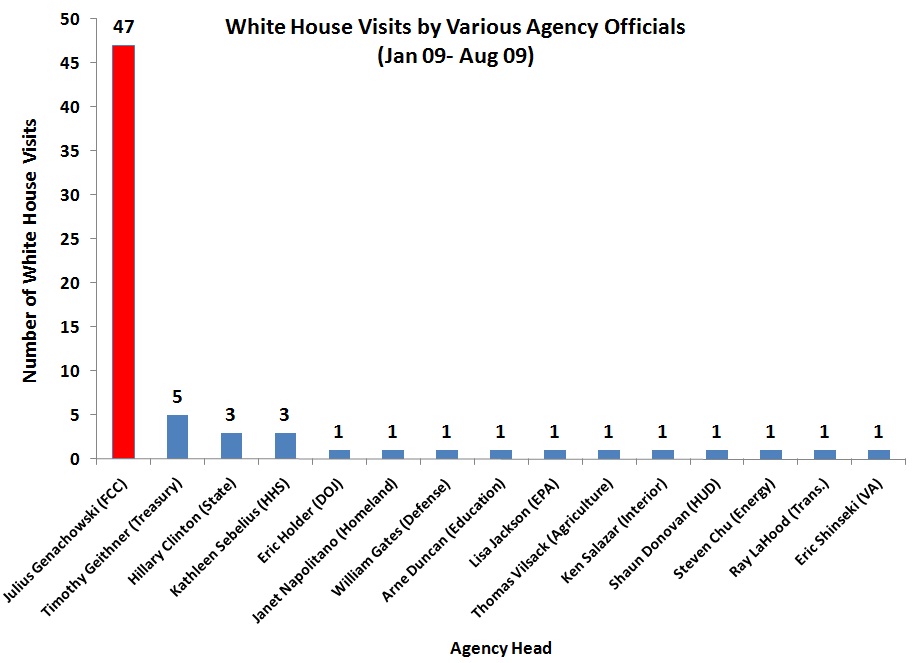
Move over, health care reform, climate change, and the economy. Judging by White House visits by various government agency heads, the Obama administration instead appears preoccupied with the re-regulation of communications, media, and the Internet. The Administration has just released logs of all visitors to the White House and Executive Office Buildings from Obama’s inauguration through August—including a staggering 47 visits by Federal Communications Commission (FCC) Chairman Julius Genachowski. By contrast, no other major agency head logged more than five visits.  Chairman Genachowski obviously has an audience with those at the highest levels of power, including the President himself, but this raises questions about just how “independent” this particular regulator and his agency really are.

Genachowski visits to White House

Unprecedented Transparency by White House

The Administration deserves credit for releasing these visitor logs, which offer unprecedented transparency into the White House’s workings.  Unfortunately, the logs lack visitors’ affiliation and title, making it difficult to discern subtle patterns.  Furthermore, each entry indicates only one “visitee” and the total number of people involved.  Full disclosure requires identifying all meeting participants. Nonetheless, President Obama’s gesture is a great first step toward improved government accountability.

This openness allows us to ask questions we couldn’t pose for previous administrations—such as why the FCC head seems to have unparalleled access to the White House.  Lacking data from previous administrations, it’s difficult to make direct comparisons with previous FCC Chairmen, but the sheer number of visits by Chairman Genachowski leaves no doubt about his uniquely close involvement with the White House. Continue reading →

As someone who follows the federal regulatory process, I was amazed to see this in a recent American Spectator post about White House technology advisor Susan Crawford’s return to the University of Michigan Law School:

But White House sources say that she ran afoul of senior White House economics adviser Larry Summers, who claimed he and other senior Obama officials were unaware of how radical the draft Net Neutrality regulations were when they were initially internally circulated to Obama administration officials several weeks ago … In the end, the proposed regulations were slightly moderated from the original language FCC chairman Julius Genachowski, a Crawford ally, circulated.

Unlike regulatory agencies that are considered part of the executive branch, the Federal Communications Commission is an “independent” regulatory agency — which means the president cannot fire its five commissioners. Before executive branch agencies can propose a regulation, it must be reviewed by the Office of Management and Budget’s Office of Information and Regulatory Affairs (OIRA). No administration has yet tried to bring independent agencies like the FCC under OIRA review.

Typically, congressional and private watchdogs scream bloody murder when they see the White House trying to influence independent agencies. But I haven’t heard any barking about this one.

Personally, I think independent agencies’ regulations should be subject to OIRA review. I don’t mind letting the president and his advisors have their say on regulations proposed by people he appointed. But I’d like to see it happen through the formal OIRA review process, where the public knows it’s happening and knows what the rules are.

For example: If you want to know which proposed regulations OIRA has reviewed, go here.  If you want to know the standards OIRA uses to review regulations, go here. If you want to know what outside parties have met with OIRA to discuss regulations, go here.

I like the idea of having a neutral Internet that allows me to go where I want to go and read what I want to read, all for the price of my monthly subscription.  Sure, it took me awhile to figure out why anyone would want to access skype on an iphone (after all, an iphone is already a phone!), but now I can see why some people might enjoy making free international calls without having to plop down in front of the ol’ PC wedged into the guest bedroom.

At the same time, I don’t see a pressing need for regulation to ensure that we get whatever degree of neutrality is practical. Even in his speech announcing that he would propose net neutrality rules, FCC Chairman Genachowski could cite only the same three old anecdotes that have been tirelessly trotted out by others as proof that new regulation is required.  Sure, by Washington standards, that’s two more anecdotes than are usually required to justify issuing a regulation. But it’s hardly proof of a broad, systemic problem that requires new rules (as Jerry Brito and I argued here.)

Nevertheless, as the saying goes, “You can’t beat something with nothing.”  So I suggest a positive agenda to promote sustainable net neutrality. 

Many of the arguments for a non-neutral net are based on the assumption that last-mile bandwidth is, at least sometimes, congested — or may soon become that way as people use more bandwidth-intensive applications. One solution is for the network operator to prioritize some packets over others, so if I have a heart attack, my wife’s VOIP call for an ambulance doesn’t get crowded out by the neighbor’s kid playing video games with his buddies in Australia.  Another solution, though, is to make sure the network operators have adequate ability and incentive to build plenty of bandwidth. As an economist, I understand that some network management or usage-based pricing might be less expensive for consumers than building massive bandwidth. But that’s no reason to persist with policies that artificially constrain bandwidth. 

For wired broadband, a positive agenda to promote sustainable net neutrality means avoiding regulations that impair incentives for investment that increases the capacity of the last-mile network. For wireless broadband, that means freeing up more spectrum to be auctioned for commercial wireless services.  

And while you’re at it, FCC, maybe you can do something about the NIMBY problem that prevents me from receiving a decent 3G broadband signal in my house.  Now that would expand last-mile bandwidth and promote competition to boot!