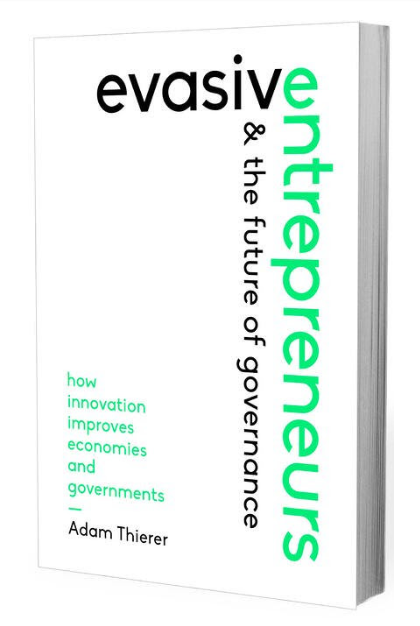
A pandemic is no time for bad governance. As the COVID-19 crisis intensified, bureaucrats and elected officials slumbered. Government regulations prevented many in the private sector from helping with response efforts. The result was a sudden surge of evasive entrepreneurialism and technological civil disobedience. With institutions and policies collapsing around them, many people took advantage of cutting‐edge technological capabilities to evade public policies that were preventing practical solutions from emerging.
Examples were everywhere. Distilleries started producing hand sanitizers to address shortages while average folks began sharing do‐it‐yourself sanitizer recipes online. The Food and Drug Administration (FDA) looked to modify hand sanitizer guidelines quickly to allow for it, but few really cared because those rules weren’t going to stop them. Gray markets in face masks, medical face shields, and respirators developed. Some people and organizations worked together to make medical devices using off‐the‐shelf hardware and open source software. More simply, others just fired up sewing machines to make masks—and then, faced with an emerging public health consensus, the guidance from the federal government shifted dramatically: where formerly ordinary people were instructed not to buy or use masks, within a matter of days, the policy reversed, and all were encouraged to make and use cloth protective masks. Continue reading →
A key point that Berin and I try to get across in our Forbes editorialtoday about the Yahoo!-Microsoft deal is that the high-tech marketplace evolves too rapidly for creaky Analog Era antitrust laws to keep up. We wanted to say more on that point in our piece, but we had a tight deadline (and a strict word limit!) Well, turns out that we really don’t need to do so now because Farhad Manjoo of Slate has done a better job than we ever could have making that point in this essay today entitled, “The Case Against the Case Against Google“:
But if the government was right on the facts [in the Microsoft case], it was wrong on the big picture. The theory behind the prosecution was that Microsoft’s mobster tactics would raise the price of software and slow down innovation. But that didn’t happen. In 2002, Microsoft settled the antitrust case with the Bush administration; it faced no substantial penalties for its years of bad behavior. At that point, it still looked unbeatable—it had the same OS monopoly, office-software monopoly, and Web-browser monopoly. And you know what happened? It got beat anyway. Many of Microsoft’s assets turned out not to matter, because upstarts like Google and old foes like Apple found ways to innovate around them.
Great piece in Wired by Fred Vogelstein asking “Why Is Obama’s Top Antitrust Cop Gunning for Google?” It paints a pretty good picture of the coming antitrust ordeal that Google is likely to be subjected to by the Obama Administration. And, as usual, I couldn’t agree more with the skepticism that Eric Goldman of Santa Clara University Law School articulates when he notes: “The problem for antitrust in high tech is that the environment changes so rapidly. Someone who looks strong today won’t necessarily be strong tomorrow.” More importantly, as Vogelstein’s article notes, we’ve been down this path before with less than stellar results when you look at the IBM investigation in the 70s and the Microsoft case from the 90s (a fiasco that is still going on today):
After the government initiated its case against IBM, the company spent two decades scrupulously avoiding even the appearance of impropriety. By the time the suit was dropped in the early 1980s, company lawyers were weighing in on practically every meeting and scrutinizing every innovation, guarding against anything that could be seen as anticompetitive behavior. A decade later, innovation at Big Blue had all but ceased, and it had no choice but to shrink its mainframe business. (It has since reinvented itself as a services company.)
Microsoft took the opposite approach. Gates and company were defiant, to the point of stonewalling regulators and refusing to take the charges seriously. “Once we accept even self-imposed regulation, the culture of the company will change in bad ways,” one former Microsoft executive told
Wired at the time. “It would crush our competitive spirit.” Gates put it even more directly: “The minute we start worrying too much about antitrust, we become IBM.” Microsoft’s hostility to the very idea of regulation resulted in several avoidable missteps—including remarkably antagonistic deposition testimony from Gates—that ultimately helped the DOJ rally support for its ongoing antitrust suit against the company. Although Microsoft ultimately settled, the public beating appears to have taken a toll on the company, which has been unable to maintain its reputation for innovation and industry leadership.
Read the whole article for all the gory details. This is going to be the biggest antitrust case of all-time once it is finally launched and I feel confident predicting that it will make many lawyers and consultants very, very rich while doing absolutely nothing to help consumer welfare. But perhaps those DOJ lawyers can at least get Google to lower the prices for all those services they offer. Oh, wait, they’re all free. But don’t worry, I’m sure Beltway bureaucrats will do a great job of running something as complex as search algorithms and online advertising markets. Right.
The Technology Liberation Front is the tech policy blog dedicated to keeping politicians' hands off the 'net and everything else related to technology. Learn more about TLF →

 The Technology Liberation Front is the tech policy blog dedicated to keeping politicians' hands off the 'net and everything else related to technology.