Posts tagged as:
Profectus is an excellent new online magazine featuring essays and interviews on the intersection of academic literature, public policy, civilizational progress, and human flourishing. The Spring 2022 edition of the magazine features a “Progress Roundtable” in which six different scholars were asked to contribute their thoughts on three general questions:
  1. What is progress?
  2. What are the most significant barriers holding back further progress?
  3. If those challenges can be overcome, what does the world look like in 50 years?

I was honored to be asked by Clay Routledge to contribute answers to those questions alongside others, including: Steven Pinker (Harvard University), Jason Crawford (Roots of Progress), Matt Clancy (Institute for Progress), Marian Tupy (Human​Progress​.org), James Pethokoukis (AEI). I encourage you to jump over the roundtable and read all their excellent responses. I’ve included my answers down below:

Continue reading →

[This is a draft of a section of a forthcoming study on “A Flexible Governance Framework for Artificial Intelligence,” which I hope to complete shortly. I welcome feedback. I have also cross-posted this essay at Medium.]

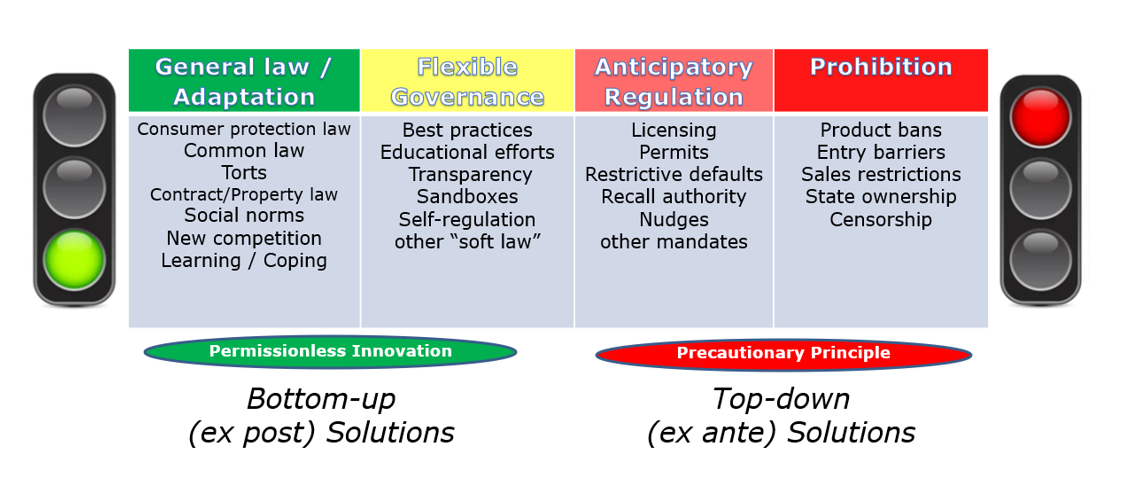
Debates about how to embed ethics and best practices into AI product design is where the question of public policy defaults becomes important. To the extent AI design becomes the subject of legal or regulatory decision-making, a choice must be made between two general approaches: the precautionary principle or the proactionary principle.[1] While there are many hybrid governance approaches in between these two poles, the crucial issue is whether the initial legal default for AI technologies will be set closer to the red light of the precautionary principle (i.e., permissioned innovation) or to the green light of the proactionary principle (i.e., (permissionless innovation). Each governance default will be discussed.

Continue reading →

Here’s a slide presentation on “The Future of Innovation Policy” that I presented to some student groups recently. It builds on themes discussed in my recent books, Permissionless Innovation: The Continuing Case for Comprehensive Technological Freedom, and Evasive Entrepreneurs and the Future of Governance: How Innovation Improves Economies and GovernmentsI specifically discuss the tension between permissionless innovation and the precautionary principle as competing policy defaults.

This is a compendium of readings on “ progress studies ,” or essays and books which generally make the case for technological innovation, dynamism, economic growth, and abundance. I will update this list as additional material of relevance is brought to my attention.   

[Last update: 10/11/22]

Recent Essays

Continue reading →

Discourse magazine has just published my review of Where Is My Flying Car?, by J. Storrs Hall, which I argue is the most important book on technology policy written in the past quarter century. Hall perfectly defines what is at stake if we fail to embrace a pro-progress policy vision going forward. Hall documents how a “Jetsons” future was within our grasp, but it was stolen away from us. What held back progress in key sectors like transportation, nanotech & energy was anti-technological thinking and the overregulation that accompanies it. “[T]he Great Stagnation was really the Great Strangulation,” he argues. The culprits: negative cultural attitudes toward innovation, incumbent companies or academics looking to protect their turf, litigation-happy trial lawyers, and a raft of risk-averse laws and regulations.

Hall coins the term “the Machiavelli Effect” to identify why many people simultaneously fear the new and different, and they also want to protect whatever status quo they benefit from (or at least feel comfortable with). He builds on this passage from Niccolò Machiavelli’s classic 1532 study of political power, “The Prince”: Continue reading →

It was my great pleasure to recently join Paul Matzko and Will Duffield on the Building Tomorrow podcast to discuss some of the themes in my last book and my forthcoming one. During our 50-minute conversation, which you can listen to here, we discussed:

  • the “pacing problem” and how it complicates technological governance efforts;
  • the steady rise of “innovation arbitrage” and medical tourism across the globe;
  • the continued growth of “evasive entrepreneurialism” (i.e., efforts to evade traditional laws & regs while innovating);
  • new forms of “technological civil disobedience;”
  • the rapid expansion of “soft law” governance mechanism as a response to these challenges; and,
  • craft beer bootlegging tips!  (Seriously, I move a lot of beer in the underground barter markets).

Bounce over to the Building Tomorrow site and give the show a listen. Fun chat.

This week I will be traveling to Montreal to participate in the 2018 G7 Multistakeholder Conference on Artificial Intelligence. This conference follows the G7’s recent Ministerial Meeting on “Preparing for the Jobs of the Future” and will also build upon the  G7 Innovation Ministers’ Statement on Artificial Intelligence . The goal of Thursday’s conference is to, “focus on how to enable environments that foster societal trust and the responsible adoption of AI, and build upon a common vision of human-centric AI.” About 150 participants selected by G7 partners are expected to participate, and I was invited to attend as a U.S. expert, which is a great honor. 

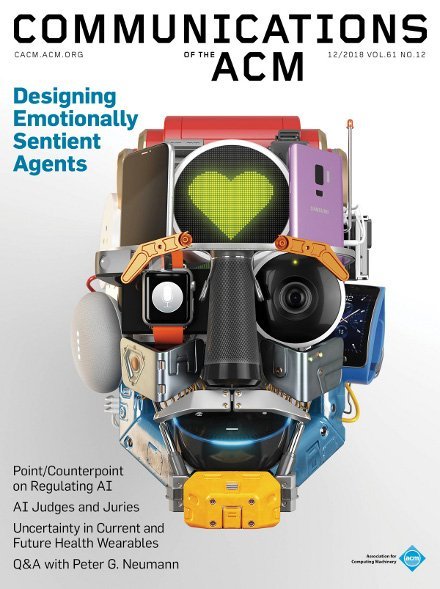
I look forward to hearing and learning from other experts and policymakers who are attending this week’s conference. I’ve been spending a lot of time thinking about the future of AI policy in recent books, working papers, essays, and debates. My most recent essay concerning a vision for the future of AI policy was co-authored with Andrea O’Sullivan and it appeared as part of a point/counterpoint debate in the latest edition of the Communications of the ACM. The ACM is the Association for Computing Machinery, the world’s largest computing society, which “brings together computing educators, researchers, and professionals to inspire dialogue, share resources, and address the field’s challenges.” The latest edition of the magazine features about a dozen different essays on “Designing Emotionally Sentient Agents” and the future of AI and machine-learning more generally.

In our portion of the debate in the new issue, Andrea and I argue that “Regulators Should Allow the Greatest Space for AI Innovation.” “While AI-enabled technologies can pose some risks that should be taken seriously,” we note, “it is important that public policy not freeze the development of life-enriching innovations in this space based on speculative fears of an uncertain future.” We contrast two different policy worldviews — the precautionary principle versus permissionless innovation — and argue that:

artificial intelligence technologies should largely be governed by a policy regime of permissionless innovation so that humanity can best extract all of the opportunities and benefits they promise. A precautionary approach could, alternatively, rob us of these life-saving benefits and leave us all much worse off.

That’s not to say that AI won’t pose some serious policy challenges for us going forward that deserve serious attention. Rather, we are warning against the dangers of allowing worst-case thinking to be the default position in these discussions. Continue reading →

[first published at The Bridge on August 9, 2018]

What happens when technological innovation outpaces the ability of laws and regulations to keep up?

This phenomenon is known as “the pacing problem,” and it has profound ramifications for the governance of emerging technologies. Indeed, the pacing problem is becoming the great equalizer in debates over technological governance because it forces governments to rethink their approach to the regulation of many sectors and technologies.

The Innovation Cornucopia

Had Rip Van Winkle woken up his famous nap today, he’d be shocked by all the changes around him. At-home genetics tests, personal drones, driverless cars, lab-grown meats, and 3D-printed prosthetic limbs are just some of the amazing innovations that would boggle his mind. New devices and services are flying at us so rapidly that we sometimes forget that most did not even exist a short time ago. Continue reading →

[originally posted on Medium ]

Today is the anniversary of the day the machines took over.
Exactly twenty years ago today, on May 11, 1997, the great chess grandmaster Garry Kasparov became the first chess world champion to lose a match to a supercomputer. His battle with IBM’s “Deep Blue” was a highly-publicized media spectacle, and when he lost Game 6 of his match against the machine, it shocked the world.

At the time, Kasparov was bitter about the loss and even expressed suspicions about how Deep Blue’s team of human programmers and chess consultants might have tipped the match in favor of machine over man. Although he still wonders about how things went down behind the scenes during the match, Kasparov is no longer as sore as he once was about losing to Deep Blue. Instead, Kasparov has built on his experience that fateful week in 1997 and learned how he and others can benefit from it.

The result of this evolution in his thinking is Deep Thinking: Where Machine Intelligence Ends and Human Creativity Begins, a book which serves as a paean to human resiliency and our collective ability as a species to adapt in the face of technological disruption, no matter how turbulent.

Kasparov’s book serves as the perfect antidote to the prevailing gloom-and-doom narrative in modern writing about artificial intelligence (AI) and smart machines. His message is one of hope and rational optimism about future in which we won’t be racing against the machines but rather running alongside them and benefiting in the process.

Overcoming the Technopanic Mentality

There is certainly no shortage of books and articles being written today about AI, robotics, and intelligent machines. The tone of most of these tracts is extraordinarily pessimistic. Each page is usually dripping with dystopian dread and decrying a future in which humanity is essentially doomed.

As I noted in a recent essay about “The Growing AI Technopanic,” after reading through most of these books and articles, one is left to believe that in the future: “Either nefarious-minded robots enslave us or kill us, or AI systems treacherously trick us, or at a minimum turn our brains to mush.” These pessimistic perspectives are clearly on display within the realm of fiction, where every sci-fi book, movie, or TV show depicts humanity as certain losers in the proverbial “race” against machines. But such lugubrious lamentations are equally prevalent within the pages of many non-fiction books, academic papers, editorials, and journalistic articles.

Given the predominantly panicky narrative surrounding the age of smart machines, Kasparov’s Deep Thinking serves as a welcome breath of fresh air. The aim of his book is finding ways of “doing a smarter job of humans and machines working together” to improve well-being. Continue reading →

Today, the U.S. Department of Transportation released its eagerly-awaited “Federal Automated Vehicles Policy.” There’s a lot to like about the guidance document, beginning with the agency’s genuine embrace of the potential for highly automated vehicles (HAVs) to revolutionize this sector and save thousands of lives annually in the process.

It is important we get HAV policy right, the DOT notes, because, “35,092 people died on U.S. roadways in 2015 alone” and “94 percent of crashes can be tied to a human choice or error.” (p. 5) HAVs could help us reverse that trend and save thousands of lives and billions in economic costs annually. The agency also documents many other benefits associated with HAVs, such as increasing personal mobility, reducing traffic and pollution, and cutting infrastructure costs.

I will not attempt here to comment on every specific recommendation or guideline suggested in the new DOT guidance document. I could nit-pick about some of the specific recommended guidelines, but I think many of the guidelines are quite reasonable, whether they are related to safety, security, privacy, or state regulatory issues. Other issues need to be addressed and CEI’s Marc Scribner does a nice job documenting some of them is his response to the new guidelines.

Instead of discussing those specific issues today, I want to ask a more fundamental and far-reaching question which I have been writing about in recent papers and essays: Is this guidance or regulation? And what does the use of informal guidance mechanisms like these signal for the future of technological governance more generally? Continue reading →