Harvard Berkman Center professor Jonathan Zittrain has published another pessimistic, Steve-Jobs-is-Taking-Us-Straight-To-Cyber-Hell editorial building on the gloomy thesis he set forth in his 2008 book, The Future of the Internet and How to Stop It. His latest piece appears in the Financial Times and it’s entitled, “A Fight over Freedom at Apple’s Core. Concerning the recent Apple iPad announcement, Zittrain warns: “Mr Jobs ushered in the personal computer era and now he is trying to usher it out.”
I’m not going to go into yet another lengthy dissertation about what it so misguided about his thesis that cyberspace is becoming more “regulable” and that digital “generativity” is dying because of the rise of devices like the iPhone & iPad, or sites like Facebook. Instead, I will just point you to the many things I’ve written before explaining just how far off the mark Prof. Zittrain is on this point. [See the complete list down below + video of our debate.]
But let me just say this… Ignoring that fact that he is an iPhone user himself — which makes no sense considering that he thinks of Apple as the font of all cyber-evil — he can’t muster any substantive empirical evidence proving that the Net and digital devices are being more “closed, sterile, and tethered,” as he repeatedly claims in his book and editorials. And that’s not surprising because the reality is that the digital world is more open and generative than ever, and even if there are some “closed” devices and systems out there, they are actually quite innovative and not perfectly closed as Zittrain suggests. The spectrum of “open vs. closed” systems and devices is incredible diverse and nothing is
perfectly “open” or “closed.” We can have the best of both worlds: many open systems with some partial “walled gardens” here and there (or hybrid systems combining both). Regardless, we are witnessing greater digital “generativity” and innovation with each passing year. Until Zittrain can prove the opposite, his thesis must be considered a failure.
Finally, I want to associate myself with this excellent critique of the Zittrain thesis by Prof. Ed Felten, who points out that Zittrain’s argument doesn’t even work for the iPad, which I would agree is a fairly “closed appliance” in the Zittrainian scheme of the things:
Continue reading →
 Seems like everywhere I turn someone is gushing about their new Droid phone, including my TLF colleagues Berin Szoka, Braden Cox, and Ryan Radia, who all had great fun rubbing their new toys in my nose over the past couple of days. And why not, it’s a very cool little device. It makes my HTC Touch seems positively archaic in some ways, and it’s only a year old. Apparently, 100,000 people already picked up a Droid in just its first weekend on the market.
But here’s the first thing that pops in my mind every time I see someone showing off their new Droid: How can a device like this even exist when America’s leading cyberlaw experts have been telling us that the whole digital world is increasingly going to hell because of “closed” devices, proprietary code, and managed networks? I’m speaking, of course, about the lamentations of Harvard professors Lawrence Lessig, Jonathan Zittrain, and their many disciples. As faithful readers will recall, I have relentlessly hammered this crew for their unwarranted cyber-Chicken Little-ism and hyper techno-pessimism. (See my many battles with Zittrain [1, 2, 3, 4, 5, 6 + video] and my 2-part debate with Lessig earlier this year).
“Left to itself,” Lessig warned in Code, “cyberspace will become a perfect tool of control.” He went on to forecast a dystopian future in which nefarious corporate schemers would quash our digital liberties unless benevolent public philosopher kings stepped in to save our poor souls. Code was the Old Testament of cyber-collectivism. The New Testament arrived last year with Zittrain’s
The Future of the Internet and How to Stop It. In it, we hear the grim prediction that “sterile and tethered” digital technologies and networks will triumph over the more “open and generative” devices and systems of the past. The iPhone and TiVo are cast as villains in Zittrain’s drama since they apparently represent the latest manifestations of Lessig’s “perfect control” paranoia.
Apple’s “Angel of Death”
How completely out-of-control has this thinking gotten? Well, here’s David Weinberger — another Harvard Berkman Center worrywart — talking about that supposed satanic font of all evil, the Apple AppStore: Continue reading →
I’ve been hammering Jonathan Zittrain pretty hard here over the past year for the thesis he sets forth in The Future of the Internet and How to Stop It that digital “generativity” is at risk today. The reason I have been doing so is because all signs point in the exact opposite direction, and more so with each passing day. Contrary to Jonathan’s fear that the Internet and digital technologies are growing more closed, tethered, and sterile, I have argued that the facts on the ground show us how the world is actually becoming far more open, untethered, and innovative. And that’s true even for the technology that Jonathan singles out in the book for special scorn — the iPhone.
Consider David Pogue’s post today on the
New York Times‘ technology blog today entitled “So Many iPhone Apps, So Little Time.” Pogue reports that:
there are now 15,000 programs available on the App Store, and so many more are flooding in that Apple’s army of screeners can’t even keep up. I keep meaning to write a thoughtful, thorough roundup of the very best of these amazing programs, but every day that I don’t do it, the job becomes more daunting.
[…]
Apple, which runs the store, keeps 30 percent of each sale. Even so, Ocarina [an application Pogue discusses in his essay] demonstrates that a programmer can make a staggering amount of money from the iPhone store. It’s a crazy new software model that I don’t remember seeing anywhere else. It’s not a boxed software program for $600, or even a shareware program you download for $25. It’s a buck a copy.
The beauty here is that at these prices, there’s very little risk in trying something out. How many software programs have you bought for your Mac or PC? Two? Four? Well, the average iPhone owner may wind up installing 10, 20 or 30 programs. In all, according to Apple, iPhone owners have downloaded 500 million copies of these programs. Half a billion–since last July.
There’s a lot of gloom in the tech industry (and every industry, for that matter). But even when the economy is crashing down around us, there’s still amazing power in a single good idea. And the one on display here–pricing software so low that millions of people buy it without batting an eye–is turning a few clever programmers into millionaires.
I ask you: Does this sound like a world that is growing less generative, as Zittrain argues? Because it sure doesn’t sound like it to me. Moreover, if you still don’t think the iPhone is open enough, then there’s always a simple solution to that: just buy another phone!
Jason Kuznicki of the Cato Institute is asking some very sharp questions about Jonathan Zittrain’s book The Future of the Internet and How to Stop. He’s echoing a lot of the same concerns and criticisms I have raised here many times before about how overblown Zittrain’s fears are regarding the supposed death of digital generativity and online openness. Kuznicki argues:
First, the example he uses is far from perfect. The Internet abounds with descriptions of iPhone hacks, many of them well-documented and remarkably successful. The menacing control exists, but it’s often a paper tiger. And although Apple didn’t originally publish an iPhone software development kit, it does now. So which one is it? Is the iPhone still not hacky enough? Or should we find another, better example? But the hacking community delights in finding supposedly uncrackable devices, and in cracking them — often within days of release. Offhand, I can’t think of a single recently released Internet-enabled device that someone hasn’t hacked. (Another of Zittrain’s purported bad examples, the Xbox 360, supports an avid hacking community, albeit with far less support from Microsoft. It isn’t a community for everyone, but then, hacking isn’t for everyone. Neither is macrame.)
Continue reading →
It’s been a big year for tech policy books. Several important titles were released in 2008 that offer interesting perspectives about the future of the Internet and the impact digital technologies are having on our lives, culture, and economy. Back in September, I compared some of the most popular technology policy books of the past five years and tried to group them into two camps: “Internet optimists” vs. “Internet pessimists.” That post generated a great deal of discussion and I plan on expanding it into a longer article soon. In this post, however, I will merely list what I regard as the most important technology policy books of the past year.
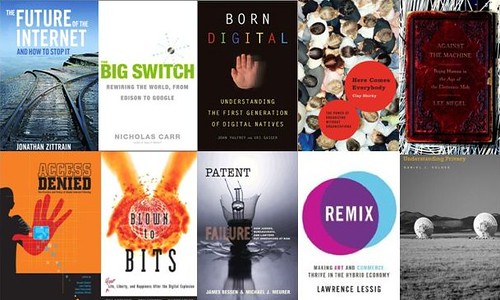
What qualifies as an “important” tech policy book? Basically, it’s a title that many people in this field are currently discussing and that we will likely be talking about for many years to come. I want to make it clear, however, that merely because a book appears on this list it does not necessarily mean I agree with everything said in it. In fact, I found much with which to disagree in my picks for the two most important books of 2008, as well as many of the other books on the list. [Moreover, after reading all these books, I am more convinced than ever that libertarians are badly losing the intellectual battle of ideas over Internet issues and digital technology policy. There’s just very few people defending a “Hands-Off-the-Net” approach anymore. But that’s a subject for another day!]
Another caveat: Narrowly focused titles lose a few points on my list. For example, as was the case in past years, a number of important IP-related books have come out this year. If a book deals exclusively with copyright or patent issues, it does not exactly qualify as the same sort of “tech policy book” as other titles found on this list since it is a narrow exploration of just one set of issues that have a bearing on digital technology policy. The same could be said of a book that deals exclusively with privacy policy, like Solove’s
Understanding Privacy. It’s an important book with implications for the future of tech policy, but I demoted it a bit because of its narrow focus.
With those caveats in mind, here are my Top 10 Most Important Tech Policy Books of 2008 (and please let me know about your picks for book of the year):
Continue reading →
This afternoon at the New America Foundation, Jonathan Zittrain and I engaged in a spirited debate about his provocative new book, The Future of the Internet and How to Stop It. As always, Jonathan gave an us an interesting and highly entertaining show, and it was a great honor for me to be given the opportunity to provide some feedback about his book. I’ve been quite critical of the thesis that Jonathan sets forth in his book, and I have discussed my reservations in a lengthy book review and a series of follow-up essays here and elsewhere. (Part 1, 2, 3, 4, 5).
Jonathan opens with about 45 minutes of remarks and I come into the conversation around the 49 mark of the video. Michael Calabrese of NAF also has some comments about Jonathan’s book after I speak and then there is some interaction with the audience.
http://www.youtube.com/v/KDgxGN6cqTA&hl=en&fs=1
 If you’re here in D.C. next Thursday, you might want to drop by the New America Foundation to watch Jonathan Zittrain and me go at it about his important new book, The Future of the Internet and How to Stop It. Our debate will take place on Thursday, November 6th from 3:30 – 5:00 p.m. at New America Foundation headquarters (1630 Connecticut Ave, NW, 7th Floor). My old friend (but frequent intellectual sparring partner) Michael Calabrese will also be speaking. Michael is the Director of New America’s “Wireless Future Program” and one of the all-around nicest guys in the world of tech policy. You can RSVP for the event here.
I’ve been quite critical of the thesis that Jonathan sets forth in his book, and I have discussed my reservations in a lengthy book review and a series of follow-up essays here and elsewhere.
(Part 1, 2, 3, 4, 5). We’ve also debated his book on the an NPR-Boston affiliate station if you care to hear a preview of our debate next week. That show is online here.
I encourage you to join us for what promises to be a very interesting discussion. As I pointed out in my original review of his book, if you have never had the chance to hear Jonathan speak, you’re in for a real treat. He is, bar none, the most entertaining tech policy wonk in the world.
Again, RSVP here.
 Sorry if it seems like I am beating a dead horse here, but the folks at the City Journal asked me a pen a review of Jonathan Zittrain’s new book, The Future of the Internet and How to Stop It. Faithful readers here will no doubt remember that I have already penned a review of the book and several follow-up essays. (Part 1, 2, 3, 4). I swear I am not picking on Jonathan, but his book is probably the most important technology policy book of the year–Nick Carr’s Big Switch would be a close second–and deserves attention. Specifically, I think it deserves attention because I believe that Jonathan’s provocative thesis is wildly out of touch with reality. As I state in the City Journal review of his book:
[C]ontrary to what Zittrain would have us believe, reports of the Internet’s death have been greatly exaggerated. […] Not only is the Net not dying, but there are signs that digital generativity and online openness are thriving as never before. […]
Essentially, Zittrain creates a false choice regarding the digital future we face. He doesn’t seem to believe that a hybrid future is possible or desirable. In reality, however, we can have a world full of some tethered appliances or even semi-closed networks that also includes generative gadgets and open networks. After all, millions of us love our iPhones and TiVos, but we also take full advantage of the countless other open networks and devices at our disposal. […]
Continue reading →
Well, I actually didn’t exactly get a chance to say quite enough for this to qualify as much of a “debate,” but I was brought in roughly a half hour into this WBUR (Boston NPR affiliate) radio show featuring Jonathan Zittrain, author of the recently released: The Future of the Internet–And How to Stop It. Jonathan was kind enough to suggest to the producers that I might make a good respondent to push back a bit in opposition to the thesis set forth in his new book.
Jonathan starts about 6 minutes into the show and they bring me in around 29 minutes in. Although I only got about 10 minutes to push back, I thought the show’s host Tom Ashbrook did an excellent job raising many of the same questions I do in my 3-part review (Part 1, 2, 3) of Jonathan’s provocative book.
In the show, I stress the same basic points I made in those reviews: (1) he seems to be over-stating things quite a bit in saying that the old “generative” Internet is “dying”; and in doing so, (2) he creates a false choice of possible futures from which we must choose. What I mean by false choice is that Jonathan doesn’t seem to believe a hybrid future is possible or desirable. I see no reason why we can’t have the best of both worlds–-a world full of plenty of tethered appliances, but also plenty of generativity and openness.
If you’re interested, listen in.
I swear I’m not trying to pick on Jonathan Zittrain, but I continue to find examples that create problems for his thesis from The Future of the Internet–And How to Stop It that the whole world is going to hell because of the rise of what he contemptuously calls “sterile, tethered devices.” Again, in his provocative book, Zittrain argues that, for a variety of reasons, the glorious days of the generative, open Internet and general-purpose PCs are supposedly giving way to closed networks and closed devices. In my lengthy review of his book, I argued that Zittrain was over-stating things and creating a false choice of possible futures from which we must choose. I see no reason why we can’t have the best of both worlds–a world full of plenty of tethered appliances, but also plenty of generativity and openness. In a follow-up essay, I pointed out how Apple’s products create a particular problem for Zittrain’s thesis because even though they are “sterile and tethered,” there is no doubt that the company’s approach has produced some wonderful results. As I said..
Personally… I prefer all those “general purpose” devices that Zittrain lionizes. But, again, we can have both. Let Steve Jobs be a control freak and keep those walls around Apple’s digital garden high and tight if he wants. There are plenty of other wide open gardens for the rest of us to play in.
In my original review, I briefly mentioned another problem for the Zittrain thesis: old people! I was reminded about this when I was reading this
New York Times article today entitled, “At a Certain Age, Simplicity Sells in High-Tech Gadgets,” by Alina Tugend. Tugend argues:
Continue reading →

 The Technology Liberation Front is the tech policy blog dedicated to keeping politicians' hands off the 'net and everything else related to technology.