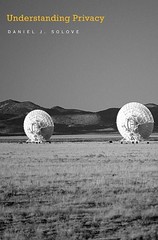
 With the publication of Understanding Privacy (Harvard University Press 2008), George Washington University Law School professor Daniel J. Solove has firmly established himself as one of America’s leading intellectuals in the field of information policy and cyberlaw. Solove had already made himself a force to be reckoned with in this field with the publication of important books like The Future of Reputation: Gossip, Rumor, and Privacy on the Internet (Yale University Press 2007), The Digital Person: Technology and Privacy in the Information Age (NYU Press 2004) and his treatise on Information Privacy Law with Paul M. Schwartz of the Berkeley School of Law (Aspen Publishing, 2d ed. 2006). But with Understanding Privacy, Solove has now elevated himself to that rarefied air of “people worth watching” in the cyberlaw field; an intellectual — like Lawrence Lessig or Jonathan Zittrain — whose every publication becomes something of an event in the field to which all eyes turn upon release.
Like those other intellectuals, however, my respect for their stature should not be confused with agreement with their positions. In fact, my disagreements with Lessig and Zittrain are frequently on display here and, we have been critical of Solove here in the past as well. [Here’s Jim Harper’s review of Solove’s last book, with which I am in wholehearted agreement.] In a similar vein, although I greatly appreciate what Prof. Solove attempts to accomplish in Understanding Privacy — and I am sure it will change the way we conceptualize and debate privacy policy in the future — I found his approach and conclusions highly problematic.
Continue reading →
Indiana University law professor Fred Cate writes with characteristic thoroughness and organization in his article Government Data Mining: The Need for a Legal Framework, published in the Harvard Civil Rights-Civil Liberties Law Review this summer.
It took me a while to get around to reading it – a little longer to write it up. Don’t make the same mistakes I did! It’s good!
Here’s a snippet from the abstract:
The article describes the extraordinary volume and variety of personal data to which the government has routine access, directly and through industry, and examines the absence of any meaningful limits on that access. So-called privacy statutes are often so outdated and inadequate that they fail to limit the government’s access to our most personal data, or they have been amended in the post-9/11 world to reduce those limits. And the Fourth Amendment, the primary constitutional guarantee of individual privacy, has been interpreted by the Supreme Court to not apply to routine data collection, accessing data from third parties, or sharing data, even if illegally gathered.
Professor Cate spends a good deal of time on the Supreme Court’s pernicious “third party doctrine,” which exempts information shared with a third party (think of ISPs, banks, etc.) from Fourth Amendment protection. This rule was bad when it was written and it grows worse and worse as we move our lives further and further online.
Oh, there are details from the paper I would have treated differently. He mistakenly says the 9/11 terrorists used false ID. (Fraudulently gotten, yes. False identities, no.) And he omits the Federal Agency Data Mining Reporting Act of 2007, passed as §804 of the Implementing Recommendations of the 9/11 Commission Act of 2007 (Public Law 110-53). But these are trivial issues with a paper that is excellent overall.
Poking around among the Internets to confirm this and that detail, I found this post saying that Professor Cate authored much of a recent report called “Protecting Individual Privacy in the Struggle Against Terrorists.” It’s also very good stuff.
Fred Cate, people!
One of the bright lights.

 The Technology Liberation Front is the tech policy blog dedicated to keeping politicians' hands off the 'net and everything else related to technology.