A growing number of conservatives are calling for Big Government censorship of social media speech platforms. Censorship proposals are to conservatives what price controls are to radical leftists: completely outlandish, unworkable, and usually unconstitutional fantasies of controlling things that are ultimately much harder to control than they realize. And the costs of even trying to impose and enforce such extremist controls are always enormous.
I’ll offer a few more thoughts here in addition to what I’ve already said elsewhere. First, here is my response to the Rosen essay. National Review gave me 250 words to respond to her proposal:
While admitting that “law is a blunt instrument for solving complicated social problems,” Christine Rosen (“Keep Them Offline,” June 27) nonetheless downplays the radicalness of her proposal to make all teenagers criminals for accessing the primary media platforms of their generation. She wants us to believe that allowing teens to use social media is the equivalent of letting them operate a vehicle, smoke tobacco, or drink alcohol. This is false equivalence. Being on a social-media site is not the same as operating two tons of steel and glass at speed or using mind-altering substances.
Teens certainly face challenges and risks in any new media environment, but to believe that complex social pathologies did not exist before the Internet is folly. Echoing the same “lost generation” claims made by past critics who panicked over comic books and video games, Rosen asks, “Can we afford to lose another generation of children?” and suggests that only sweeping nanny-state controls can save the day. This cycle is apparently endless: Those “lost generations” grow up fine, only to claim it’s the
next generation that is doomed!
Rosen casually dismisses free-speech concerns associated with mass-media criminalization, saying that her plan “would not require censorship.” Nothing could be further from the truth. Rosen’s prohibitionist proposal would deny teens the many routine and mostly beneficial interactions they have with their peers online every day. While she belittles media literacy and other educational and empowerment-based solutions to online problems, those approaches continue to be a better response than the repressive regulatory regime she would have Big Government impose on society.
I have a few more things to say beyond these brief comments. Continue reading →
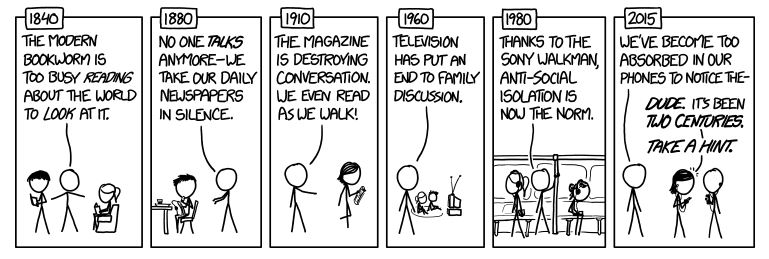
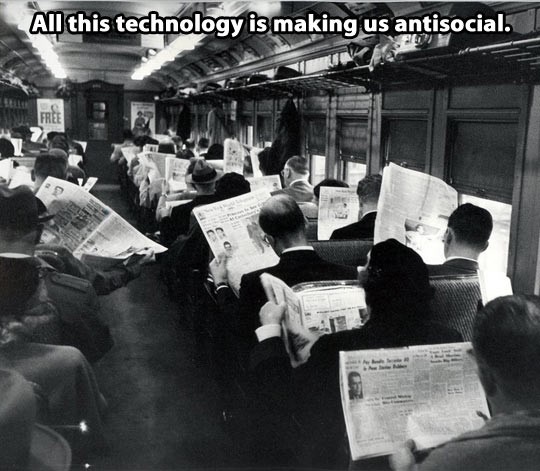
Last week, science writer Michael Shermer tweeted out this old xkcd comic strip that I had somehow missed before. Shermer noted that it represented, “another reply to pessimists bemoaning modern technologies as soul-crushing and isolating.” Similarly, there’s this meme that has been making the rounds on Twitter and which jokes about how newspapers made us as antisocial in the past much as newer technologies supposedly do today.
The sentiments expressed by the comic and that image make it clear how people often tend to romanticize past technologies or fail to remember that many people expressed the same fears about them as critics do today about newer ones. I’ve written dozens of articles about “moral panics” and “techno-panics,” most of which are cataloged here. The common theme of those essays is that, when it comes to fears about innovations, there really is nothing new under the sun. Continue reading →
On Sunday night, 60 Minutes aired a feature with the ominous title, “Nobody’s Safe on the Internet,” that focused on connected car hacking and Internet of Things (IoT) device security. It was followed yesterday morning by the release of a new report from the office of Senator Edward J. Markey (D-Mass) called Tracking & Hacking: Security & Privacy Gaps Put American Drivers at Risk,which focused on connected car security and privacy issues. Employing more than a bit of techno-panic flare, these reports basically suggest that we’re all doomed.
On
60 Minutes, we meet former game developer turned Department of Defense “cyber warrior” Dan (“call me DARPA Dan”) Kaufman–and learn his fears of the future: “Today, all the devices that are on the Internet [and] the ‘Internet of Things’ are fundamentally insecure. There is no real security going on. Connected homes could be hacked and taken over.”
60 Minutes reporter Lesley Stahl, for her part, is aghast. “So if somebody got into my refrigerator,” she ventures, “through the internet, then they would be able to get into everything, right?” Replies DARPA Dan, “Yeah, that’s the fear.” Prankish hackers could make your milk go bad, or hack into your garage door opener, or even your car.
This segues to a humorous segment wherein Stahl takes a networked car for a spin. DARPA Dan and his multiple research teams have been hard at work remotely programming this vehicle for years. A “hacker” on DARPA Dan’s team proceeded to torment poor Lesley with automatic windshield wiping, rude and random beeps, and other hijinks. “Oh my word!” exclaims Stahl. Continue reading →
California’s continuing effort to make the Internet their own digital fiefdom continued this week with Gov. Jerry Brown signed legislation that creates an online “Eraser Button” just for minors. The law isn’t quite as sweeping as the seriously misguided “right to be forgotten” notion I’ve critique here (1, 2, 3, 4) and elsewhere (5, 6) before. In any event, the new California law will:
require the operator of an Internet Web site, online service, online application, or mobile application to permit a minor, who is a registered user of the operator’s Internet Web site, online service, online application, or mobile application, to remove, or to request and obtain removal of, content or information posted on the operator’s Internet Web site, service, or application by the minor, unless the content or information was posted by a 3rd party, any other provision of state or federal law requires the operator or 3rd party to maintain the content or information, or the operator anonymizes the content or information. The bill would require the operator to provide notice to a minor that the minor may remove the content or information, as specified.
As always, the very best of intentions motivate this proposal. There’s no doubt that some digital footprints left online by minors could come back to haunt them in the future, and that concern for their future reputation and privacy is the primary motivation for the measure. Alas, noble-minded laws like these often lead to many unintended consequences, and even some thorny constitutional issues. I’d be hard-pressed to do a better job of itemizing those potential problems than Eric Goldman, of Santa Clara University School of Law, and Stephen Balkam, Founder and CEO of the Family Online Safety Institute, have done in recent essays on the issue. Continue reading →
Timothy B. Lee, founder of The Washington Post’s blog The Switch discusses his approach to reporting at the intersection of technology and policy. He covers how to make tech concepts more accessible; the difference between blogs and the news; the importance of investigative journalism in the tech space; whether paywalls are here to stay; Jeff Bezos’ recent purchase of The Washington Post; and the future of print news.
As federal regulators launch fresh investigations into Silicon Valley, their history of drawn-out cases has companies on edge. In taking on an industry that moves at lightening speed, federal officials risk actions that could appear to be too heavy-handed or embarrassingly outdated, some analysts and antitrust experts say.
For example, she cites ongoing regulatory oversight of Microsoft and MySpace, even though both companies have fallen from the earlier King of the Hill status in their respective fields. Kang notes that some “want the government to aggressively pursue abusive practices but question whether antitrust laws are too dated to rein in firms that are continually redefining themselves and using their dominance in one arena to press into others.”
Simply put, antitrust can’t keep up with an economy built on Moore’s Law, which refers to the rule of thumb that the processing power of computers doubles roughly every 18 months while prices remain fairly constant. This issue has been the topic of several of my
Forbes columns over the past year, as well as several other essays I’ve written here and elsewhere. [See the list at bottom of this essay.] Moore’s Law has been a relentless regulator of markets and has helped keep the power of “tech titans” in check better than any Beltway regulator ever could. As I noted here before in my essay, “Antitrust & Innovation in the New Economy: The Problem with the Static Equilibrium Mindset“: Continue reading →
In my most recent weekly Forbes column, “Common Sense About Kids, Facebook & The Net,” I consider the wisdom of an online petition that the child safety advocacy group Common Sense Media is pushing, which demands that Facebook give up any thought of letting kids under the age of 13 on the site. “There is absolutely no proof of any meaningful social or educational value of Facebook for children under 13,” their petition insists. “Indeed, there are very legitimate concerns about privacy, as well as its impact on children’s social, emotional, and cognitive development.” Common Sense Media doesn’t offer any evidence to substantiate those claims, but one can sympathize with some of the general worries. Nonetheless, as I argue in my essay:
Common Sense Media’s approach to the issue is short-sighted. Calling for a zero-tolerance, prohibitionist policy toward kids on Facebook (and interactive media more generally) is tantamount to a bury-your-head-in-sand approach to child safety. Again, younger kids are increasingly online, often because their parents allow or even encourage it. To make sure they get online safely and remain safe, we’ll need a different approach than Common Sense Media’s unworkable “just-say-no” model.
Think about it this way: Would it make sense to start a petition demanding that kids be kept out of town squares, public parks, or shopping malls? Most of us would find the suggestion ludicrous. Continue reading →
Imagine the following scenario. The government passes a law that includes regulations governing “transactional consent” for retail commerce. These regulations stipulate how buyers and sellers of various goods shall do business. Some of the rules give the sellers special rights to demand that the stores carry some of their goods as well as rules stipulating that stores not carry the goods of competing sellers from other markets. On the flip side, other preexisting rules give buyers the right to demand that certain sellers deal their goods to them at regulated rates.
Now, it’s true that a contractual negotiation takes place in this “marketplace” governed by “transactional consent” regulations, but does this sound like a truly free market to you? Most of us would say No.
Regrettably, that’s the essential error that the American Conservative Union (ACU) makes in a letter they sent to members of Congress this week in which they made the case against H.R. 3675 and S. 2008, “The Next Generation Television Marketplace Act.” That bill, which is sponsored by Senator Jim DeMint (R-SC) and Rep. Steve Scalise (R-LA), represents a comprehensive attempt to deregulate America’s heavily regulated video marketplace. In a recent Forbes oped, I argued that the DeMint-Scalise effort would take us “Toward a True Free Market in Television Programming” by eliminating a litany of archaic media regulations that should have never been on the books to begin with. The measure would:
eliminate: “retransmission consent” regulations (rules governing contractual negotiations for content);
end “must carry” mandates (the requirement that video distributors carry broadcast signals even if they don’t want to);
repeal “network non-duplication” and “syndicated exclusivity” regulations (rules that prohibit distributors from striking deals with broadcasters outside their local communities);
end various media ownership regulations; and
end the compulsory licensing requirements of the Copyright Act of 1976, which essentially forced a “duty to deal” upon content owners to the benefit of video distributors.
Despite these clearly deregulatory provisions, in its letter to Capitol Hill, the ACU argues that the DeMint-Scalise bill would somehow interfere with what they regard as a free market in video programming. The ACU writes: Continue reading →
My thanks to both Maria H. Andersen and Michael Sacasas for their thoughtful responses to my recent Forbes essay on “10 Things Our Kids Will Never Worry About Thanks to the Information Revolution.” They both go point by point through my Top 10 list and offer an alternative way of looking at each of the trends I identify. What their responses share in common is a general unease with the hyper-optimism of my Forbes piece. That’s understandable. Typically in my work on technological “optimism” and “pessimism” — and yes, I admit those labels are overly simplistic — I always try to strike a sensible balance between pollyannism and hyper-pessimism as it pertains to the impact of technological change on our culture and economy. I have called this middle ground position “pragmatic optimism.” In my Forbes essay, however, I was in full-blown pollyanna mode. That doesn’t mean I don’t generally feel very positive about the changes I itemized in that essay, rather, I just didn’t have the space in a 1,000-word column to identify the tradeoffs inherent in each trend. Thus, Andersen and Sacasas are rightfully pushing back against my lack of balance.
But there is a problem with their slightly pessimistic pushback, too. To better explain my own position and respond to Andersen and Sacasas, let me return to the story we hear again and again in discussion about technological change: the well-known allegorical tale from Plato’s
Phaedrus about the dangers of the written word. In the tale, the god Theuth comes to King Thamus and boasts of how Theuth’s invention of writing would improve the wisdom and memory of the masses relative to the oral tradition of learning. King Thamus shot back, “the discoverer of an art is not the best judge of the good or harm which will accrue to those who practice it.” King Thamus then passed judgment himself about the impact of writing on society, saying he feared that the people “will receive a quantity of information without proper instruction, and in consequence be thought very knowledgeable when they are for the most part quite ignorant.”
I’m currently finishing up my next book. It addresses various strands of “Internet pessimism” and attempts to explain why all the gloom and doom theories we hear about the Internet’s impact on modern culture and economy are not generally warranted. A key theme of my book is that most Internet pessimists overlook the importance of human adaptability in the face of technological change. The amazing thing about humans is that we adapt so much better than other creatures. We learn how to use the new tools given to us and make them part of our lives and culture. The worst situations often bring out the most creative, innovative solutions. Media critic Jack Shafer has noted that “the techno-apocalypse never comes” because “cultures tend to assimilate and normalize new technology in ways the fretful never anticipate.”
In a cultural sense, humans have again and again adapted to technological change despite the radical disruptions to their lives, mores, manners, and methods of learning. As Aleks Krotoski recently points out in her new
Guardian essay, “How the Internet Has Changed Our Concept of What Home Is”: Continue reading →
The Technology Liberation Front is the tech policy blog dedicated to keeping politicians' hands off the 'net and everything else related to technology. Learn more about TLF →


 The Technology Liberation Front is the tech policy blog dedicated to keeping politicians' hands off the 'net and everything else related to technology.