Posts tagged as:

GMLR coverI’m pleased to announce the release of my latest law review article, “A Framework for Benefit-Cost Analysis in Digital Privacy Debates.” It appears in the new edition of the George Mason University Law Review. (Vol. 20, No. 4, Summer 2013)

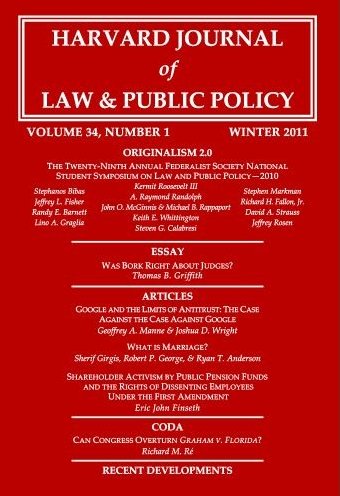
This is the second of two complimentary law review articles I am releasing this year dealing with privacy policy. The first, “The Pursuit of Privacy in a World Where Information Control is Failing,” was published in Vol. 36 of the Harvard Journal of Law & Public Policy this Spring. (FYI: Both articles focus on privacy claims made against private actors — namely, efforts to limit private data collection — and not on privacy rights against governments.)

My new article on benefit-cost analysis in privacy debates makes a seemingly contradictory argument: benefit-cost analysis (“BCA”) is extremely challenging in online child safety and digital privacy debates, yet it remains essential that analysts and policymakers attempt to conduct such reviews. While we will never be able to perfectly determine either the benefits or costs of online safety or privacy controls, the very act of conducting a regulatory impact analysis (“RIA”) will help us to better understand the trade-offs associated with various regulatory proposals. Continue reading →

HJLPP coverI’m excited to announce the release of my latest law review article, “The Pursuit of Privacy in a World Where Information Control is Failing,” which appears in the next edition (vol. 36) of the Harvard Journal of Law & Public Policy. This is the first of two complimentary law review articles that I will be releasing this year dealing with privacy policy. The second, which will be published later this summer by the George Mason University Law Review, is entitled, “A Framework for Benefit-Cost Analysis in Digital Privacy Debates.” (FYI: Both articles focus on privacy claims made against private actors — namely, efforts to limit private data collection — and not on privacy rights against governments.)

The new Harvard Journal article is divided into three major sections. Part I focuses on some of normative challenges we face when discussing privacy and argues that there may never be a widely accepted, coherent legal standard for privacy rights or harms here in the United States. It also explores the tensions between expanded privacy regulation and online free speech. Part II turns to the many enforcement challenges that are often ignored when privacy policies are being proposed or formulated and argues that legislative and regulatory efforts aimed at protecting privacy must now be seen as an increasingly intractable information control problem. Most of the problems policymakers and average individuals face when it comes to controlling the flow of private information online are similar to the challenges they face when trying to control the free flow of digitalized bits in other information policy contexts, such as online safety, cybersecurity, and digital copyright.

If the effectiveness of law and regulation is limited by the normative considerations discussed in Part I and the practical enforcement complications discussed in Part II, what alternatives remain to assist privacy-sensitive individuals? I address that question in Part III of the paper and argue that the approach America has adopted to deal with concerns about objectionable online speech and child safety offers a path forward on the privacy front as well. Continue reading →

Advocates of regulation will credit regulators for the fact that major browser providers Microsoft and Mozilla are going after online “tracking.” In forthcoming versions of their browsers, they will provide controls that protect against unwanted monitoring even better than the controls that now exist.

When consumer advocates cluster in Washington, D.C., asking federal agencies to solve consumer issues, of course, any progress on the issues will be credited to the threat of coercion. But experiments like these have no controls.

Decisions about the qualities of goods and services are made out at the leading edge of consumer demand, where producers work to anticipate developing public interests. Meeting demand after it has been realized is a recipe for business failure because competitors getting there before the others win market share and profits. Laggards are losers.

You can tell when regulators push for something that does not match up with consumer demand as perceived in the business sector. The regulators get nowhere. That would be the FTC’s call a decade ago for a suite of regulations requiring “notice, choice, access, and security.” The current push for “tracking” controls does appear to meet up with consumer demand, and, again, the browser providers are working on it years ahead of what any regulation would have required.

I’ve put “tracking” in scare quotes because the open question is just what anyone means by the word. The report linked above notes a comment from Google, provider of the Chrome browser:

“The idea of ‘Do Not Track’ is interesting, but there doesn’t seem to be consensus on what ‘tracking’ really means, nor how new proposals could be implemented in a way that respects people’s current privacy controls,” said the company…

Maybe Google will be the laggard and loser for not moving on “tracking” as fast as its competitors. That’s one approach, while Microsoft and Mozilla will each take a different tack to the problem. The result will be an experiment that does have controls. The browser provider that meets up with consumer interests, in the consumer-friendliest way, wins. Such would not be the case if a federal regulation—yes, one-size-fits-all—determined what “tracking” was and how browsers or others would provide protection against it.

Marketplace competition will do better than any other known method for determining what “tracking” means to consumers and what to do about it. There is no privacy advocate, there is no technologist, no advocacy group, nor academic who knows what to do here.

The one thing I recommend is that do-not-track efforts should control the content of the header and the domains the browser communicates with. Simply putting a “do-not-track” signal in the header would punt the problem back to regulators and the cadre that surrounds them. This group would come up with something that satisfies itself, the regulatory community, but that does not digest and reconcile actual consumers’ competing interests in privacy, convenience, access to content, and so on.

NY venture capitalist Fred Wilson notes eight advantages of using the iPhone’s Safari browser over iPhone apps to access content. Fred’s arguments seem pretty sound to me and help to illustrate the point I was trying to make a few months ago in a heated exchange over Adam’s post on Apple’s App Store, Porn & “Censorship”: Although Apple restricts pornographic apps, it does not restrict what iPhone (or iPad or iTouch) users can access on their  browsers. (And it’s not censorship, anyway, because that’s what governments do!)

As I noted in that exchange, the main practical advantage of apps right now over the browser seems to be the ability to play videos from websites that require Flash—which is especially useful for porn! Apple has rejected using Flash on the iPhone on technical grounds, in favor of HTML5, which will allow websites to display video without Flash—including on mobile devices. But once HTML5 is implemented (large scale adoption expected in 2012), this primary advantage of apps over mobile Safari will disappear: Users will be able to view porn on their browsers without needing to rely on apps—and Apple’s control over apps based on their content will no longer matter so much, if at all.

Of course, it may take several more years for HTML5 to really become the standard, but what matters is that all Apple products, including mobile Safari, already support HTML5. So it’s just a question of when porn sites move from Flash to HTML5. That seems already to be happening, with major porn publishers already starting the transition. The main stumbling block seems to be HTML5 support from the other browser makers. But Internet Explorer 9 supports HTML5, and is expected out early in 2011 with a beta version due out this August. Mozilla’s Firefox 4.0 (formerly 3.7) also promises HTML5 support and is due out this November. Since porn publishers have always been on the cutting edge of implementing new web technologies, I’d bet we’ll start seeing many porn sites move to HTML5 by this Christmas. And by Christmas 2011, as we all sit around the fire with Grandma sipping eggnog and enjoying our favorite adult websites on our overpriced-but-elegant Apple products loading in HTML5 in the Safari browser, we’ll all look back and wonder why anyone made such a big deal about Apple restricting porn apps.

Oh, and if you get tired of waiting, get an Android phone! Anyway, here are my comments on Adam’s February post: Continue reading →

The disabled have much to give thanks for this year—but contrary to common assumptions, it’s not for paternalistic government accessibility mandates, regulations or subsidies (see, for example, the FCC’s November 6 Broadband Accessibility workshop), but for the good ol’ fashioned private sector ingenuity that has made America great. Five broad categories of examples suggest how constantly-improving computing power and innovation can make life easier for many, if not all, disabled users—and how market forces empower the disabled along with everyone else.

Video transcription. Last week, Google announced “the preliminary roll-out of automatic captioning in YouTube, an innovation that takes advantage of our speech recognition technology to turn the spoken word into text captions.” Google uses the same speech recognition technology it refined with its free Goog-411 and Google Voice services to automatically transcribe video dialog (which can also be automatically translated using Google’s translation engine). Why? Not because of any government mandate, but because of some combination of three factors: (i) it’s an easy way for Google to invest in its “reputational capital,” (ii) the underlying technologies of transcribing videos make videos easier to use for all users, not just the hearing-impaired, and (iii) those technologies also make it possible to contextually target advertising to the verbal content of videos.

http://www.youtube.com/v/kTvHIDKLFqc&hl=en_US&fs=1&

It’s worth noting that Hulu currently offers closed captioning for some of its television programming but notes that “closed-captioning data that’s used for broadcast TV isn’t easily translated for online use.” The online television clearinghouse promises to offer more closed-captioning soon. Perhaps they ought to license Google’s algorithmic transcription?

Voice recognition for direct consumer use—most notably, Dragon NaturallySpeaking 10, the latest version of the leading voice recognition software, which was released in summer 2008 but only recently seems to have really hit critical mass. Continue reading →

Really, what would we do without European antitrust regulators protecting us from the evils of browser innovation? If Microsoft was allowed to actually bundle its Internet Explorer browser alongside its operating system we might actually do something really crazy… like perhaps try it! After all, the latest browser stats make it pretty clear most of us have a choice and that fewer and fewer of us rely on IE. As Erick Schonfeld noted on Tech Crunch today:

The new browser wars on on. More than a decade after Microsoft killed off Netscape with Internet Explorer, competition in the browser market has never been stronger. Just last week, Mozilla released Firefox 3.5, which has now been downloaded nearly 14 million times. Earlier in June, Apple released Safari 4. In March, Microsoft introduced Internet Explorer 8, and Google came out with a speedier beta of its Chrome browser. Some early data is coming in showing relative market share and how fast people are upgrading. If you look at the chart above from Statcounter, it indicates that since March Internet Explorer has lost 11.4 percent market share to other browsers. [..] Where did that go? It went to Firefox, Safari, and Chrome. Nearly 5 percent of that, or about half, went to Firefox 3.0, which currently has 27.6 percent market share. That doesn’t count last week’s upgrade.

08-09 browser stats

Alas, as I pointed out in my essay a few weeks ago (“European Regulators Think Consumers Too Stupid to Know How to Download a Different Browser“), some Euro-crats still seem to believe that changing browsers requires great detective skills to unearth alternatives.  It’s just pure poppycock and yet another sad example of how antitrust law is usually hopelessly behind the times and has absolutely nothing to do with protecting consumers or fostering innovation.

Now, please excuse me while I get back to surfing the Net via Firefox and Chrome (and Opera on my mobile phone). My God, how did I ever find these browser alternatives!

chris soghoianIn episode #44 of “Tech Policy Weekly,” Berin Szoka and Adam Thierer engage in a debate with Internet security expert Chris Soghoian, who is a student fellow at the Berkman Center for Internet & Society at Harvard University. He is also a Ph.D. candidate at Indiana University’s School of Informatics.

Chris is an up-and-coming star in the field of cyberlaw and technology policy as he has quickly made a name for himself in debates over privacy policy, data security, and government surveillance.  He straddles the line between academic and activist, and the role he often plays in many tech policy debates is somewhat akin to what Ralph Nader has done in many other fields through the years. Except, in this case, instead of “Unsafe at Any Speed” it’s more like “Unsafe at Any Setting,” since Chris is often raising a stink about what he regards as unjust or unreasonable privacy or security settings that various online websites or service providers use.

On the show, Chris talks about two of his recent crusades to get certain online providers to change their default settings to improve user security or privacy: (1) His effort this week to get major email providers—and Google in particular—to change their default security settings on their email offerings; and (2) his earlier crusade to create permanent opt-out cookies to stop behavioral advertising by advertising networks.

There are several ways to listen to today’s TLF Podcast. You can press play on the player below to listen right now, or download the MP3 file. You can also subscribe to the podcast by clicking on the button for your preferred service. (And do us a favor, Digg this podcast!)

[display_podcast]

Continue reading →

According to Ina Fried of CNet News, Microsoft plans to remove its Internet Explorer web browser from the new versions of Windows 7 when it ships it in Europe later this year. [Additional coverage at ZDNet.]  MS is apparently doing so to assuage the concerns of EU antitrust officials, who have been obsessed with the company for the past decade. [Update: Here is MS official announcement.]

Apparently, European officials think their citizens are too stupid to find an alternative browser.  I mean, seriously, how hard is it?  Does the competition lack name recognition such that consumers can’t find them?  Hmmm… Google and Apple seem to be pretty well known brands, and their browsers (Chrome & Safari) are pretty easy to find.  And then there’s Mozilla’s Firefox browser (my PC favorite) and Opera (my mobile phone favorite), which are outstanding browsers. [Incidentally, Firefox already has 31% share of the European market.]

OK, OK, the regulators might say, but these competitors are just too expensive!  Uh, no, wait… every one of them is free. So, strike that theory.

Well, the regulators need another theory then. How about illegal tying of products and services! You know, there’s only certain sites or services you can use with IE, right?   Nope, that theory doesn’t work either.  And does anyone believe that MS could really tie OS functionality to the use of IE? How long would the world tolerate Outlook e-mails or Word documents that only allowed linking to URLs via IE??  Come on.

OK, any other theories left? Not that I can think of. Which brings us back to the only theory the Euro-crats have left: people are sheep. They’ll take whatever MS bundles into the OS free, you see, and they will use it more than they use competing products.  Thus, we regulators have to save them from their own stupidity! The masses just don’t know what’s good for them!  These free, integrated services are harming them! And, therefore, the only remaining solution is to kill innovation by crippling functionality and removing the free offering. That’s pro-consumer! … or so say the European antitrust bureaucrats.

Meanwhile, back in the real world, a whole lotta innovation continues to take place. But shhhh.. don’t tell the Euro-crats. They need a company to pick on. Welcome to the Theater of the Techno-Absurd.

Ted Dziuba has penned a humorous and sharp-tongued piece for The Register about last week’s Adblock vs. NoScript fiasco.  For those of you who aren’t Firefox junkies, a nasty public spat broke out between the makers of these two very popular Firefox Browser extensions (they are the #1 and #3 most popular downloads respectively).  To make a long and complicated story much shorter, basically, NoScript didn’t like Adblock placing them on their list of blacklisted sites and so they fought back by tinkering with the NoScript code to evade the prohibition.  Adblock responded by further tinkering with their code to circumvent the circumvention!  And then, as they say, words were exchanged.

Thus, a war of words and code took place.  In the end, however, it had a (generally) happy ending with NoScript backing down and apologizing. Regardless, Mr. Dzuiba doesn’t like the way things played out:

The real cause of this dispute is something I like to call Nerd Law.  Nerd Law is some policy that can only be enforced by a piece of code, a public standard, or terms of service. For example, under no circumstances will a police officer throw you to the ground and introduce you to his friend the Tazer if you crawl a website and disrespect the robots.txt file. The only way to adjudicate Nerd Law is to write about a transgression on your blog and hope that it gets to the front page of Digg. Nerd Law is the result of the pathological introversion software engineers carry around with them, being too afraid of confrontation after that one time in high school when you stood up to a jock and ended up getting your ass kicked.

Dziuba goes on to suggest that “If you actually talk to people, network, and make agreements, you’ll find that most are reasonable” and, therefore, this confrontation and resulting public fight could have been avoided. They “could have come to a mutually-agreeable solution,” he says.

But no. Sadly, software engineers will do what they were raised to do. And while it may be a really big hullabaloo to a very small subset of people who Twitter and blog their every thought as if anybody cared, to the rest of us, it just reaffirms our knowledge that it’s easy to exploit your average introvert.  After all, what’s he gonna do? Blog about it?

OK, so maybe the developers could have come to some sort of an agreement if they had opened direct channels of communications or, better yet, if someone at the Mozilla Foundation could have intervened early on and mediated the dispute.  At the end of the day, however, that did not happen and a public “Nerd War”  ensued.  But I’d like to say a word in defense of Nerd Law and public fights about “a piece of code, a public standard, or terms of service.”

Continue reading →