It remains unclear how interested the Federal Trade Commission (FTC) is in bringing a formal antitrust action against Google, but we at least know that inquiries have been made. I suspect these inquires are far more serious than whatever the agency is fishing for with its new Twitter inquires. After all, as I note in my latest Forbes column, “Google isn’t even a teenager yet (having only been founded in September 1998), but the firm’s rise has been meteoric and it has made a long list of enemies in the process. Practically every major player in the Digital Economy… is gunning for Google these days, both in the commercial and political marketplace.” In this sense, it’s not surprising the FTC might take a keen interest in the company with so many competitors complaining.
Still, I just can’t find much merit in an antitrust case against Google since, as I noted in my column, “The firm’s success seems tied to high quality products that users prefer over rival services. Importantly, barriers to entry are low: there’s nothing stopping new entrants from innovating and offering competing online services to match Google.”
Regardless, instead of arguing about the merits of an antitrust action against Google, let’s consider the more interesting, and I think intractable, question of remedies. Here’s what I had to say about that in my Forbes essay: Continue reading →
Forbes.com has just published an editorial that Berin Szoka and I penned about yesterday’s net neutrality announcement from the FCC.
by Adam Thierer & Berin Szoka
There was a time, not so long ago, when the term “Internet Freedom” actually meant what it implied: a cyberspace free from over-zealous legislators and bureaucrats. For a few brief, beautiful moments in the Internet’s history (from the mid-90s to the early 2000s), a majority of Netizens and cyber-policy pundits alike all rallied around the flag of “Hands Off the Net!” From censorship efforts, encryption controls, online taxes, privacy mandates and infrastructure regulations, there was a general consensus as to how much authority government should have over cyber-life and our cyber-liberties. Simply put, there was a “presumption of liberty” in all cyber-matters.
Those days are now gone; the presumption of online liberty is giving way to a presumption of regulation. A massive assault on real Internet freedom has been gathering steam for years and has finally come to a head. Ironically, victory for those who carry the banner of “Internet Freedom” would mean nothing less than the death of that freedom.
We refer to the gradual but certain movement to have the federal government impose “neutrality” regulation for all Internet actors and activities—and in particular, to yesterday’s announcement by Federal Communications Commission (FCC) Chairman Julius Genachowski that new rules will be floated shortly. “But wait,” you say, “You’re mixing things up! All that’s being talked about right now is the application of ‘simple net neutrality,’ regulations for the infrastructure layer of the net.” You might even claim regulations are not really regulation but pro-freedom principles to keep the net “free and open.”
Such thinking is terribly short-sighted. Here is the reality: Because of the steps being taken in Washington right now, real Internet Freedom—for all Internet operators and consumers, and for economic and speech rights alike—is about to start dying a death by a thousand regulatory cuts. Policymakers and activists groups are ramping up the FCC’s regulatory machine for a massive assault on cyber-liberty. This assault rests on the supposed superiority of common carriage regulation and “public interest” mandates over not just free markets and property rights, but over general individual liberties and freedom of speech in particular. Stated differently, cyber-collectivism is back in vogue—and it’s coming very soon to a computer near you! Continue reading →
Cory Doctorow has called for a Wikipedia-style effort to build an open source, non-profit search engine. From his column in The Guardian:
What’s more, the way that search engines determine the ranking and relevance of any given website has become more critical than the editorial berth at the New York Times combined with the chief spots at the major TV networks. Good search engine placement is make-or-break advertising. It’s ideological mindshare. It’s relevance…
It’s a terrible idea to vest this much power with one company, even one as fun, user-centered and technologically excellent as Google. It’s too much power for a handful of companies to wield.
The question of what we can and can’t see when we go hunting for answers demands a transparent, participatory solution. There’s no dictator benevolent enough to entrust with the power to determine our political, commercial, social and ideological agenda. This is one for The People.
Put that way, it’s obvious: if search engines set the public agenda, they should be public.
He goes on to claim that “Google’s algorithms are editorial decisions.” For Doctorow, this is an outrage: “so much editorial power is better vested in big, transparent, public entities than a few giant private concerns.”
I wish Doctorow well in his effort to crowdsource a Google-killer, but I’m more than a little skeptical that anyone would actually want to use his search engine of The People. My guess is that, like most things produced in the name of “The People” (Soviet toilet paper comes to mind), it will probably won’t be much fun to use, and will likely chafe noticeably. (For the record, I love and regularly use Wikipedia; I just don’t think that model is unlikely to produce a particularly useful search engine. As Doctorow himself has noted of Google, “they make incredibly awesome search tools.”)
But I’m glad to see that Doctorow has conceded an important point of constitutional law:
The First Amendment protects the editorial discretion of search engines, like all private companies, to decide what to content to communicate. For a newspaper, that means deciding which articles or editorials to run. For a library or bookstore, it means which books to carry. For search engines, it means how to write their search algorithims. Continue reading →
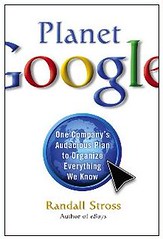 I finally got around to reading Planet Google: One Company’s Audacious Plan to Organize Everything We Know, by Randall Stross. It’s very well done. Stross is a frequently contributor to the New York Times and the author of several other interesting books on the technology industry. He knows how to weave a story together, and it helps that Google’s story is a pretty amazing one.
Each chapter discusses a different part of Google’s growing family of services — GMail, Google Maps, Google Earth, Book Search, and YouTube. Of course, it all started with search and Stross does a good job explaining how the ingenious Google search algorithm has grown from dorm room project to the greatest aggregator of human knowledge that the world has ever known. This, in turn, has powered Google’s hugely successful online advertising system. The real secret of their success with online advertising, Stross argues, is that “Google’s impersonal, mathematical approach search also provides you with the ability to serve advertisements that are tailored to a search, rather than to the person submitting the search request, whose identity would have to be known.”
Despite the benefits of such generally anonymous searching, as Google has grown and added new services and capabilities, concerns about the sheer volume of data that the company collects have led to heightened privacy concerns. Indeed, privacy is a core theme that Stross uses in the book to tie many of the chapters and issues together. Google is constantly struggling to strike the right balance between providing more access to the world’s information while also being careful not to raise privacy concerns. But it’s unclear exactly how much more information collection that users (or public officials) will tolerate before advocating stricter limits on Google’s reach. As Stross points out:
Guided by its founding mission, to organize all the world’s information, Google has created storage capacity that allows it to gain control of what its users are you doing in a comprehensive way that no other company has done, and to preserve those records indefinitely, without the need to clear out old records to make way for new ones. Moreover, Google differentiates its service by refining its own proprietary software formula to mine and massage the data, technology that it zealously protects from the sight of rivals. This sets up a conflict between Google’s wish to operate a “black box” (completely opaque to the outside) and its users’ wish for transparency.
Continue reading →

 The Technology Liberation Front is the tech policy blog dedicated to keeping politicians' hands off the 'net and everything else related to technology.