
[last updated 4/3/2025 – Check my Medium page for latest posts]
This a running list of all the essays and reports I’ve already rolled out on the governance of artificial intelligence (AI), machine learning (ML), and robotics. Why have I decided to spend so much time on this issue? Because this will become the most important technological revolution of our lifetimes. Every segment of the economy will be touched in some fashion by AI, ML, robotics, and the power of computational science. It should be equally clear that public policy will be radically transformed along the way.
Eventually, all policy will involve AI policy and computational considerations. As AI “eats the world,” it eats the world of public policy along with it. The stakes here are profound for individuals, economies, and nations. As a result, AI policy will be the most important technology policy fight of the next decade, and perhaps next quarter century. Those who are passionate about the freedom to innovate need to prepare to meet the challenge as proposals to regulate AI proliferate.
There are many socio-technical concerns surrounding algorithmic systems that deserve serious consideration and appropriate governance steps to ensure that these systems are beneficial to society. However,
there is an equally compelling public interest in ensuring that AI innovations are developed and made widely available to help improve human well-being across many dimensions. And that’s the case that I’ll be dedicating my life to making in coming years.
Here’s the list of what I’ve done so far. I will continue to update this as new material is released: Continue reading →
Give us our drone-delivered beer!
That’s how the conversation got started between John Stossel and me on his show this week. I appeared on Stossel’s Fox Business TV show to discuss the many beneficial uses of private drones. The problem is that drones — which are more appropriately called unmanned aircraft systems — have an image problem. When we think about drones today, they often conjure up images of nefarious military machines dealing death and destruction from above in a far-off land. And certainly plenty of that happens today (far, far too much in my personal opinion, but that’s a rant best left for another day!).
But any technology can be put to both good and bad uses, and drones are merely the latest in a long list of “dual-use technologies,” which have both military uses and peaceful private uses. Other examples of dual-use technologies include: automobiles, airplanes, ships, rockets and propulsion systems, chemicals, computers and electronic systems, lasers, sensors, and so on. Put simply, almost any technology that can be used to wage war can also be used to wage peace and commerce. And that’s equally true for drones, which come in many sizes and have many peaceful, non-military uses. Thus, it would be wrong to judge them based upon their early military history or how they are currently perceived. (After all, let’s not forget that the Internet’s early origins were militaristic in character, too!)
Some of the other beneficial uses and applications of unmanned aircraft systems include: agricultural (crop inspection & management, surveying); environmental (geological, forest management, tornado & hurricane research); industrial (site & service inspection, surveying); infrastructure management (traffic and accident monitoring); public safety (search & rescue, post-natural disaster services, other law enforcement); and delivery services (goods & parcels, food & beverages, flowers, medicines, etc.), just to name a few.
http://video.foxbusiness.com/v/embed.js?id=3402036832001&w=466&h=263
Watch the latest video at
video.foxbusiness.com
Continue reading →
 I am pleased to announce the release of my latest book, “Permissionless Innovation: The Continuing Case for Comprehensive Technological Freedom.” It’s a short manifesto (just under 100 pages) that condenses — and attempts to make more accessible — arguments that I have developed in various law review articles, working papers, and blog posts over the past few years. I have two goals with this book.
First, I attempt to show how the central fault line in almost all modern technology policy debates revolves around “the permission question,” which asks:
Must the creators of new technologies seek the blessing of public officials before they develop and deploy their innovations? How that question is answered depends on the disposition one adopts toward new inventions. Two conflicting attitudes are evident.
One disposition is known as the “precautionary principle.” Generally speaking, it refers to the belief that new innovations should be curtailed or disallowed until their developers can prove that they will not cause any harms to individuals, groups, specific entities, cultural norms, or various existing laws, norms, or traditions.
The other vision can be labeled “permissionless innovation.” It refers to the notion that experimentation with new technologies and business models should generally be permitted by default. Unless a compelling case can be made that a new invention will bring serious harm to society, innovation should be allowed to continue unabated and problems, if they develop at all, can be addressed later.
I argue that we are witnessing a grand clash of visions between these two mindsets today in almost all major technology policy discussions today. Continue reading →
The Internet is massive. That’s the ‘no-duh’ statement of the year, right? But seriously, the sheer volume of transactions (both economic and non-economic) is simply staggering. Consider a few factoids to give you a flavor of just how much is going on out there:
- In 2006, Internet users in the United States viewed an average of 120.5 Web pages each day.
- There are over 1.4 million new blog posts every day.
- Social networking giant Facebook reports that each month, its over 300 million users upload more than 2 billion photos, 14 million videos, and create over 3 million events. More than 2 billion pieces of content (web links, news stories, blog posts, notes, photos, etc.) are shared each week. There are also roughly 45 million active user groups on the site.
- YouTube reports that 20 hours of video are uploaded to the site every minute.
- Amazon reported that on December 15, 2008, 6.3 million items were ordered worldwide, a rate of 72.9 items per second.
- Every six weeks, there are 10 million edits made to Wikipedia.
Now, let’s think about how some of our lawmakers and media personalities talk about the Internet. If we were to judge the Internet based upon the daily headlines in various media outlets or from the titles of various Congressional or regulatory agency hearings, then we’d be led to believe that the Internet is a scary, dangerous place. That ‘s especially the case when it comes to concerns about online privacy and child safety. Everywhere you turn there’s a bogeyman story about the supposed dangers of cyberspace.
But let’s go back to the numbers. While I certainly understand the concerns many folks have about their personal privacy or their child’s safety online, the fact is
the vast majority of online transactions that take place online each and every second of the day are of an entirely harmless, even socially beneficial nature. I refer to this disconnect as the “problem of proportionality” in debates about online safety and privacy. People are not just making mountains out of molehills, in many cases they are just making the molehills up or blowing them massively out of proportion. Continue reading →
 On this episode of “Tech Policy Weekly,” we’re launching a new format called “Tech Book Corner” that will feature occasional conversations with the authors of important new books about technology policy and the other issues that we debate frequently at the Tech Liberation Front blog.
On this debut episode of Book Corner, we are joined by John Palfrey, a professor of law at Harvard University and the co-director of the Berkman Center for Internet & Society at Harvard. Along with his Berkman Center colleague Urs Gasser, Prof. Palfrey has recently co-authored Born Digital: Understanding the First Generation of Digital Natives, which was published last summer by Basic Books and which you can find out more information about at www.borndigitalbook.com. [Incidentally, I reviewed Born Digital here last October and I also named it one of the most important technology policy books of 2008.]
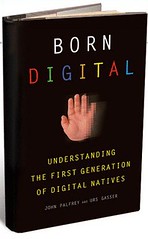
In our discussion, Prof. Palfrey explains who exactly counts as a “digital native” and tells us why he decided to write a book about them. He discusses why he believes that there has been some overreaction by older generations to fears about this Digital Generation and he argues that we need “to separate what we need to worry about from what’s not so scary” and “what we ought to resist from what we ought to embrace.” He then outlines how we should think about these issues and concerns going forward, and he stresses the importance of “balancing caution with encouragement” as we do so. Finally, he then applies that framework to three specific issues: privacy, child safety, and copyright.
It’s an interesting conversation and you can begin listening to it immediately by downloading the MP3 file here or by just clicking the play button below!
[display_podcast]
I’ve spent a lot of time in recent years trying to debunk various myths about online child safety or at least put those risks into perspective. Too often, press reports and public policy initiatives are being driven by myths, irrational fears, or unjustified “moral panics.” Luckily, the New York Times reports that there’s another study out this week that helps us see things in a more level-headed light. This new MacArthur Foundation report is entitled Living and Learning with New Media: Summary of Findings from the Digital Youth Project. This white paper is a summary of three years of research on kids’ informal learning with digital media. The survey incorporates the insights from 800 youth and young adults and over 5000 hours of online observations. The information will eventually be contained in a book from MIT Press (“Hanging Out, Messing Around, Geeking Out: Living and Learning with New Media.”)
From the summary of the study on the MacArthur website:
“It might surprise parents to learn that it is not a waste of time for their teens to hang out online,” said Mizuko Ito, University of California, Irvine researcher and the report’s lead author. “There are myths about kids spending time online – that it is dangerous or making them lazy. But we found that spending time online is essential for young people to pick up the social and technical skills they need to be competent citizens in the digital age.”
Importantly, regarding the concerns many parents and policymakers have about online predation, Ms. Ito told the
New York Times that, “Those concerns about predators and stranger danger have been overblown.” “There’s been some confusion about what kids are actually doing online. Mostly, they’re socializing with their friends, people they’ve met at school or camp or sports.”
In the report, according to the summary, the researchers “identified two distinctive categories of teen engagement with digital media: friendship-driven and interest-driven. While friendship-driven participation centered on “hanging out” with existing friends, interest-driven participation involved accessing online information and communities that may not be present in the local peer group.” The specific findings of the study are as follows:
Continue reading →


 The Technology Liberation Front is the tech policy blog dedicated to keeping politicians' hands off the 'net and everything else related to technology.
Running List of My Research on AI, ML & Robotics Policy
by Adam Thierer on July 29, 2022 · 0 comments
[last updated 4/3/2025 – Check my Medium page for latest posts]
This a running list of all the essays and reports I’ve already rolled out on the governance of artificial intelligence (AI), machine learning (ML), and robotics. Why have I decided to spend so much time on this issue? Because this will become the most important technological revolution of our lifetimes. Every segment of the economy will be touched in some fashion by AI, ML, robotics, and the power of computational science. It should be equally clear that public policy will be radically transformed along the way.
Eventually, all policy will involve AI policy and computational considerations. As AI “eats the world,” it eats the world of public policy along with it. The stakes here are profound for individuals, economies, and nations. As a result, AI policy will be the most important technology policy fight of the next decade, and perhaps next quarter century. Those who are passionate about the freedom to innovate need to prepare to meet the challenge as proposals to regulate AI proliferate.
There are many socio-technical concerns surrounding algorithmic systems that deserve serious consideration and appropriate governance steps to ensure that these systems are beneficial to society. However, there is an equally compelling public interest in ensuring that AI innovations are developed and made widely available to help improve human well-being across many dimensions. And that’s the case that I’ll be dedicating my life to making in coming years.
Here’s the list of what I’ve done so far. I will continue to update this as new material is released: Continue reading →