Posts tagged as:

James Pethokousis of AEI interviews me about the current miserable state of modern science fiction, which is just dripping with dystopian dread in every movie, show, and book plot. How does all the techno-apocalyptica affect societal and political attitudes about innovation broadly and emerging technologies in particular. Our discussion builds on my recent a recent Discourse article, “How Science Fiction Dystopianism Shapes the Debate over AI & Robotics.” [Pasted down below.] Swing on over to Jim’s “Faster, Please” newsletter and hear what Jim and I have to say. And, for a bonus question, Jim asked me is we doing a good job of inspiring kids to have a sense of wonder and to take risks. I have some serious concerns that we are falling short on that front.

Continue reading →

The endless apocalyptic rhetoric surrounding Net Neutrality and many other tech policy debates proves there’s no downside to gloom-and-doomism as a rhetorical strategy. Being a techno-Jeremiah nets one enormous media exposure and even when such a person has been shown to be laughably wrong, the press comes back for more. Not only is there is no penalty for hyper-pessimistic punditry, but the press actually furthers the cause of such “fear entrepreneurs” by repeatedly showering them with attention and letting them double-down on their doomsday-ism. Bad news sells, for both the pundit and the press.

But what is most remarkable is that the press continues to label these preachers of the techno-apocalypse as “experts” despite a track record of failed predictions. I suppose it’s because, despite all the failed predictions, they are viewed as thoughtful & well-intentioned. It is another reminder that John Stuart Mill’s 1828 observation still holds true today: “I have observed that not the man who hopes when others despair, but the man who despairs when others hope, is admired by a large class of persons as a sage.”

Additional Reading:

Originally published on the AIER blog on 9/8/19 as “The Worst Regulation Ever Proposed.”


Imagine a competition to design the most onerous and destructive economic regulation ever conceived. A mandate that would make all other mandates blush with embarrassment for not being burdensome or costly enough. What would that Worst Regulation Ever look like?

Unfortunately, Bill de Blasio has just floated a few proposals that could take first and second place prize in that hypothetical contest. In a new Wired essay, the New York City mayor and 2020 Democratic presidential candidate explains, “Why American Workers Need to Be Protected From Automation,” and aims to accomplish that through a new agency with vast enforcement powers, and a new tax.

Taken together, these ideas represent one of the most radical regulatory plans any America politician has yet concocted.

Politicians, academics, and many others have been panicking over automation at least since the days when the Luddites were smashing machines in protest over growing factory mechanization. With the growth of more sophisticated forms of robotics, artificial intelligence, and workplace automation today, there has been a resurgence of these fears and a renewed push for sweeping regulations to throw a wrench in the gears of progress. Mayor de Blasio is looking to outflank his fellow Democratic candidates for president with an anti-automation plan that may be the most extreme proposal of its kind. Continue reading →

Over at the American Institute for Economic Research blog, I recently posted two new essays discussing increasing threats to innovation and discussing how to counter them. The first is on “The Radicalization of Modern Tech Criticism,” and the second discusses, “How To Defend a Culture of Innovation During the Technopanic.”

“Technology critics have always been with us, and they have sometimes helped temper society’s occasional irrational exuberance about certain innovations,” I note in the opening of the first essay. The problem is that the “technology critics sometimes go much too far and overlook the importance of finding new and better ways of satisfying both basic and complex human needs and wants.” I continue on to highlight the growing “technopanic” rhetoric we sometimes hear today, including various claims that “it’s OK to be a Luddite” and push for a “degrowth movement” that would slow the wheels of progress. That would be a disaster for humanity because, as I note in concluding that first essay:

Through ongoing trial-and-error tool building, we discover new and better ways of satisfying human needs and wants to better our lives and the lives of those around us. Human flourishing is dependent upon our collective willingness to embrace and defend the creativity, risk-taking, and experimentation that produces the wisdom and growth that propel us forward. By contrast, today’s neo-Luddite tech critics suggest that we should just be content with the tools of the past and slow down the pace of technological innovation to supposedly save us from any number of dystopian futures they predict. If they succeed, it will leave us in a true dystopia that will foreclose the entrepreneurialism and innovation opportunities that are paramount to raising the standard of living for billions of people across the world.

In the second essay, I make an attempt to sketch out a more robust vision and set of principles to counter the tech critics. Continue reading →

This week I will be traveling to Montreal to participate in the 2018 G7 Multistakeholder Conference on Artificial Intelligence. This conference follows the G7’s recent Ministerial Meeting on “Preparing for the Jobs of the Future” and will also build upon the  G7 Innovation Ministers’ Statement on Artificial Intelligence . The goal of Thursday’s conference is to, “focus on how to enable environments that foster societal trust and the responsible adoption of AI, and build upon a common vision of human-centric AI.” About 150 participants selected by G7 partners are expected to participate, and I was invited to attend as a U.S. expert, which is a great honor. 

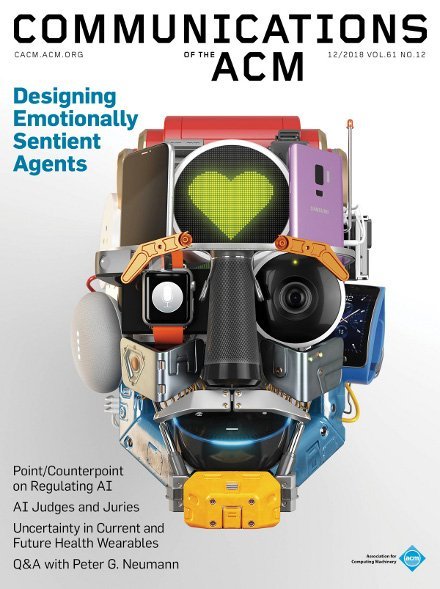
I look forward to hearing and learning from other experts and policymakers who are attending this week’s conference. I’ve been spending a lot of time thinking about the future of AI policy in recent books, working papers, essays, and debates. My most recent essay concerning a vision for the future of AI policy was co-authored with Andrea O’Sullivan and it appeared as part of a point/counterpoint debate in the latest edition of the Communications of the ACM. The ACM is the Association for Computing Machinery, the world’s largest computing society, which “brings together computing educators, researchers, and professionals to inspire dialogue, share resources, and address the field’s challenges.” The latest edition of the magazine features about a dozen different essays on “Designing Emotionally Sentient Agents” and the future of AI and machine-learning more generally.

In our portion of the debate in the new issue, Andrea and I argue that “Regulators Should Allow the Greatest Space for AI Innovation.” “While AI-enabled technologies can pose some risks that should be taken seriously,” we note, “it is important that public policy not freeze the development of life-enriching innovations in this space based on speculative fears of an uncertain future.” We contrast two different policy worldviews — the precautionary principle versus permissionless innovation — and argue that:

artificial intelligence technologies should largely be governed by a policy regime of permissionless innovation so that humanity can best extract all of the opportunities and benefits they promise. A precautionary approach could, alternatively, rob us of these life-saving benefits and leave us all much worse off.

That’s not to say that AI won’t pose some serious policy challenges for us going forward that deserve serious attention. Rather, we are warning against the dangers of allowing worst-case thinking to be the default position in these discussions. Continue reading →

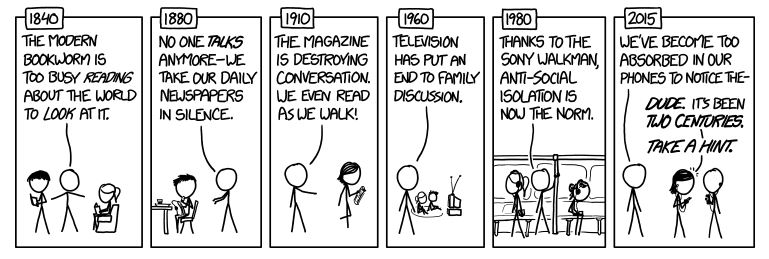
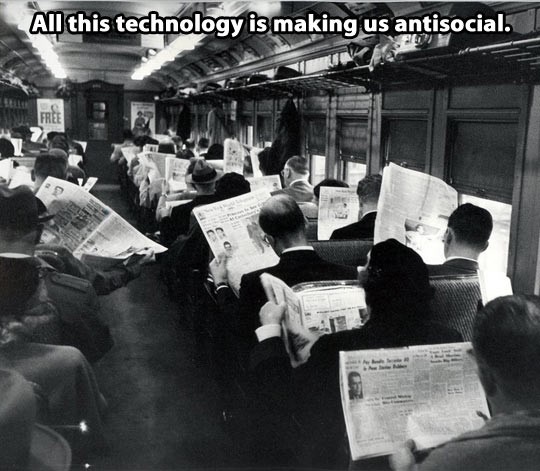
Last week, science writer Michael Shermer tweeted out this old xkcd comic strip that I had somehow missed before. Shermer noted that it represented, “another reply to pessimists bemoaning modern technologies as soul-crushing and isolating.” Similarly, there’s this meme that has been making the rounds on Twitter and which jokes about how newspapers made us as antisocial in the past much as newer technologies supposedly do today.

‏The sentiments expressed by the comic and that image make it clear how people often tend to romanticize past technologies or fail to remember that many people expressed the same fears about them as critics do today about newer ones. I’ve written dozens of articles about “moral panics” and “techno-panics,” most of which are cataloged here. The common theme of those essays is that, when it comes to fears about innovations, there really is nothing new under the sun. Continue reading →

Reason magazine recently published my review of Franklin Foer’s new book, World Without Mind: The Existential Threat of Big Tech. My review begins as follows:

If you want to sell a book about tech policy these days, there’s an easy formula to follow. First you need a villain. Google and Facebook should suffice, but if you can throw in Apple, Amazon, or Twitter, that’s even better. Paint their CEOs as either James Bond baddies bent on world domination or naive do-gooders obsessed with the quixotic promise of innovation. Finally, come up with a juicy Chicken Little title. Maybe something like World Without Mind: The Existential Threat of Big Tech. Wait—that one’s taken. It’s the title of Franklin Foer’s latest book, which follows this familiar techno-panic template almost perfectly.

The book doesn’t break a lot of new ground; it serves up the same old technopanicky tales of gloom-and-doom that many others have said will befall us unless  something is done to save us. But Foer’s unique contribution is to unify many diverse strands of modern tech criticism in one tome, and then amp up the volume of panic about it all. Hence, the “existential” threat in the book’s title. I bet you didn’t know the End Times were so near!

Read the rest of my review over at Reason. And, if you care to read some of my other essays on technopanics through the ages, here’s a compendium of them.

I’ve written here before about the problems associated with the “technopanic mentality,” especially when it comes to how technopanics sometimes come to shape public policy decisions and restict important new, life-enriching innovations. As I argued in a recent book, the problem with this sort Chicken Little thinking is that, “living in constant fear of worst-case scenarios—and premising public policy on them—means that best-case scenarios will never come about. When public policy is shaped by precautionary principle reasoning, it poses a serious threat to technological progress, economic entrepreneurialism, social adaptation, and long-run prosperity.”

Perhaps the worst thing about worst-case thinking is how short-sighted and hubristic it can be. The technopanic crowd often has an air of snooty-ness about them in that they ask us to largely ignore the generally positive long-run trends associated with technological innovation and instead focus on hypothetical fears about an uncertain future that apparently only they can foresee. This is the case whether they are predicting the destruction of jobs, economy, lifestyles, or culture. Techno-dystopia lies just around the corner, they say, but the rest of us ignorant sheep who just can’t see it coming!

In his wonderful 2013 book,  Smarter Than You Think: How Technology Is Changing Our Minds for the BetterClive Thompson correctly noted that “dystopian predictions are easy to generate” and “doomsaying is emotionally self-protective: if you complain that today’s technology is wrecking the culture, you can tell yourself you’re a gimlet-eyed critic who isn’t hoodwinked by high-tech trends and silly, popular activities like social networking. You seem like someone who has a richer, deeper appreciation for the past and who stands above the triviality of today’s life.”

Stated differently, the doomsayers are guilty of a type of social and technical arrogance. They are almost always wrong on history, wrong on culture, and wrong on facts. Again and again, humans have proven remarkably resilient in the face of technological change and have overcome short-term adversity. Yet, the technopanic pundits are almost never called out for their elitist attitudes later when their prognostications are proven wildly off-base. And even more concerning is the fact that their Chicken Little antics lead them and others to ignore the more serious risks that could exist out there and which are worthy of our attention.

Here’s a nice example of that last point that comes from a silent film made all the way back in 1911! Continue reading →

[originally posted on Medium ]

Today is the anniversary of the day the machines took over.
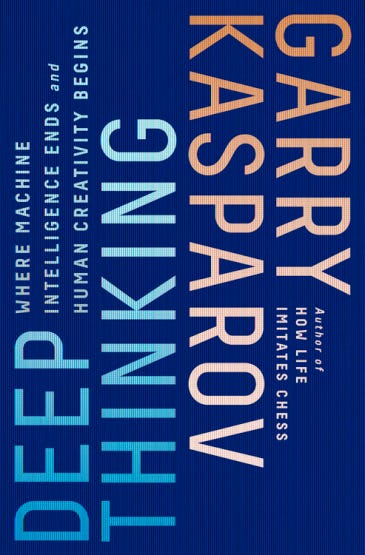
Exactly twenty years ago today, on May 11, 1997, the great chess grandmaster Garry Kasparov became the first chess world champion to lose a match to a supercomputer. His battle with IBM’s “Deep Blue” was a highly-publicized media spectacle, and when he lost Game 6 of his match against the machine, it shocked the world.

At the time, Kasparov was bitter about the loss and even expressed suspicions about how Deep Blue’s team of human programmers and chess consultants might have tipped the match in favor of machine over man. Although he still wonders about how things went down behind the scenes during the match, Kasparov is no longer as sore as he once was about losing to Deep Blue. Instead, Kasparov has built on his experience that fateful week in 1997 and learned how he and others can benefit from it.

The result of this evolution in his thinking is Deep Thinking: Where Machine Intelligence Ends and Human Creativity Begins, a book which serves as a paean to human resiliency and our collective ability as a species to adapt in the face of technological disruption, no matter how turbulent.

Kasparov’s book serves as the perfect antidote to the prevailing gloom-and-doom narrative in modern writing about artificial intelligence (AI) and smart machines. His message is one of hope and rational optimism about future in which we won’t be racing against the machines but rather running alongside them and benefiting in the process.

Overcoming the Technopanic Mentality

There is certainly no shortage of books and articles being written today about AI, robotics, and intelligent machines. The tone of most of these tracts is extraordinarily pessimistic. Each page is usually dripping with dystopian dread and decrying a future in which humanity is essentially doomed.

As I noted in a recent essay about “The Growing AI Technopanic,” after reading through most of these books and articles, one is left to believe that in the future: “Either nefarious-minded robots enslave us or kill us, or AI systems treacherously trick us, or at a minimum turn our brains to mush.” These pessimistic perspectives are clearly on display within the realm of fiction, where every sci-fi book, movie, or TV show depicts humanity as certain losers in the proverbial “race” against machines. But such lugubrious lamentations are equally prevalent within the pages of many non-fiction books, academic papers, editorials, and journalistic articles.

Given the predominantly panicky narrative surrounding the age of smart machines, Kasparov’s Deep Thinking serves as a welcome breath of fresh air. The aim of his book is finding ways of “doing a smarter job of humans and machines working together” to improve well-being. Continue reading →

By Jordan Reimschisel & Adam Thierer

[Originally published on Medium on May 2, 2017.]

Americans have schizophrenic opinions about artificial intelligence (AI) technologies. Ask the average American what they think of AI and they will often respond with a combination of fear, loathing, and dread. Yet, the very same AI applications they claim to be so anxious about are already benefiting their lives in profound ways.

Last week, we posted complementary essays about the growing “technopanic” over artificial intelligence and the potential for that panic to undermine many important life-enriching medical innovations or healthcare-related applications. We were inspired to write those essays after reading the results of a recent poll conducted by Morning Consult, which suggested that the public was very uncomfortable with AI technologies. “A large majority of both Republicans and Democrats believe there should be national and international regulations on artificial intelligence,” the poll found, Of the 2,200 American adults surveyed, the poll revealed that “73 percent of Democrats said there should be U.S. regulations on artificial intelligence, as did 74 percent of Republicans and 65 percent of independents.”

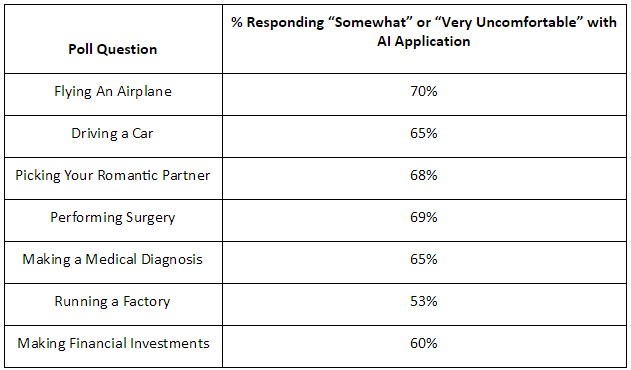
We noted that there were reasons to question the significance of those in light of the binary way in which the questions were asked. Nonetheless, there are clearly some serious concerns among the public about AI and robotics. You see that when you read deeper into the poll results for specific questions and find respondents saying that they are “somewhat” to “very uncomfortable” about a wide range of specific AI applications.

Yet, in each case, Americans are already deriving significant benefits from each of the AI applications they claim to be so uncomfortable with.

Continue reading →