Ladar Levison, founder of encrypted email service Lavabit, discusses recent government action that led him to shut down his firm. When it was suspected that NSA whistleblower Edward Snowden used Lavabit’s email service, the FBI issued a National Security Letter ordering Levison to hand over SSL keys, jeopardizing the privacy of Lavabit’s 410,000 users. Levison discusses his inspiration for founding Lavabit and why he chose to suspend the service; how Lavabit was different from email services like Gmail; developments in his case and how the Fourth Amendment has come into play; and his involvement with the recently-formed Dark Mail Technical Alliance.
Download
Related Links
No, I’m not here to tell you more about the “supersized” FTC. Berin has done yeoman’s work to highlight that issue, among other things with the PFF event you can review here. On TechDirt, Mike Masnick wrote this morning about how the feds are itching to regulate the Internet.
This is about the direct government invasions of privacy likely to occur if S. 3217 passes. On the Cato@Liberty blog I write about the detailed financial market research that new regulatory agencies would do—research aimed at you.
Example:
Section 1071(b) requires any deposit-taking financial institution to geo-code customer addresses and maintain records of deposits for at least three years. Think of the government having its own Google map of where you and your neighbors do your banking. The Bureau [of Consumer Financial Protection] may “use the data for any other purpose as permitted by law,” such as handing it off to other bureaus, like the Federal Bureau of Investigation.
“Washington, D.C. has determined that Washington, D.C. should manage the financial services industry. Your personal and private financial affairs will be managed there too.”
What would I say about my own writing but read the whole thing?
The website ProCon.org has a new debate online laying out the different perspectives about the question: “Do violent video games contribute to youth violence?” It includes citations for a wide variety of studies that come down on both sides of the question. Simply put, there’s a study for everyone out there. Do you want to find a study suggesting that there’s a strong correlation between violently-themed media and aggression? You can find plenty. Or do you want to hear that there’s no correlation between these things? Well, there’s plenty of studies suggesting that, too.
As someone who briefly flirted with a degree in psychology, I find this an interesting intellectual debate. But here’s the thing I can’t get away from —
lab studies by psychology professors and students are not the real-world. I am consistently shocked and disappointed at the lack of scrutiny these studies receive when they are little more than artificial constructions of reality.
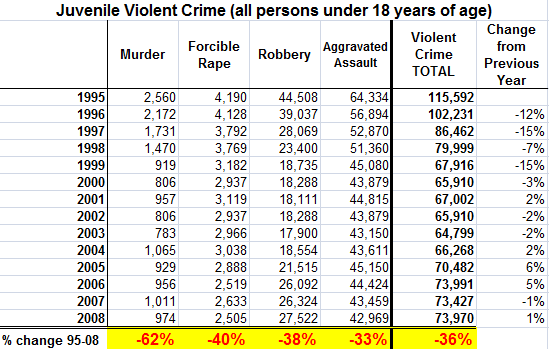
So, how can we determine whether watching depictions of violence will turn us all into killing machines, rapists, robbers, or just plain ol’ desensitized thugs? Well, how about looking at the real world! Whatever lab experiments might suggest, the evidence of a link between depictions of violence in media and the real-world equivalent just does not show up in the data. The FBI produces ongoing Crime in the United States reports that document violent crimes trends. Here’s what the data tells us about overall violent crime, forcible rape, and juvenile violent crime rates over the past two decades: They have all fallen. Perhaps most impressively, the juvenile crime rate has fallen an astonishing 36% since 1995 (and the juvenile murder rate has plummeted by 62%).
Continue reading →
Last year, my PFF colleague Adam Thierer asked whether State AGs + NCMEC = The Net’s New Regulators? Adam noted that NCMEC, the National Center for Missing and Exploited Children, a private non-profit organization, was playing a law enforcement role in regulating child pornography—but without any clear mechanisms for ensuring its accountability and effectiveness. Adam’s point wasn’t just that transparency is a good thing, but that when it comes to a cause as important as protecting children from exploitation, it’s vital to ensuring that we’re that we’re actually doing a good job at it!
Yesterday, Emmanuel Lazaridis commented on that post:
Given the increasing regulatory and investigative powers of the NCMEC, it is no longer clear whether or not the [Freedom of Information Act] applies to NCMEC records. We are about to find out. I am right now bringing a case against the NCMEC in federal court for access to records under the FOIA and, failing that, for discovery under 28 U.S.C. § 1782(a).
Mr. Lazaridis’s complaint in the D.C. District Court claims that Lazaridis (a Greek national) has been unfairly deemed a fugitive from U.S. justice for having taken his daughter to Greece over the objections of the girl’s American mother, Lazaridis’s ex-wife. NCMEC got involved by placing the girl on their MissingKids.com registry of abducted children. Lazaridis wants the court to recognize his custody, deem him not to be a fugitive, and to order NCMEC to turn over all their records on the girl.
This is, of course, just one side of the story (and such cases are usually so complicated as to be indecipherable to outsiders). But even if Lazaridis’s case were wholly without merit, his basic argument would be a sound one: Why shouldn’t NCMEC, in exercising any of its essentially governmental functions, be subject to the same accountability requirements through FOIA as the FBI would be?
When the issue is the Lazaridis family’s trans-Atlantic custody battle, it may seem easy to ignore this question. But when NCMEC is essentially making policy regarding filtering Internet content, blacklisting websites, turning over user logs to law enforcement, or “cleaning up” Craigslist, the question of NCMEC’s accountability under FOIA cannot be avoided as a critical decision about the future of Internet governance. Continue reading →
Over the past year, I have been monitoring a very interesting trend with important ramifications for the future of Internet policy. State Attorneys General (AGs) — often in league with the National Center for Missing and Exploited Children (NCMEC) — have been striking a variety of “voluntary” agreements with various Internet companies that deal with child safety concerns or other online issues. These agreements require the companies involved to take various steps to alter site architecture and functionality, commit to stop certain practices, or take steps to block certain users (ex: predators; escort services) or types of content (ex: child porn; online “discrimination”) altogether.
To begin, let me be very clear about one thing: Some of these activities or types of content warrant a law enforcement response. That is certainly the case with child pornography or predation, for example. However, as I will note down below, there is a legitimate question about whether state officials and a non-profit private organization should be crafting legal or regulatory policies to address such concerns for a global medium like the Internet. Regardless, these agreements are creating a new layer of Internet regulation (almost extra-legal in character) that is worthy of exploration.
First, let me itemize some of these recent “voluntary” agreements between Internet companies and the AGs and/or NCMEC:
Continue reading →
Dennis McCauley of Gamepolitics.com takes on that issue today in a column:
In the United States, the FBI tracks annual statistics on police officer slayings as well as assaults on police officers. I compared these figures to the various release dates for the three major GTA console game releases to date (GTA III, GTA Vice City, GTA San Andreas) and plotted the whole thing on the chart below. It’s a bit like the well-known video games vis-a-vis juvenile crime graph created by Duke Ferris of GameRevolution a few years back, although with a much narrower focus.The FBI statistics portray a much different picture than that painted by critics like Thompson and Grossman.
 In the chart, I’ve plotted FBI figures for police officers feloniously killed (blue line) and police officers assaulted (red line, listed in thousands). As can be seen, police officer murders peaked at 70 in 1997 (i.e., four years
before GTA III) and again in 2001. GTA III was released in late October that year, so if the game caused that year’s spike, it would have had only two months in which to do so. (also, the 2001 figures don’t count the 72 officers lost when the World Trade Centers collapsed).
The chart shows that since GTA III was released police killings have been trending downward to a low of 48 in 2006. Although the FBI has not yet posted 2007 numbers, the National Law Enforcement Officers Memorial Fund lists 68 police officers as having been shot to death in 2007. But it’s worth pointing out that while there may have been a spike in police slayings last year, there was no corresponding GTA release. There hasn’t been a new Grand Theft Auto console title issued since San Andreas in October, 2004.
In the chart, I’ve plotted FBI figures for police officers feloniously killed (blue line) and police officers assaulted (red line, listed in thousands). As can be seen, police officer murders peaked at 70 in 1997 (i.e., four years
before GTA III) and again in 2001. GTA III was released in late October that year, so if the game caused that year’s spike, it would have had only two months in which to do so. (also, the 2001 figures don’t count the 72 officers lost when the World Trade Centers collapsed).
The chart shows that since GTA III was released police killings have been trending downward to a low of 48 in 2006. Although the FBI has not yet posted 2007 numbers, the National Law Enforcement Officers Memorial Fund lists 68 police officers as having been shot to death in 2007. But it’s worth pointing out that while there may have been a spike in police slayings last year, there was no corresponding GTA release. There hasn’t been a new Grand Theft Auto console title issued since San Andreas in October, 2004.
I’ve commented more on these issues in my essay on “Why hasn’t violent media turned us into a nation of killers?”

 The Technology Liberation Front is the tech policy blog dedicated to keeping politicians' hands off the 'net and everything else related to technology.